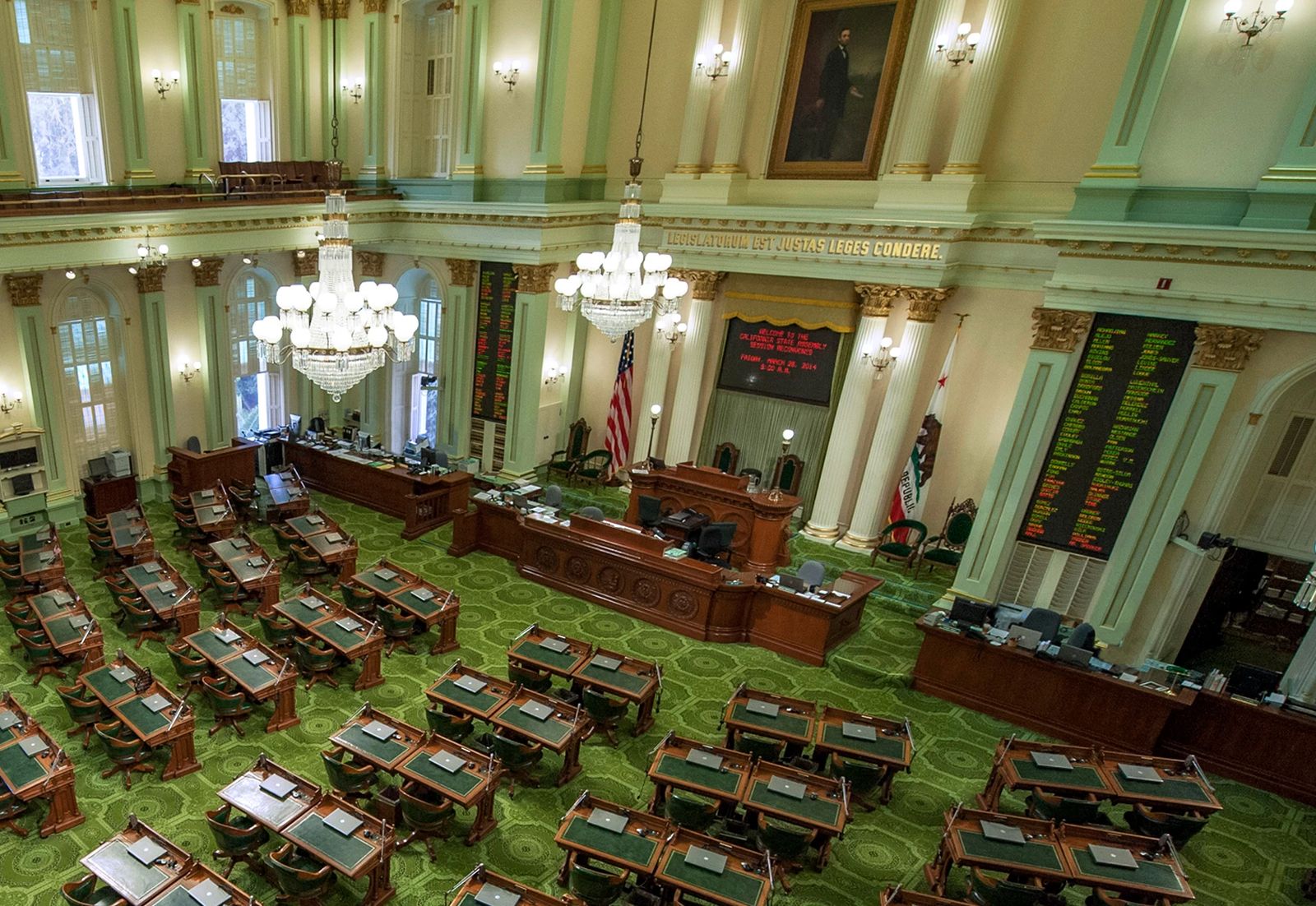
Assembly Passes Final Budget Bill Over Republican Objections
Democrats call the plan a shield against Washington; Republicans call it overspending.
6 min read
SACRAMENTO — The last budget bill of California’s two-year legislative session cleared the Assembly on Tuesday, 60 to 11, sending Governor Gavin Newsom a measure that releases roughly $2.7 billion in climate bond money, $450 million in transit grants, and $5 million for the state’s wolf program. Democrats presented the bill as a shield against federal policy. Republicans argued that a state collecting more revenue than ever is spending it on the wrong things, and they gave most of the debate to a single $20 million line item.
The measure is what the Capitol calls a budget bill junior. Rather than replace the Budget Act of 2026, which Newsom signed on June 29, Assembly Bill 113 amends it to finish appropriations lawmakers deliberately left open in June, most of them the climate spending the two houses could not settle before the summer recess. Assemblymember Jesse Gabriel, a Democrat from Encino who chairs the Assembly Budget Committee, presented it on the floor. Because the bill carries an urgency clause, it needed a two-thirds vote, or 54 of the Assembly’s 80 members, and it takes effect the moment the Governor signs it. The clause also allowed the vote to happen at all, since the state Constitution bars most bills from passing on or after September 1 in an even-numbered year.
Two accounts of the same budget
Gabriel opened by measuring the budget against Washington rather than against the Assembly’s Republicans. He told members the Legislature had balanced the state’s books for two years rather than one, shielded health care and safety-net programs from the reductions in H.R. 1, and placed a constitutional amendment strengthening the Rainy Day Fund on the November ballot. “The budget is the ultimate group project,” he said, thanking the committee for 65 hearings.
Assemblymember David Tangipa of Fresno, the budget committee’s vice chair, answered on the size of the budget rather than its contents. “The state of California has never had more money available to it,” he said, arguing that a record year undercuts the majority’s account of hard choices. He said the plan assumes the stock market will keep performing indefinitely, warned that a correction would arrive sooner rather than later, and said the Legislative Analyst’s Office has told lawmakers the budget has grown too convoluted to track. “Math doesn’t play partisan games,” he said.
Republicans built the rest of their opposition around $20 million for the California Highway Patrol. As KCRA first reported the night before the vote, the money would pay for officers to serve as personal security for current and former state elected officials and their families depending on the results of a threat assessment, and it would come out of the Motor Vehicle Account that drivers pay into through registration fees. Assemblymember Jeff Gonzalez, a Republican whose 36th Assembly District covers the southeastern corner of the state, described the appropriation as protection for the families of Newsom and former Vice President Kamala Harris, and said his own district cannot get officers for its highways. “We desperately need more CHP resources to patrol Highway 74, Highway 371, and our entire mountain communities,” he said.
The Governor’s office defended the spending as routine. “Protecting current and former officials facing credible threats as a result of their public service has long been a bipartisan notion, and these security decisions are based solely on threat assessments by law enforcement,” spokesman Brandon Richards told KCRA. Senate Republicans objected to the funding source rather than the purpose. Senator Roger Niello, the Republican vice chair of the Senate Budget Committee, said the Motor Vehicle Account is forecast to run out of money within two to three years, and noted that California already allows campaign funds to be spent on security. “It is in my opinion inappropriate, and it might even be unconstitutional,” Niello said.
The security money produced the sharpest exchange on the floor. Assemblymember Chris Rogers, a Democrat from Santa Rosa, said he did not want to spend it either, then told Republicans to consider their own social media posts and the threats members’ families have described. Assemblymember Joe Patterson, a Republican from Rocklin, called the suggestion that Republicans were endangering colleagues “complete and utter bull crap,” and pointed to the assassination attempts on President Donald Trump.
Assemblymember Sharon Quirk-Silva, a Democrat from Fullerton who chaired the budget subcommittee on state administration, urged opponents into the process rather than out of it. “Get involved in the budget, go to hearings,” she said. She said her constituents are counting pennies over rent, groceries, and whether a child can sign up for soccer, and that responsibility for affordability is shared. “We all have work to do together, my friends,” she said.
Closing, Gabriel returned to federal policy. He cited the health care reductions in H.R. 1, tariffs he called taxes on goods Americans need, and what he described as Washington politicizing disaster aid in the state that sends the most tax money to the federal government. He asked for an aye vote “because this budget invests in all of our communities.”
Five million dollars for wolf conflicts
Assembly Bill 113 raises the Department of Fish and Wildlife’s General Fund support from $180,595,000 to $185,595,000 and assigns the entire increase to wolves: “$2,500,000 shall be available for wolf-livestock compensation and $2,500,000 shall be available for other related activities including, but not limited to, rapid-response and wolf management needs.”
The money arrives after the state’s compensation program spent more than two years with almost nothing to pay out. The Legislature created the Wolf-Livestock Compensation Pilot Program with $3 million in the 2021 Budget Act, and the Department of Fish and Wildlife exhausted the fund in March 2024. A later $600,000 appropriation was small enough that the department narrowed the program to direct livestock losses, dropping applications for nonlethal deterrents and for the “pay for presence” payments meant to offset the cost of ranching inside wolf territory.
In January, the California Farm Bureau, the California Cattlemen’s Association, and the Rural County Representatives of California asked lawmakers for $30 million for the wolf program in the 2026-27 budget, including $25 million for compensation and deterrence and roughly $1 million for additional department staff. The budget Newsom signed in June contained none of it. Tuesday’s $5 million is the first substantial state money the program has received since the pilot fund ran dry.
State Senator Megan Dahle, a Republican from Bieber whose First Senate District covers 14 counties across the northeastern corner of the state, announced the appropriation Tuesday afternoon. Dahle said what ranchers most need is for wolves to be removed from state and federal endangered species protections and for permits allowing them to act when wolves attack livestock. “For now, that means we need a consistently funded compensation program and other support for ranchers,” she said. Her office said the second $2.5 million could pay for investigations of suspected attacks, collaring wolves, and tracking wolf activity in areas the animals have newly reached, none of which the bill itself specifies.
A companion measure is already on the Governor’s desk. Senate Bill 1135, by Senator Catherine Blakespear, a Democrat from Encinitas, renames the pilot the California Wolf-Livestock Coexistence and Compensation Program and writes it into the Fish and Game Code alongside a broader wildlife coexistence program. The Assembly passed it 58 to 17 on August 19, the Senate concurred 31 to 9 on August 26, and it was presented to the Governor on August 31. The bill appropriates nothing on its own; each program it creates operates only upon appropriation by the Legislature.
The bill’s larger natural resources spending comes almost entirely from Proposition 4, the climate bond voters approved in 2024. It sends $60 million to the Department of Conservation for the Regional Forest and Fire Capacity Program, which distributes block grants by region for wildfire planning and project development. CAL FIRE receives a series of local assistance appropriations from the same bond, among them $61.4 million for fire prevention and $19.6 million in grants covering fuel reduction, defensible space, and reforestation.