County Seeks to Save Two Commercial Street Trees
PG&E plans another evaluation after its arborist identified decay.
3 min read
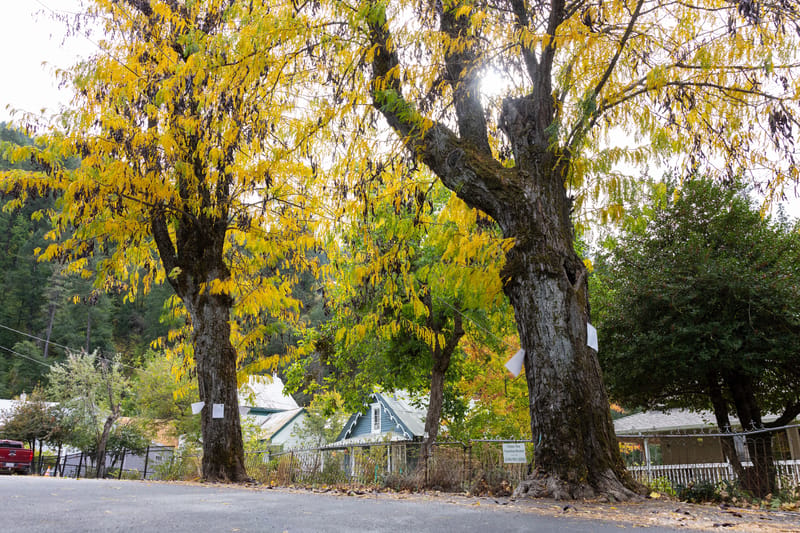
The two locust trees on Commercial Street in Downieville targeted by PG&E for removal.
DOWNIEVILLE – Sierra County officials are seeking to preserve two black locust trees beside 340 Commercial Street through pruning, while Pacific Gas and Electric Company continues to seek their removal, Public Works Director Josh Handel reported October 20.
PG&E spokesman Paul Moreno said October 21 that decay found by an arborist had left both trees weak and susceptible to breakage or falling, posing a hazard to power lines and the community. The company is bringing in a second arborist of its own for further evaluation and continues to work with the county, he said.
Handel told the Board of Supervisors October 20 that he had yet to hold a formal meeting with PG&E’s vegetation crew or local representatives. Supervisor Lee Adams reiterated the county’s preference for trimming the trees, whose canopy he has defended as part of downtown’s character.
Letters signed by Handel and attached to both trees tell PG&E and its contractors: “DO NOT MODIFY THIS TREE IN ANY WAY.” The September 15 notice says the county does not consent to removal or modification of the trees, identifies their location as county right-of-way, and requires coordination with county Public Works before any proposed changes.
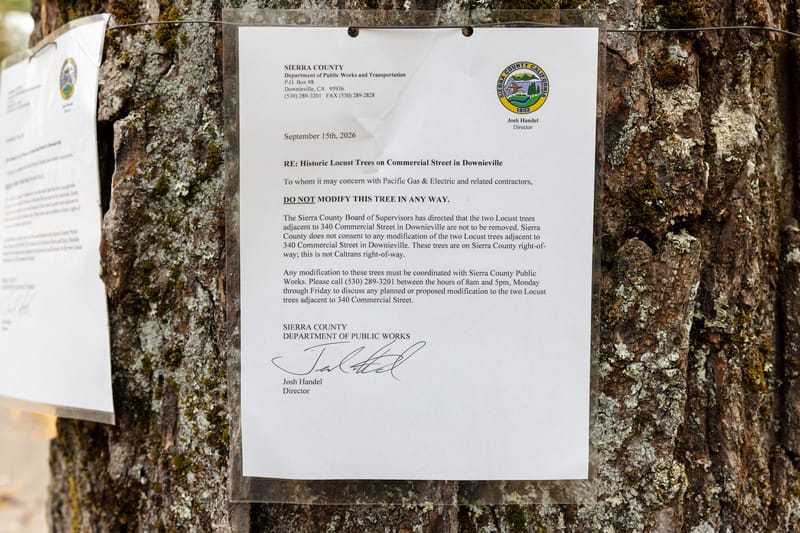
Letters signed by Public Works Director Josh Handel and attached to the trees instruct PG&E and its contractors not to remove or modify them.
The county’s position follows a September 15 discussion of the trees’ condition and competing recommendations for managing the risk. Supervisors directed Handel to meet with PG&E and other arborists to obtain estimates for safe pruning.
At that meeting, Handel described significant decay in both trees. He said PG&E’s arborist recommended removal, and a second assessment rated failure within five years as probable, even though the trees continued to produce healthy foliage.
A third assessment offered a way to retain them. Handel read a written evaluation by Tom O’Brien of First Impressions Tree Service describing rot cavities roughly eight to 10 feet above the ground, estimated at about 60% of each tree’s diameter. O’Brien recommended reducing the tops by 25% and balancing the canopies to lessen their weight.
O’Brien’s assessment, as read by Handel, said he generally would recommend removing trees in that condition close to structures. He wrote that the trees would not reach structures and considered keeping them with adequate pruning acceptable if the people around them felt safe. Handel said that assessment made him comfortable recommending trimming.
Adams supported the approach but wanted the pruning balanced around each tree. He warned that cutting only the branches near utility wires could leave the trees uneven. He also said nearby residents wanted to keep them despite the mess they create.
Adams raised another consideration October 20: planned undergrounding in Downieville. He questioned removing the trees when he expected the overhead wires to go away. PG&E’s public maps show planned upgrades along that section of roadway but do not specify whether the lines will be buried there.
In response to the Mountain Messenger’s questions about those upgrades, Moreno wrote: “Work to place power lines underground in this area is not currently taking place, with updates to be determined in the future.”
The county’s longer-term discussion also includes planting replacement trees. At the September meeting, Handel proposed adding new street trees, and Adams supported staggered replacement so downtown would retain a canopy as older trees eventually come out.