Grass Valley Advances Historical Commission Merger
Council backs a single review body as residents defend history programs.
5 min read
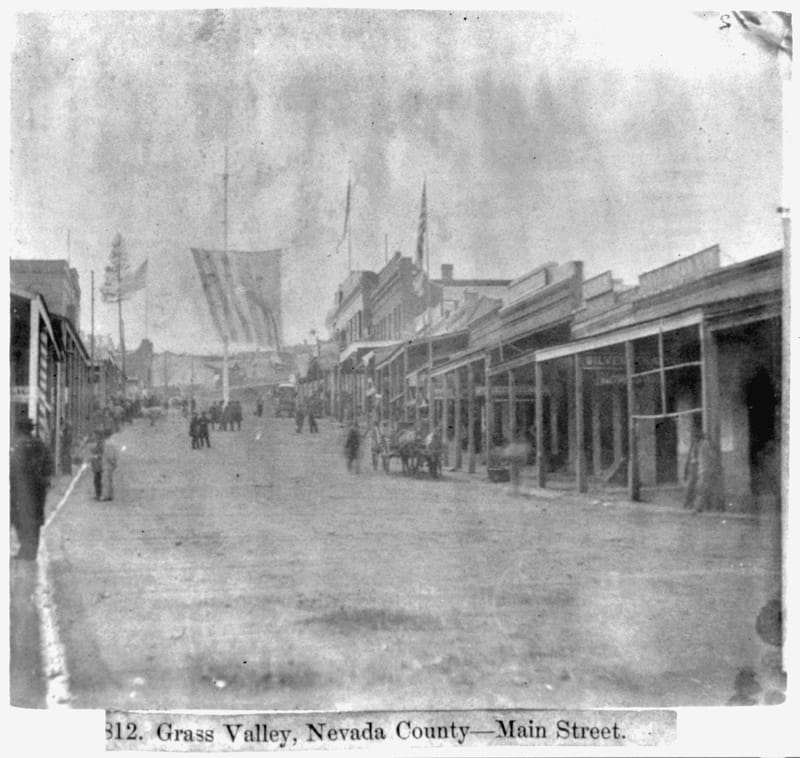
Main Street in Grass Valley in a photograph published in 1866.
GRASS VALLEY – The Grass Valley City Council moved toward dissolving the city’s separate Historical Commission on October 27, advancing a proposal to put historic-preservation duties under the Development Review Committee with one appointed historical representative. Supporters on the City Council said combining reviews would simplify projects for property owners, while some residents urged the city to preserve the volunteer work behind walking tours, historic plaques, and other programs.
The Historical Commission has five members and an alternate, appointed by the City Council to identify historic places and encourage their preservation. For property owners, its role includes reviewing proposed changes to historic buildings and offering guidance on preserving their historic character.
The commission also helps residents explore the city’s history. In a letter read at the meeting, longtime member Teresa Poston described its work on guided and self-guided walking tours, plaques on landmark properties, Heritage Home Awards, and a historic-homes booklet.
The council introduced Ordinance 842 for a first reading and approved a companion appointment policy, amended to make a council screening committee optional. The ordinance next requires a second reading and adoption. It would take effect 30 days after adoption. The appointment policy would be implemented once the ordinance is incorporated into the city code.
For an owner seeking approval to alter a historic building, the proposal would bring preservation and development review into the same committee. Deputy City Manager Taylor Whittingslow told the council that projects requiring both reviews currently move between bodies whose meetings can fall two to four weeks apart. Mayor Hilary Hodge emphasized that the people using that process may be individual building owners or families making changes to a storefront.
The commission’s duties would move to the five-member review committee, which under the proposed ordinance would include the community development director or city planner, the city engineer, a Planning Commission member, a contracted design professional, and the historical representative. The new representative would replace the fire department’s voting seat. Whittingslow said projects would continue going to the fire department for its safety review.
The historical representative would serve a two-year term and could vote on other development matters as an equal member. The committee could also act on historic matters when that representative was absent, provided it had a quorum.
The appointment policy gives the Nevada County Historical Society the first review of applications for the new historical seat, followed by city consideration and a final appointment by the council. Candidates should demonstrate knowledge of local history and preservation; professional experience may be considered but is not required. The policy strongly encourages involvement with the society.
At Councilmember Tom Ivy’s suggestion, the council made an additional screening committee optional, allowing a future council to decide whether it needs that step when filling the position.
The city’s staff report describes the consolidation as an administrative change retaining existing historic-preservation standards. The ordinance keeps distinctions among routine maintenance, minor alterations that maintain a building’s historic integrity, and major changes to its defining features. Staff would continue handling projects exempt from a development review permit; larger projects would go through the committee or Planning Commission according to the existing review process.
The city’s historic-property rules focus on the 1872 Historic Townsite, the old town boundary used for preservation review. Whittingslow said adding historical expertise to the committee would also bring that perspective to projects elsewhere in the city. She described the additional historical input outside the townsite as recommendations to help owners understand and preserve their properties’ history. Existing demolition-review rules also apply to buildings constructed before 1945 outside the townsite. The committee already approves some development projects and advises the Planning Commission on larger ones.
The public discussion focused heavily on work beyond permits.
Liz Coots read Poston’s letter, which supported a historical representative on the development committee while opposing the loss of the separate commission.
Terry McAteer, who also has served on the commission, warned that dismantling the commission could cost the city programs built by volunteers. He cited History Day for families, free walking tours, banners recognizing historical figures, and efforts to recognize and preserve sites such as Walsh Mill and the old firehouse. He asked the council to reject the proposal and let the next council revisit it.
Former Councilmember Bob Branstrom said he understood the cost of drawn-out project reviews, but questioned shifting the commission’s work to a development-focused committee and a countywide historical society. He recalled commissioners initiating projects including the Memorial Park clock repair and rose garden, sidewalk stars honoring people from the city’s history, and the reprinting of the historic-homes booklet.
“I think we need to retain a group that focuses on Grass Valley history,” Branstrom said.
Hodge responded that volunteers could organize a Grass Valley-focused team under the Nevada County Historical Society and continue those projects with city support. Whittingslow said she had discussed the transition with society representatives and wanted to sustain the educational work, including walking tours and school programs. She described the nonprofit as a source of research and a partner better positioned to pursue some fundraising and volunteer initiatives.
The ordinance itself assigns the development committee duties that extend beyond project review, including maintaining the historic-resource inventory, promoting educational and interpretive programs, and helping owners find preservation information and incentives.
Vice Mayor Haven Caravelli supported the consolidation as a way to simplify the building process and bring a historical perspective to projects throughout Grass Valley. Councilmember Joe Bonomolo said he wanted the tours, plaques, and other history work to continue and viewed the proposal as a reduction in government.
Ivy supported improving development review but pressed for a separate response to volunteers who felt they were losing their recognized role in the community. He asked the city to put a solution on a future agenda that would acknowledge their work and help it continue.
“My yes vote comes with next steps,” Ivy said.
Whittingslow offered to return in six months with the historical society for a progress report on completed work, shared goals, and each organization’s needs. Ivy welcomed the report and asked that the follow-through also address what former commissioners felt they were losing.