Grass Valley Sues Over Fire Truck Prices and Delays
City alleges overcharges on two KME trucks; case moves to Wisconsin.
3 min read
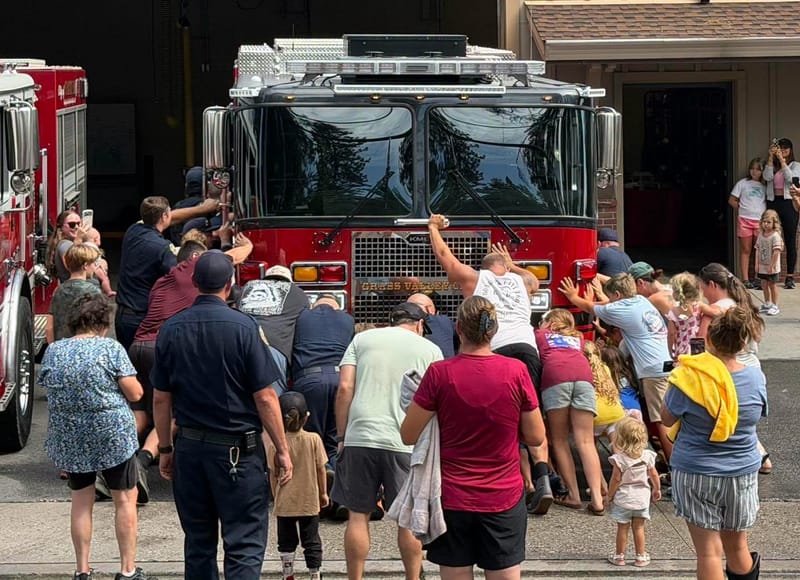
Firefighters and community members push Grass Valley’s new Engine 1 into Fire Station 1 during an August 7 ceremony.
Grass Valley Fire Department
GRASS VALLEY — Grass Valley has filed an antitrust lawsuit against fire truck maker REV Group, private equity firm American Industrial Partners, and other companies, alleging that industry consolidation led to hundreds of thousands of dollars in overcharges on two KME trucks. The city also alleges that one of those trucks, a pumper, took more than four years to arrive.
The city’s complaint, filed August 7 in federal court in California, says KME quoted a delivery window of 360 to 390 days for the pumper. The final invoice, including change orders and taxes, came to $704,597.24.
The second purchase was a KME aerial ladder truck. City Council minutes record approval of the $2.15 million purchase on November 28, 2023. The lawsuit says the city contracted for the truck that month and was quoted a minimum delivery time of three years. Grass Valley was still awaiting that truck when it filed the complaint.
A federal judicial panel transferred Grass Valley’s suit to Wisconsin on August 31 to join lawsuits by other cities and fire departments challenging competition and pricing in the fire truck industry. The cases share factual questions about the manufacturers’ market power, the effects of industry acquisitions, and whether buyers paid inflated prices.
The panel selected the Eastern District of Wisconsin in April, citing the headquarters of REV Group, Oshkosh, and Pierce Manufacturing there and the nine related cases already pending in that district. United States District Judge William C. Griesbach will oversee evidence gathering and motions before trial, allowing the cases to share that work and receive consistent rulings on overlapping issues.
Manufacturers and investment entities are contesting similar acquisition claims in earlier suits brought by cities including Albuquerque and Oxnard. In an August 17 joint brief seeking dismissal, their lawyers described the acquisitions as “ordinary, publicly announced transactions” and argued that the plaintiffs had failed to adequately allege harm to competition. The brief points to pandemic-driven demand, supply shortages, and inflation as causes of higher prices and longer delivery times.
The defendants also argue that many challenges to acquisitions completed years earlier were filed beyond the applicable legal deadlines.
Grass Valley’s 103-page complaint focuses on a series of acquisitions involving REV Group, American Industrial Partners, and their affiliated entities. It traces the purchase of E-ONE in 2008, KME in 2016, Ferrara in 2017, and Spartan’s emergency-response business in 2020. The city alleges that bringing those businesses under common ownership reduced competition among truck builders and suppliers of the chassis on which the vehicles are built.
The complaint also connects the consolidation to factory closures. It says REV Group announced the closure of KME plants in Pennsylvania and Virginia in 2021 and combined KME and Ferrara production in Louisiana. According to the city’s allegations, putting the two product lines and their existing backlogs into one plant slowed production and worsened delivery times.
A separate part of the suit challenges transactions involving Oshkosh, its Pierce Manufacturing subsidiary, and Boise Mobile Equipment. The city alleges that Pierce’s acquisition of a 25% interest in BME Fire Trucks in 2021, and Oshkosh’s purchase of Canadian manufacturer Maxi-Métal in 2022, reduced competition.
In their joint brief in the earlier cases, the defendants argue that the plaintiffs failed to adequately allege substantial harm to competition from the minority BME investment. They describe the arrangement as a collaboration to improve the companies’ wildland fire trucks.
Grass Valley asks the court to award damages at three times the amount of its proven losses, along with attorney fees and litigation costs. It also seeks orders requiring businesses to be sold or separated to restore competition and barring further anticompetitive conduct. The complaint requests a jury trial.
Under an order signed September 8, the defendants’ deadline to respond to Grass Valley and other newer cases is postponed until 60 days after Griesbach resolves the pending dismissal motions.
The court’s briefing schedule calls for the plaintiffs in those motions to respond by October 16 and the defendants to file replies by November 25.