Katie's Sightings
3 min read
A Brief Blog about Murmurations!
 Red-winged Blackbird — Aegelaius phoeniceus Once again I've been too busy with that Lakes Basin book to post my blog this week. So here's a brief blog about a murmuration of birds that we came across on the way to Gray Lodge last week. Murmurations are very large groups of birds that fly in tight synchronization with each other, often in response to a predator. As the birds fly together, they contract, expand, twist, twirl, bend, balloon, and dive together, creating incredible abstract shapes in the sky! They are absolutely astonishing and wild to watch!
Traditionally, the word "murmuration" only referred to the acrobatics of huge groups of European Starlings, but now it is known that true blackbirds can fly in "murmuration" style as well. We first noticed the murmuration as I was driving along a two-lane road through agricultural fields on the way to Gray Lodge.
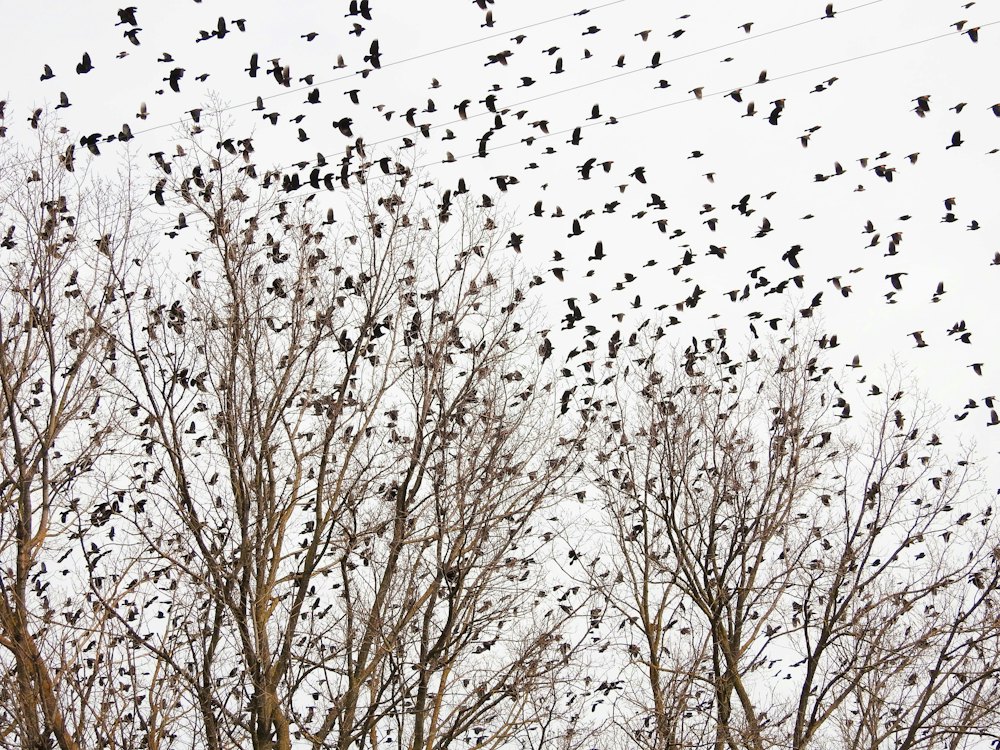
We couldn't tell what kind of birds they were, as they were silhouetted and moving fast in the air! I wondered how they flew together in synchronization, without crashing into each other. The following information about how birds navigate as a group is from https://www.audubon.org/magazine/march-april-2009/how-flock-birds-can-fly-and-move-together. It's fascinating!
"Each bird in a flock observes and responds to the movement of no more than seven neighboring birds. Mainly birds to its sides and to its front! This response by one bird creates a chain reaction that ripples quickly through the rest of the flock. Members of a flock do not stay an exact distance away from each other, like dots on a grid. This space fluctuates, with the priority being to maintain the space ahead of each individual, not so much the space to the sides or above and below. This "ripple effect" explains some of the flight behavior in flocks, but doesn't explain everything. Researchers believe that other factors affect the behavior of flocks, such as sound or even rushing air from a close neighbor. There is still a lot to learn and discover!"
Luckily they all landed in some bare-limbed trees along the road! The sound of their raucous calling was overwhelming and astounding! I quickly parked and got out of the car to watch them.
I made a movie of them landing and resettling in the tree tops, before they took off "en masse" again! Such a wonderful sight!
 Red-winged Blackbirds — Aegelaius phoeniceusAs I zoomed in with my camera, I was able to identify them as mostly male and some female, Red-winged Blackbirds! Red-winged Blackbirds live across the US year-round. Additionally, some travel north to Canada to breed.
I wondered why they were all flying together in such a huge group. From what I've read about this behavior so far, it sounds like they mainly fly together to avoid predation and to share information about food sources. Interestingly, their genus name, Agelaius, derives from the Greek word meaning “belonging to a flock.”
Your questions and comments are appreciated. Please feel free to email me at northyubanaturalist@gmail.com. Thanks!