Nevada County Adds Off-Highway Patrols for Labor Day
Deputies will watch for trespassing, unsafe riding, and illegal campfires.
5 min read
Updated
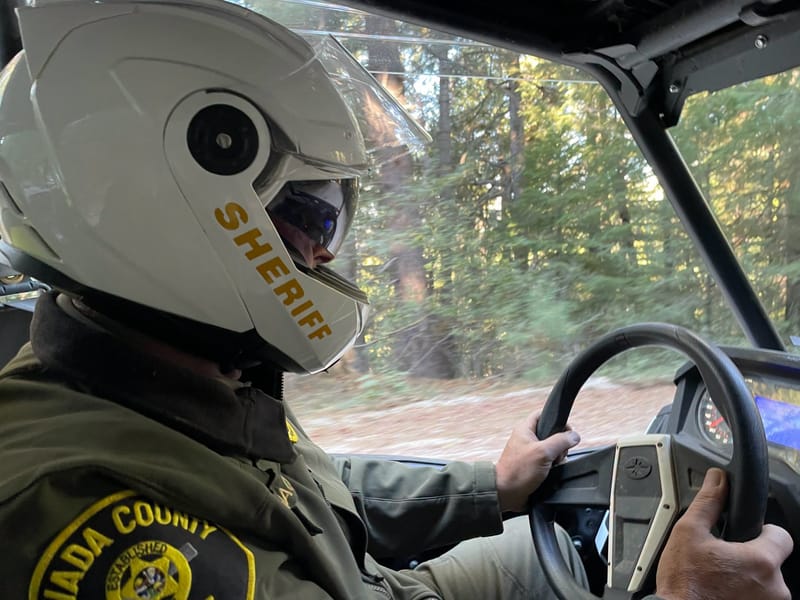
A Nevada County Sheriff’s Deputy on off-highway patrol.
Nevada County Sheriff’s Office
NEVADA CITY — Off-highway vehicle riders heading into the Nevada County backcountry over Labor Day weekend will find more deputies and fewer places they can legally ride. The Nevada County Sheriff’s Office said it will increase off-highway patrol and enforcement from Friday through Monday, September 7, concentrating on recreation areas expected to draw heavy holiday traffic and on areas that regularly generate calls for service.
Deputies cover off-road country in utility terrain vehicles, dirt bikes, electric bikes, and a four-wheel-drive Jeep rather than in patrol cars. The complaints that draw them out fall into a consistent set of categories, the Sheriff’s Office said: trespassing, unsafe operation, environmental damage, vandalism, illegal campfires, and litter left behind. On the large open tracts of private land inside the county’s riding areas, the office said it is solely responsible for enforcement.
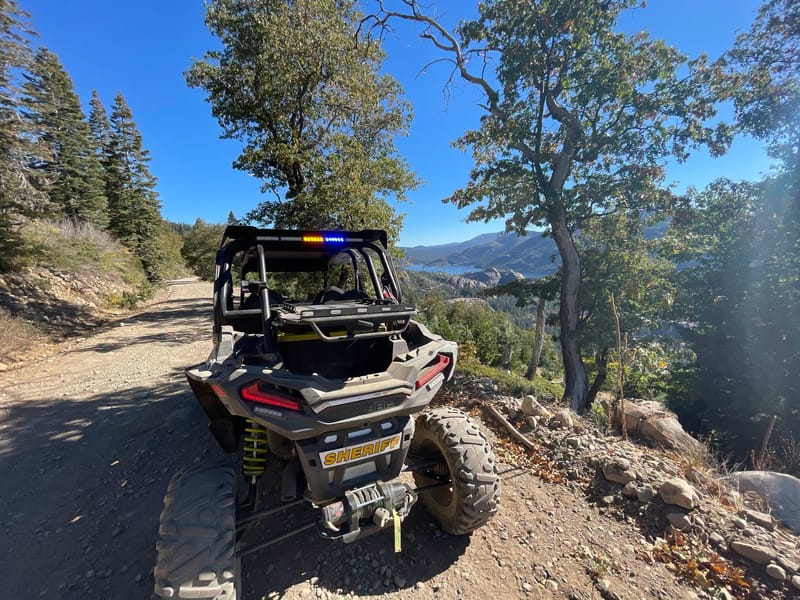
One of the Nevada County Sheriff’s Office’s off-highway vehicles.
Nevada County Sheriff’s Office
The tightest restriction over the weekend comes from the Tahoe National Forest, which has been under Stage 2 fire restrictions since August 14. The forest order bars operating an internal combustion engine off paved, gravel, or dirt National Forest System roads and trails, with two exceptions: the Prosser Pits off-highway vehicle area near Truckee, and boats on the water. Riding cross-country on forest land while the order stands is punishable by a fine of up to $5,000 for an individual, up to six months in jail, or both. The restrictions officially run through October 31, though may be ended earlier should conditions allow.
Stage 2 also closes off campfires and stove fires except in a charcoal grill or fire ring at a recreation site staffed by a campground host. Smoking is allowed only inside a vehicle or building, at one of those host-maintained sites, or in a spot at least three feet across that has been cleared of anything flammable. Riders carrying a free California campfire permit may still use a portable stove, lantern, or fire ring that burns gas, kerosene, jellied petroleum, or pressurized liquid fuel and has a shut-off valve, kept three feet from flammable material.
Legal riding in the western county centers on the authorized single-track at Chalk Bluff and Lowell Hill, part of the Burlington Motorcycle Trail System — roughly 50 miles of narrow, technical trail in the forest above Nevada City. Burlington opens and closes on soil moisture rather than on fixed dates, and the Forest Service keeps a recorded status line at 530-478-6253. East of the crest, Prosser Pits is a day-use area with no camping and no campfires, and travel outside the pit itself is limited to designated roads and trails. Everywhere else on the forest, the Motor Vehicle Use Maps govern which roads and trails are open to which vehicles.
California requires any off-highway vehicle ridden on public land to be street-licensed or registered with the Department of Motor Vehicles and to display a current sticker, and a green sticker costs $54 and lasts two years. Since January 1, 2025, red and green stickers have been equally valid year-round in areas designated for off-highway recreation, ending the seasonal limits that once applied to red-sticker machines. Visitors from states that do not run an off-highway vehicle program need a $30 nonresident permit.
California State Parks also requires a spark arrester approved by the United States Forest Service, kept in working order, on any vehicle ridden over forest, brush, or grass-covered land. Sound is capped at 96 decibels for vehicles built on or after January 1, 1986, and 101 decibels for older ones. Helmets are required for operators and passengers, all-terrain vehicle operators under 18 need a safety certificate or supervision by an adult who holds one, and doubling up on a machine not built to carry a passenger is illegal.
Pacific Gas and Electric Company, Sierra Pacific Industries, the Nevada Irrigation District, and individual residents own large open parcels that riders regularly cross. The irrigation district prohibits motorized vehicles on its canal banks and has told the public that it does not own most of the land its canals traverse, which leaves it without the authority to let anyone onto the property underneath. Under California law, willfully entering posted, unenclosed land without the owner’s written permission is an infraction carrying a $75 fine, rising to $250 for a second offense on the same or adjoining land of the same owner and to a misdemeanor for a third. Driving a vehicle onto property known not to be open to the public, without the owner’s consent, is a misdemeanor on its own.
Past patrols suggest most riders who meet a deputy do not leave with a ticket. In its 2016 annual report, the most recent year for which it published off-highway figures, the Sheriff’s Office said deputies spent 424 hours and covered 3,022 miles on off-highway patrol, made 362 contacts with riders, issued 23 warnings and a single citation, and made one arrest unrelated to off-highway laws. A 2013 staff report prepared for the county Planning Department by Philip A. Salter, drawing on the Sheriff’s grant applications, recorded a similar ratio in earlier years: 1,436 contacts, 100 warnings, and five citations in 2011, then 768 contacts, 38 warnings, and four citations in 2012. Arrests in both years were in the single digits, among them two for driving under the influence.
The holiday timing is built into how the patrols are paid for. Sheriff Shannan Moon applies each year for an off-highway vehicle enforcement grant from the Off-Highway Motor Vehicle Recreation Division of California State Parks, and a 2023 memo to the Board of Supervisors described the money as funding “OHV patrols in outlying areas during peak holiday seasons.” Supervisors approved a $28,105 renewal on December 10, 2024, covering the year that ended in November 2025, and an earlier agreement for the 2022–2023 fiscal year paired $34,409 in state reimbursement with $11,526 from the county general fund. Moon has since filed public notice of another application.
The Sheriff’s Office is responsible for more than 900 square miles of county terrain. The federal share of it falls under Tahoe National Forest and the Bureau of Land Management’s Mother Lode Field Office, which manages more than 230,000 acres scattered across ten counties. The same off-highway fleet that runs enforcement over the holiday is what the office sends into the backcountry on searches and rescues.