Supervisors Clear Way for Purdon Road Cell Tower
Nearly every speaker opposed the tower, but the appeal failed 4–1.
5 min read
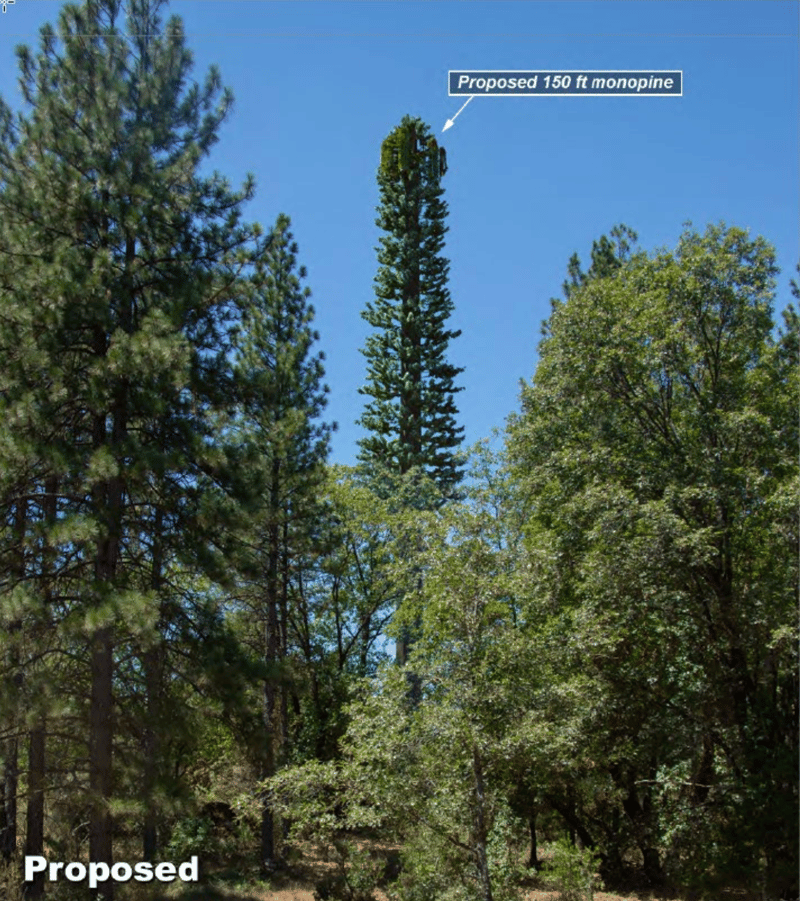
A simulation of the proposed “monopine” cell tower.
Vertical Bridge
SWEETLAND — The Nevada County Board of Supervisors voted 4–1 on Tuesday to deny an appeal against a 150-foot cellular tower disguised as a pine tree at 22044 Purdon Road, upholding the zoning administrator’s approval of the project. The vote clears the way for construction despite opposition from nearly every member of the public who spoke during the afternoon hearing at the Eric Rood Administrative Center in Nevada City.
Vertical Bridge, the tower company behind the application, plans to build the unmanned “monopine” on an 11.32-acre forest-zoned parcel about a third of a mile north of South Yuba River State Park’s Purdon crossing area. Verizon Wireless would be the first carrier on the tower, which is built to hold up to three more. A 2,500-square-foot fenced enclosure at the base would house equipment cabinets and a 30-kilowatt backup generator, and the tower would stand 192 feet from Purdon Road behind a screen of seven trees ranging from 98 to 128 feet tall. The nearest home on a neighboring property is about 600 feet away, according to Aleena Church, the assistant planner who presented the project.
The county zoning administrator approved the conditional use permit on May 13, and Nels Atkinson and other neighbors appealed the decision on May 21. Because the county deemed the application complete on February 20, the project was reviewed under the county’s previous wireless ordinance rather than the updated ordinance the board adopted on April 16, which sets larger setbacks from homes.
Atkinson told supervisors the ordinance in force requires a new tower to blend into its surroundings well enough to go unnoticed, and he showed simulations of the monopine rising above tree lines and ridgelines as seen from nearby properties. “This tower is incompatible with a residential rural forested area due to its visibility and its impact,” he said. He also challenged the backup generator, which county staff said would register 50 decibels at the property line, above the county’s 40-decibel nighttime limit. Because outages in the area are routine and long, he argued, the generator should not be treated as emergency equipment exempt from the noise standard. Proving that no less intrusive site exists, he said, is the applicant’s job, not the neighbors’.
Residents of Miller Road, Blind Shady Road, and other streets near the site echoed him during public comment, telling the board they moved to the San Juan Ridge area for quiet and would rather keep imperfect phone service than gain a tower. Several said their Verizon phones already work along Purdon Road. Others described fears of radio frequency emissions and of a tower fire beside an evacuation route. Johanna Finney of Nevada County for Safe Tech pointed to the board’s 2024 vote granting a similar appeal on Dog Bar Road, a decision Verizon challenged in federal court. “A lawsuit isn’t proof you got it wrong,” she said. “It’s what happens when a company with more lawyers than neighbors doesn’t like the answer.”
Verizon’s team countered that the coverage gap west of Nevada City is real and well documented. A company radio frequency engineer presented measurements collected by driving area roads with a phone and said “93 percent of the area does not have satisfactory coverage.” The nearest existing tower, on Oregon Peak, is running at full capacity trying to reach the area, he said. Pete Shubin of Sequoia Deployment Services, representing Vertical Bridge and Verizon, said the companies evaluated 16 alternative sites over four years and that the tower would serve 28 square miles, including evacuation routes along Purdon Road, Murphy Road, and Tyler Foote Crossing Road, plus the river canyon in South Yuba River State Park.
On health and fire, county staff and the applicant pointed to federal limits and permit conditions. Federal law bars the county from denying a tower over radio frequency emissions that comply with Federal Communications Commission standards, and a report prepared for the applicant modeled ground-level exposure at 0.3 percent of the FCC maximum. Paul Albritton, outside counsel for Verizon, said of the towers, “They’re monitored 24-7, they can be shut off 24-7, and they’re extremely safe in terms of any fire risk.” The design contains no lithium batteries, and the county fire marshal is requiring defensible space around the equipment and driveway.
The sharpest questioning concerned Verizon’s own maps. Supervisors noted the company’s public coverage maps show the same area blanketed with service, while the maps presented at the hearing show a hole. The engineer said the online maps are produced to FCC criteria showing the barest presence of a network, while drive tests and engineering models guide where towers are built. Supervisor Hardy Bullock called the contrast misleading. “I think the fidelity to information is poor,” he said. “It’s lacking. And unfortunately we don’t have a lot of control in this, but I do believe the need’s there.”
Board Chair Lisa Swarthout agreed, saying of the dual mapping, “Of all the things that I’ve heard here today, that was the most jarring to me.” Supervisor Susan Hoek, whose district includes the site, said the 2020 Jones Fire told a different story about local coverage than the residents in the room. “During the Jones Fire, that was not the case. I had everyone calling me: how come we don’t have service?” she said. Supervisor Heidi Hall said the same pressure runs through her district: “People want better cell access. Hospitals need it, kids need it for school, elders need it for telehealth, businesses need it.”
Supervisor Robb Tucker moved to deny the appeal with one change to the resolution. A finding stating the appellant had failed to show a feasible alternative site was rewritten to say the record did not show one, answering objections from Atkinson and Finney that the original wording shifted the applicant’s burden onto neighbors. Hall, Tucker, Hoek, and Bullock voted to deny the appeal. Swarthout voted no, saying she would not object to a tower beside her own Grass Valley home but deferred to rural residents willing to accept spotty service.
The permit now stands with its conditions attached. Planning Director Brian Foss said the county treats extended power outages as emergencies under its noise rules, and the permit requires the generator to sit inside a sound enclosure, run only during outages, and be tested only during daytime hours. A separate condition requires Vertical Bridge to maintain the tower and remove all equipment if the facility is ever decommissioned. Swarthout closed the hearing by reading a statement that any petition for judicial review of the decision must be filed within 90 days of it becoming final.