Night Sky
1 min read
Venus & Mars, July 2023
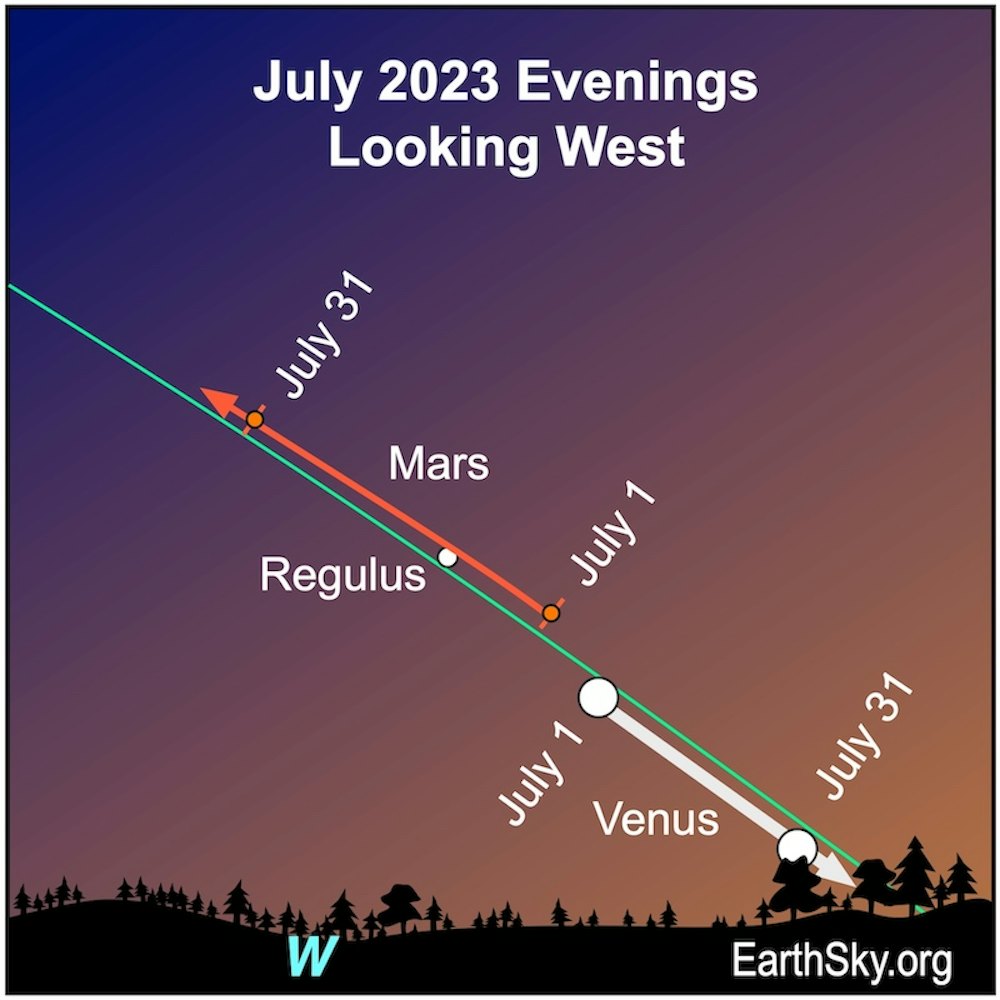
Throughout July, Venus, the most luminescent planet seen from Earth, will dominate the western sky shortly after sunset. Today, July 6th, the much fainter, red planet, Mars, will be slightly above and left of Venus and slightly to the right of Regulus, the brightest star in the constellation Leo the Lion. As the month progresses, the distance between Mars and Venus will increase. This is not because the planets are orbiting the sun in different directions. All planets travel around the sun in a counterclockwise direction, appearing to move from east to west. Moreover, Mars is not pulling away from Venus because it is moving faster than Venus. In fact, the opposite is true, the orbital speed of planets falls steadily as a planet’s distance from the sun increases. No, Venus or Mercury only appears to be moving from west to east (clockwise or retrograde) when entering or leaving a conjunction with the sun.
Prior to the early 16th century, when Copernicus proposed a heliocentric (sun-centered) solar system, astronomers followed Ptolemy’s 1st century explanation for the periodic east to west motion of planets: epicycles, little clockwise circles appended to the basically counterclockwise orbits of planets around the earth.
For an excellent graphic of apparent retrograde motion, see https://en.wikipedia.org/wiki/Apparent_retrograde_motion