Night Sky
1 min read
Mercury Hugs Western Horizon
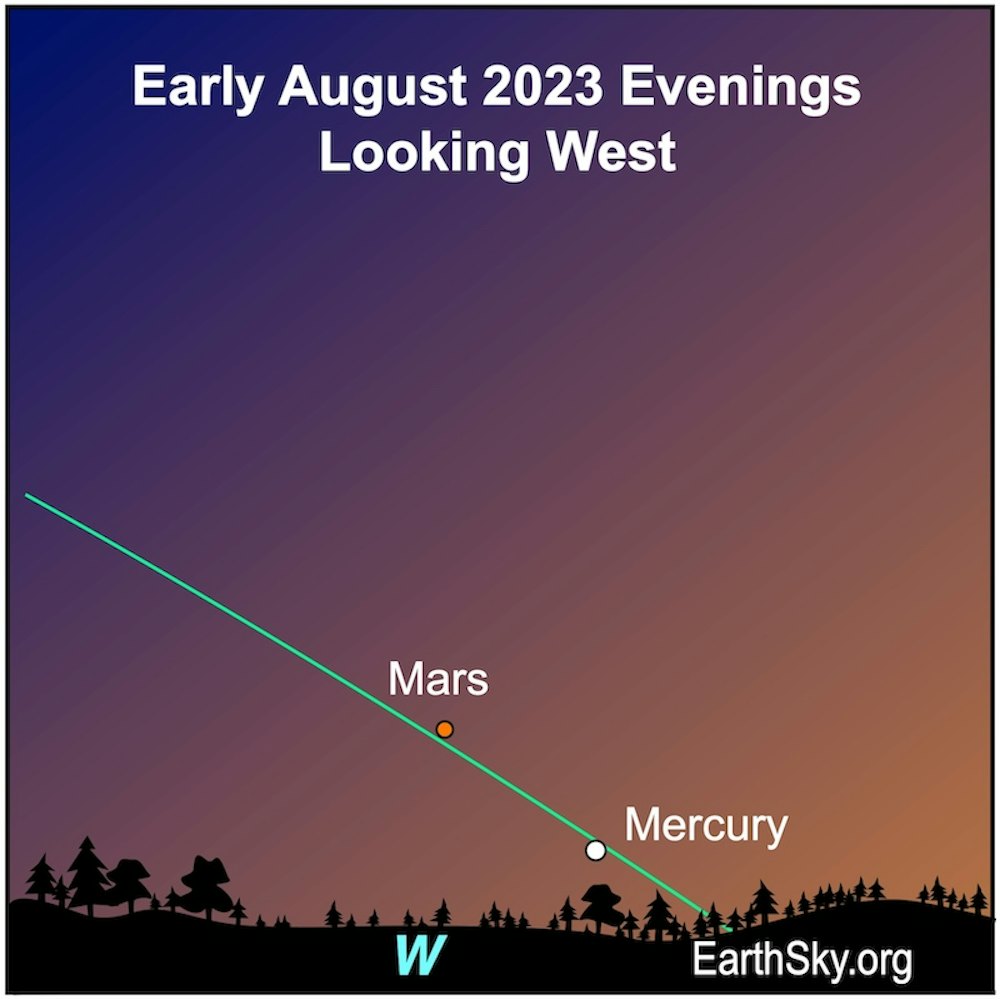
During the next week, a bright Mercury will be nestling close to the western horizon shortly after sunset. Tonight the solar system's smallest plant is as far away (roughly 28 degrees) from the sun as its sharply elliptical orbit allows. At this level of elongation, Mercury's luminosity will exceed the magnitude of most stars.
Due to Mercury's proximity to the sun (it is only observable during astronomical twilight), until very recently, it was very difficult for astronomers to observe any detail about the planet's surface. However, when NASA's Mariner 10 spacecraft made three close flybys of the planet in 1974, imaging 45% of Mercury's surface, photographic evidence of heavy cratering - similar to what we see on our Moon - was revealed. Then, in 2011 NASA's Messenger spacecraft imaged the entire plant at high resolution during six flybys and documented unique landforms ("hollows") formed within the widespread impact craters by high heat and harsh solar winds vaporizing volatile minerals, such as sulfur.