Night Sky
By Carl J. Butz
2 min read
Orionid Meteor Shower Peaks on Saturday and Sunday Morning
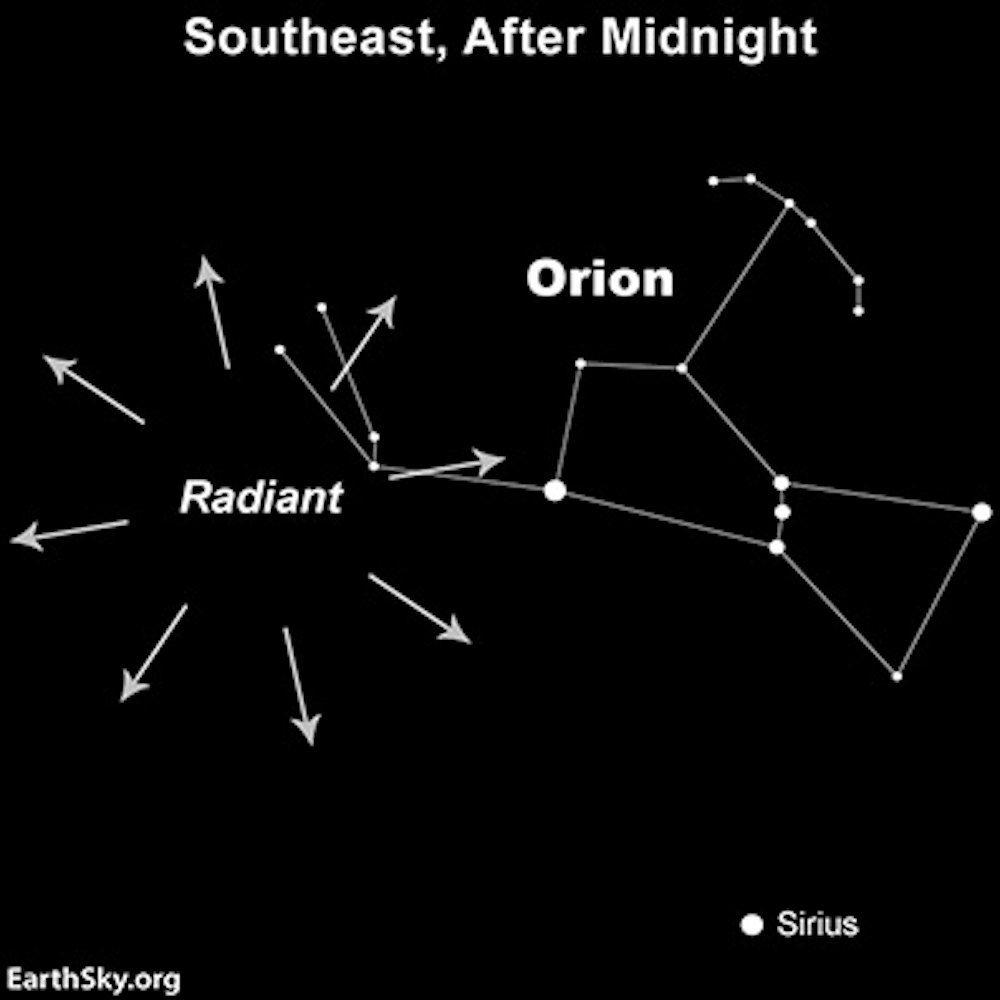 Source: EarthSky.orgThe 2023 return of rocky meteors radiating out from the general area of the constellation Orion and streaking brightly through Earth’s atmosphere began on October 2 and will last until November 7. However, the peak period of the meteor shower will occur on October 21 and 22, after midnight and in the wee hours before dawn. NASA is estimating around 23 meteors will appear each hour during these periods.
The meteors we can see now are pieces of dust lost by Halley’s comet during its inbound passage through the inner solar system every 75-76 years. When the grit enters the mesosphere, roughly 31-50 miles above us, at a speed of 41 miles per second, friction with the air causes the material to vaporize and emit the brilliant light we observe from Earth.
Since the Orionids can be seen in all parts of the sky, the wider the view of space you have, the better. Yes, those of us on the western slope of the Sierra are envious of those living in the Sierra Valley (or any other flat terrain) when meteor showers are taking place.
Meanwhile, when Haley’s comet leaves the inner solar system, it continues shedding debris. Thus, in early May, the Eta Aquariids meteor shower will take place as the Earth passes through the outbound debris field.