Night Sky
By Carl J. Butz
1 min read
Perseus + Geminid Meteor Shower
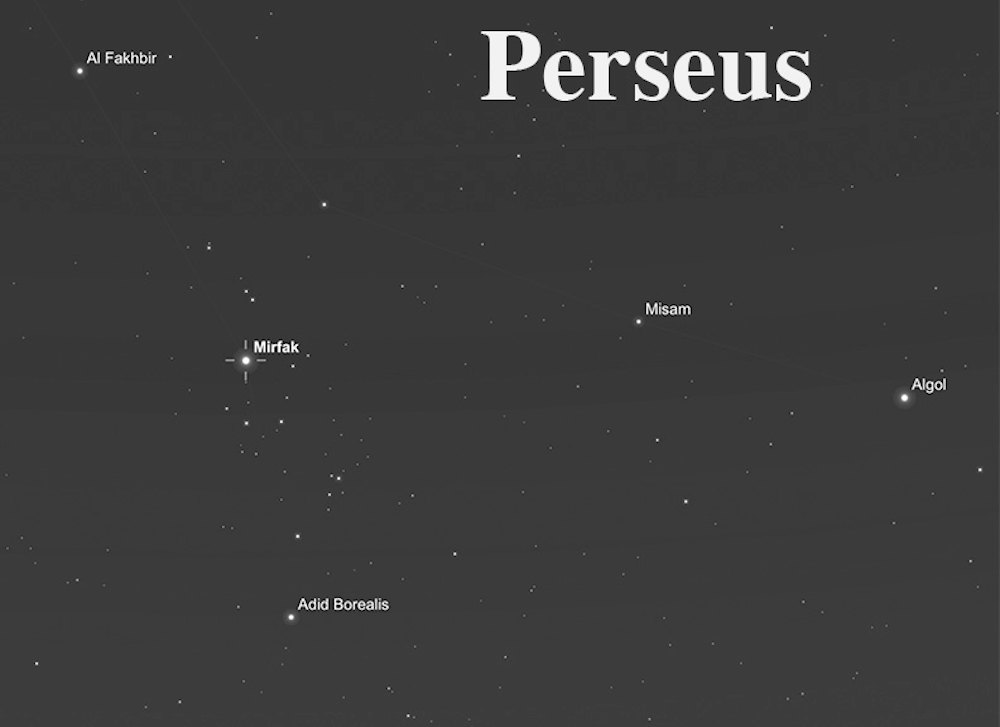 Source: SkySafariThis year, during early mid-December evenings, the constellation known as Perseus will be wedged between Jupiter in the southeast sky and the bright star Capella to the northeast while its rich star clusters sit at the outer rim of the Milky Way. The largest of the clusters surrounds Perseus’ brightest star, Mirfak, or Alpha Persei, with a collection of 100 or so hot and bright stars located about 600 light years from our Sun. A blurry smear to the naked eye, Mirfak’s cluster can be dazzling with binoculars.
Meanwhile, the Geminid meteor shower, beginning in late November and lasting until late December, is slated to peak on November 13. However, according to PivotalWeather’s jetstream forecast for the next week, our view of the sky will be blocked by clouds during the shower’s peak.
However, on Sunday, Monday, and Tuesday evening, we can expect to have clear skies and, with a new moon on Tuesday, little, if any, moonlight will be diminishing our ability to see the bright, highly colorful, and relatively slow meteors spawned by sand-size grains dropped by an asteroid, 3200 Phaethon. The asteroid, discovered in 1983 by using images from a spacecraft, has a 584-day, elliptical orbit, bringing it closer to the Sun than any other named asteroid.