PG&E Proposes 167 More Miles of Underground Lines in Three Counties
The 2028–2037 expansion awaits state review of safety benefits and costs.
4 min read
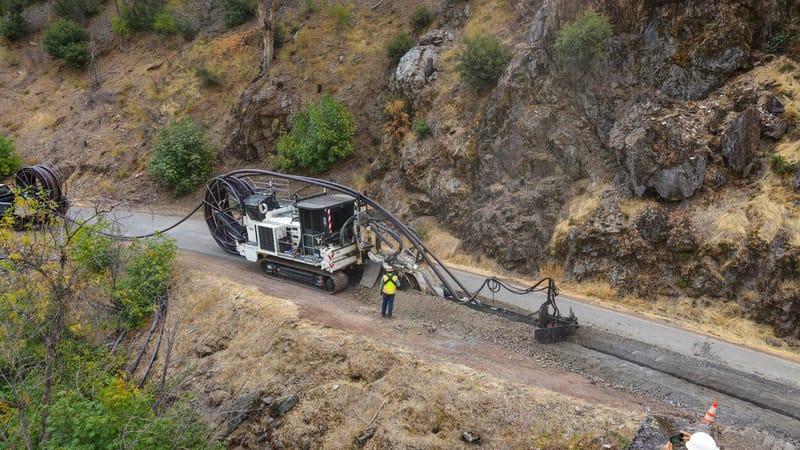
Crews install underground power lines in western Plumas County in September 2025.
PG&E
NORTHERN SIERRA – Pacific Gas and Electric Company proposes to install an estimated 167 new miles of underground power lines in Nevada, Sierra, and Plumas counties from 2028 through 2037, in addition to work it expects to complete through 2027.
The utility’s proposed 10-Year Electrical Undergrounding Plan, filed September 30, calls for approximately 5,000 miles of new underground distribution lines across more than 30 counties to reduce wildfire risk and power outages. The plan awaits state review of its safety benefits and costs.
PG&E’s October 7 forecast for the ten-year plan estimates 127 miles in Nevada County, 38 miles in Sierra County, and two miles in Plumas County.
PG&E’s 2024 climate assessment listed 1,365 miles of overhead distribution lines in high-fire-risk areas in Nevada County, 100 in Sierra County, and 251 in Plumas County.
Across its service area, PG&E’s September 2025 wildfire plan listed nearly 80,000 miles of overhead distribution lines. The ten-year proposal would replace about 4,000 overhead miles—roughly 5% of that total—with 5,000 underground miles. PG&E allows extra distance for rerouting and design constraints.
Current Work and the New Plan
PG&E’s current program includes replacing overhead distribution lines with underground cables in and around Downieville and Sierra City. Its April county map forecasts Downieville-area lines entering service in 2026 and 2027, and Sierra City-area lines in 2027. These projects are part of roughly 17 miles planned countywide over those two years. Final road and property restoration may follow after the lines enter service.
The filing also proposes carrying over any unfinished projects from the current program when the new plan begins in 2028, counting them toward its mileage.
In Plumas County, PG&E said August 21 that it had buried more than 64 miles of lines since 2021. Work already underway included an 11.5-mile project along Prattville Butt Reservoir Road near Lake Almanor, then expected to finish in early November.
The mileage forecast covers only PG&E’s distribution system. Plumas-Sierra Rural Electric Cooperative serves Sierra Valley and eastern Plumas communities, including Graeagle, Clio, and parts of Portola. Truckee Donner Public Utility District supplies neighborhoods in Truckee and eastern Nevada County.
Safety Benefits and Construction
In its filing, PG&E reported about 90% fewer faults causing sustained outages on circuit sections buried in 2022 and 2023. Its before-and-after analysis covered roughly 750 outages from 2021 through 2024.
In a comparison of its existing systems, PG&E reported to regulators in 2023 that underground circuits had roughly 95% to 96% fewer reported ignitions per mile than overhead circuits during 2015–2021.
Public safety shutoffs can still interrupt service on buried lines connected to overhead sections that must be turned off, PG&E’s wildfire plan says.
PG&E chooses work through comparisons of wildfire risk, outage risk, construction feasibility, and cost. Its proposal compares burial with alternatives such as covered overhead wires and stronger poles. Individual projects advance through engineering and further review as the utility develops the construction program.
For nearby residents and motorists, PG&E’s construction guidance describes surveying and route marking, discussions with property owners where easements are needed, and traffic controls during construction. Crews may schedule temporary outages to connect customers to the new lines. Road and property restoration follow the work.
State Review Will Address Costs
PG&E estimates construction spending of about $16.6 billion across its territory during 2028–2037, or $11.4 billion in present value, a calculation that discounts future spending to a common value.
The company also projects about $6 billion in avoided tree-trimming, operations, and maintenance costs over the equipment’s assumed 55-year life, measured in present value. Regulators will determine which costs PG&E can recover from customers.
Under the state’s undergrounding program, the Office of Energy Infrastructure Safety has nine months from submission to approve or deny the plan. Approval requires substantial wildfire-risk reduction and substantially improved reliability, including reduced use of safety-related shutoffs.
If the plan is approved, PG&E must apply within sixty days to the California Public Utilities Commission for conditional approval of costs. The commission has nine months to decide and can require changes. Annual spending audits can lead to adjustments or refunds for costs that fail to meet its conditions.
Residents can direct proposal questions to EUPinfo@pge.com and local project questions to undergrounding@pge.com.