Pumped-Storage Project Proposed in South Yuba Watershed
Developer seeks study permit for 750-megawatt plant near Nevada City
5 min read
NEVADA COUNTY – A proposal to build two reservoirs and an underground power station in the South Yuba River watershed would use water as a rechargeable battery, storing electricity for times when demand is high.
RamaFlux Sierra PSH LLC’s application to the Federal Energy Regulatory Commission describes the Fish Creek Pumped Storage Project near Nevada City. The plan places an upper reservoir on upland terrain and a lower reservoir at the canyon narrows of Fish Creek, a tributary of the South Yuba. Its proposed generating capacity is 750 megawatts.
The company is seeking a preliminary permit, which would preserve its priority to apply for a hydropower license while it studies the site. FERC accepted the application for filing and opened a public comment period in a notice published October 2. Construction would require a separate licensing process.
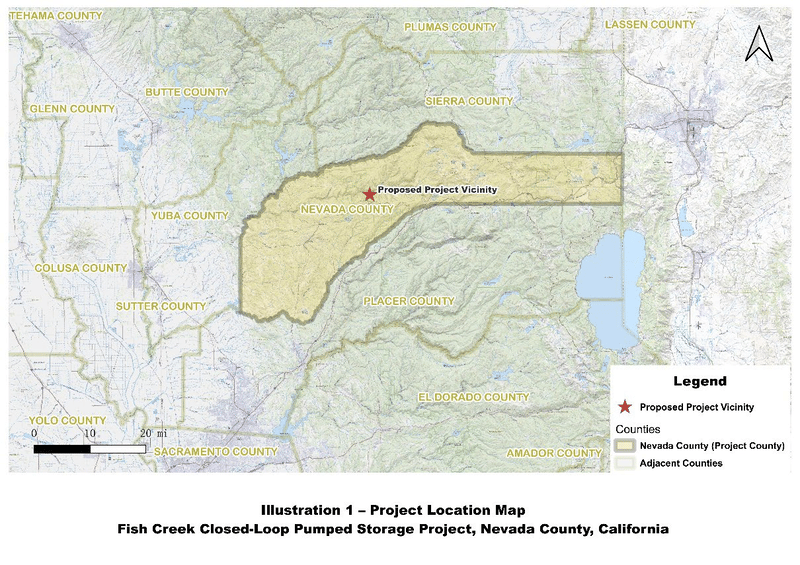
The red star marks the proposed Fish Creek Pumped Storage Project’s general location in Nevada County.
Pumped storage works by moving water between reservoirs at different elevations. When charging the system, electrically powered pumps push water uphill. When electricity is needed, operators release the water downhill through turbines that turn generators, collecting it in the lower reservoir for another cycle. The U.S. Department of Energy compares the arrangement to a giant battery.
The Fish Creek concept calls for reservoirs at elevations of roughly 4,200 and 2,600 feet above sea level, connected to reversible pump-turbines in an underground powerhouse. Pressure pipes and a shaft would carry the water between them. A new 230-kilovolt transmission line would connect the plant to the electric grid; the company proposes studying routes along existing roads and transmission rights-of-way, including the Highway 20 corridor.
RamaFlux estimates that the plant could deliver its full 750-megawatt output for about eight hours, storing approximately 6,000 megawatt-hours of energy. Feasibility studies would establish the reservoirs’ acreage and volumes, dam dimensions, and final equipment layout.
Pumping consumes electricity. Such systems generally use more energy to lift the water than they recover when it runs downhill, but their value comes from shifting electricity to the hours when it is most useful. FERC identifies support for renewable energy and grid reliability among pumped storage’s uses.
In its application, RamaFlux argues that the project would provide competitively priced electricity during peak demand and create construction, installation, and operating jobs. It also argues that concentrating the main facilities on a private parcel and limiting their interaction with natural waterways would reduce environmental effects. The company proposes studying electricity markets and project costs as part of its feasibility work.
Closed-loop pumped storage circulates water between reservoirs without a continuous connection to a naturally flowing waterway, as described in a Pacific Northwest National Laboratory report. The reservoirs still need water for their initial fill and to replace evaporation and seepage. RamaFlux describes its concept as “primarily off-stream” and places the lower reservoir at Fish Creek’s canyon narrows, where natural canyon walls would help support the dam.
For the initial fill and replacement water, the application anticipates relying mainly on precipitation and seasonal runoff within the project boundary. It also proposes examining supplemental sources within or beside the parcel, subject to water-rights requirements. Studies would calculate evaporation and seepage losses and test whether the available supply could meet the project’s needs.
RamaFlux says a waterfall downstream of the proposed lower reservoir could help separate it from lower Fish Creek and the South Yuba. The application assigns field studies to verify the feature and measure the reservoir’s relationship to surface water and underground drainage. Those studies would also inform how the project is classified for licensing.
In its Facebook post about the proposal, the South Yuba River Citizens League, known as SYRCL, challenges assurances about the water supply and points to the reservoirs, construction roads, and transmission line as concerns. The organization invokes the community’s work to protect the South Yuba as a Wild and Scenic River.
“We didn’t spend decades protecting this river to watch it get re-plumbed from the ridgetops,” SYRCL wrote.
California’s Wild and Scenic Rivers Act designates the South Yuba from Lang Crossing to its confluence with Kentucky Creek below Bridgeport. The law bars state agencies from helping other government agencies plan or build dams, reservoirs, diversions, or other water impoundments that could harm a designated river’s free-flowing condition and natural character.
In a comment submitted October 23, Nevada City resident Maia Averett asked the commission to deny the preliminary permit or require a thorough examination of potential effects. She called for study of streams and groundwater, habitat, sediment and legacy mercury, Nisenan cultural resources, construction traffic, and wildfire and evacuation risks.
The national laboratory’s 2025 report found that closed-loop projects can have lower environmental effects than systems connected to natural waterways, but that impacts vary greatly by location. Water sourcing can raise conflicts over water rights and aquatic resources, and some cultural-resource impacts may be impossible to mitigate.
The next federal decision concerns the preliminary permit. RamaFlux requests a two-year term and estimates spending $2.5 million on studies. It proposes funding that work through company and affiliated capital and possible development partners. Its proposed work includes geology and dam engineering, wildlife and archaeological surveys, water quality and rights, transmission access, and financial feasibility. The company’s schedule anticipates preparing a final license application before the permit expires.
FERC’s project notice specifies that the preliminary permit would not authorize land-disturbing work or entry onto other owners’ lands or waters without their permission.
Preparing a license application includes consultation with agencies, tribes, landowners, and other interested groups to identify issues and necessary studies. The application would then go through FERC’s environmental review, with agency recommendations and public comments informing an environmental assessment or environmental impact statement. The licensing process addresses effects on water, wildlife, cultural resources, and other uses of the area, as well as measures to avoid or reduce harm. A license carries engineering and operating conditions, including dam-safety requirements.
California also has a role. The State Water Resources Control Board intervened September 30, citing its water-quality responsibilities. Its filing establishes its participation in the proceeding; it states no position for or against the project.
Under Section 401 of the Clean Water Act, an activity that may discharge into federally protected waters needs water-quality certification, or a waiver, before a federal license can be issued. California’s certification process includes review under the California Environmental Quality Act. The developer would also need lawful access to its water supply and project land, an approved grid connection, financing, and the construction approvals required for its final design.
Public comments on the preliminary-permit application are due November 30 at 2 PM Pacific time. FERC accepts brief comments through its eComment system, using docket number P-15429-000. The application and subsequent filings can be found by searching P-15429 in FERC’s eLibrary.