Reducing Fuels on Steep Slopes
How partnerships and technology advancements are moving critical forest restoration work forward.
Lauren Faulkenberry, Tahoe National Forest
6 min read
TAHOE NATIONAL FOREST — Tahoe National Forest’s North Yuba watershed is a highly productive water source for downstream residents and the agricultural industry across northern California. Although it is the largest continuous unburned landscape in the Central Sierras, it is also one of the most difficult forests to keep safe.
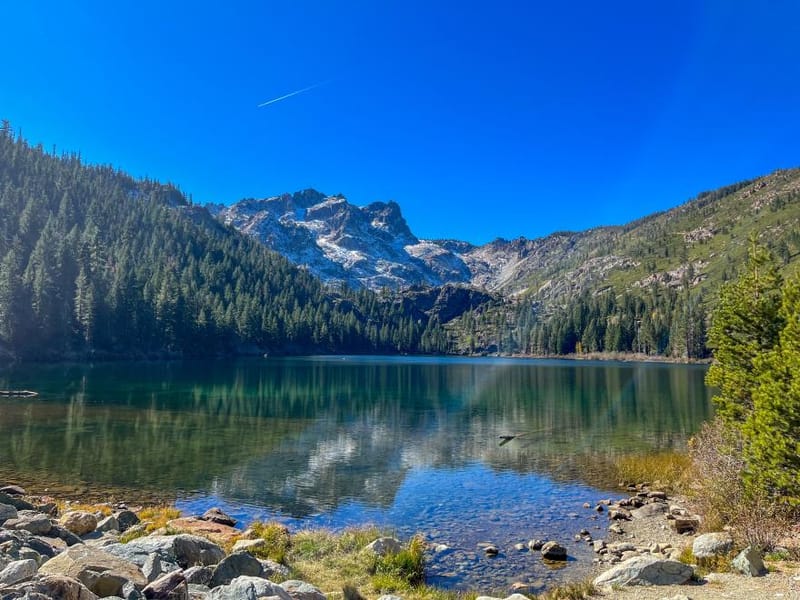
The North Yuba watershed is home to several communities and supports a booming recreation economy. The average visitor here often admires the dense forest and deep green timber-heavy mountainsides. To land managers, the overstocked condition of the forest is a public safety crisis. (Forest Service image)
This remote and rugged location has some of the most challenging terrain in California for fighting fire. The steep slopes are also why it is difficult to reduce fuels in the area, with an almost unimaginable cost to treat the landscape in this condition. Also, the checkerboard ownership pattern of the Central Sierras requires working across public-private boundaries. Taken together, treatment is nearly impossible. But the Tahoe National Forests and partners are finding a way.
“We continue to make moves on this landscape thanks to the bold efforts of the North Yuba Forest Partnership and our collective agreement that we need to act fast to proactively and sustainably reduce wildfire risk for these communities,” said Tahoe National Forest Supervisor Chris Feutrier.
The North Yuba Forest Partnership, which began in 2018, includes a diverse group of public, private and community-based groups working to reduce catastrophic wildfire risk across 275,000 acres of the North Yuba watershed.
Together, the partnership brings the needed capacity to make the impossible possible.
One puzzle piece at a time
How do you plan 275,000 acres of forest health treatments, fund it and find the contractors that can do the work? It certainly doesn't happen all at once or without hitting a few roadblocks along the pathway forward.
Increasing the pace and scale of forest restoration work is a phrase that is thrown around a lot without much background on what it takes to get there. To truly speed up fuels reduction, there must be the infrastructure in place to support it.
However, many projects on federal lands span multiple years, but rely on 1-year funding cycles. This financial uncertainty makes it challenging for contractors to enter into agreements to do the work.
This is where partners come in. They seek grants, secure funding opportunities, develop contracts and attract the skilled labor or technology needed to move projects toward the finish line.
The National Forest Foundation has been an essential Forest Service partner with its ability to organize projects into bite-sized chunks contractors can manage.
“We bring flexibility to forest restoration projects by using creative contracting mechanisms and diverse funding sources,” said National Forest Foundation Central Sierra Program Coordinator Maggie Cummings. “This approach keeps work moving, ensures contractors are paid steadily, and accelerates high-quality treatments across the landscape. It’s how we restore forest health, strengthen wildfire resilience, and support local communities and the logging and forestry industries.”
Financing fuels work
Still, the forestry industry can fluctuate with the market for forest products. When the market value of forest products hit a low, the operating risk can quickly stack against a business owner. The North Yuba Forest Partnership works to offset some of that through financing methods, creative contracting and straight gumption.
Blue Forest, a pioneer in conservation finance, has been instrumental in developing financing tools that help align diverse funding sources and expand the North Yuba Forest Partnership’s circle of influence, attracting additional investment to the landscape.
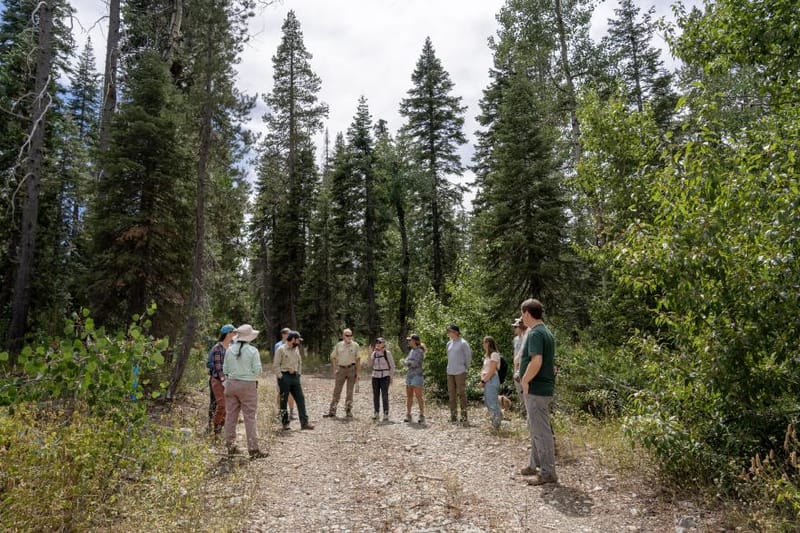
During a North Yuba Forest Partnership field tour, partners discuss active and upcoming projects ranging from fuels reduction to meadow restoration. The partnership continually works together to secure funding to plan and implement forest restoration work. (Photo courtesy of North Yuba Forest Partnership member Blue Forest)
Blue Forest’s flagship product, the Forest Resilience Bond, is a conservation finance model that finances restoration work up front, with the capital repaid over time by beneficiaries, such as utilities and corporations that depend on resilient forests and watersheds. The first ever Forest Resilience Bond, was launched in the North Yuba watershed and helped complete implementation of a 15,000-acre project in nearly half the time initially planned. Since then, two additional Forest Resilience Bonds have launched in the watershed.
"The North Yuba Forest Partnership has scaled remarkably from early collaborative efforts to a robust force for community protection and landscape resilience, all while staying grounded in strong local support,” said Blue Forest cofounder and CEO Zach Knight. “Each partner brings complementary strengths that collectively enable us to protect this vital watershed at a scale none of us could accomplish alone."
Advancements in forestry technology, paired with creative financing, are making it possible to secure the right contractors to implement work across the North Yuba watershed.
New technologies help get it done
After years of planning and preparing, work is finally happening at scale across the North Yuba.
New technologies allow work to be done in areas previously considered inaccessible by traditional equipment. For example, tethered mastication has been at work within Tahoe National Forest’s Downieville Ridgetop Fuels Project, which is designed to place strategic fuel breaks along ridgelines surrounding the community of Downieville, enhancing wildfire resilience.
The National Forest Foundation was able to attract a contractor with tethered mastication technology and the ability to efficiently reduce fuels on steep slopes that exceed 50 percent in many places—that's steeper than most double-black diamond ski runs.
Tethering improves operator safety and allows for more consistent treatment outcomes while providing another viable option for accomplishing fuels reduction objectives across challenging terrain, such as the steep slopes of Tahoe National Forest. (Forest Service photo by Lauren Faulkenberry) - AND-Video Caption: Ascent Forestry has secured the first T-Winch 10.3 tethered mastication system in the state of California. The Downieville Ridgetop Fuels Project is the first time this technology has been actively deployed. (Forest Service video by Lauren Faulkenberry)
A tethered masticator is anchored with a winch-assist cable. The masticator mulches and grinds up dense vegetation, brush and small trees. A highly trained operator controls the machine and continuously surveys conditions. A tethered masticator can handle thick vegetation on a single pass, as opposed to what would take hand crews multiple passes to hand cut, pile and masticate or burn.
With slopes so steep and forests so overgrown, many times it doesn’t make sense to build roads to accommodate heavy equipment and log trucks. This is why helicopter logging is another tool being used within the North Yuba landscape.
Sawyers hike to designated locations to fell trees. The crew then bunches logs together and attaches them to a helicopter’s specialized cable system. The helicopter then flies the logs to a nearby landing where they are processed and put on log trucks.
Navigating mountain canyons by helicopter is a specialized skill. Just like we often fight fire with assistance from aerial resources, land managers of Tahoe National Forest are leaning into using aerial resources to reduce the risk of fire. Helicopter logging has been a critical resource for reducing stand density across the significantly overgrown North Yuba project area. Bringing forests back to a more resilient state will allow trees to grow larger and healthier, reduce wildfire risk and improve wildlife habitat. (Forest Service video by Lauren Faulkenberry)
Helicopter logging minimizes soil disturbances thanks to less ground equipment operating throughout a large project area and can be 10-times as fast as traditional, ground-based methods. On Tahoe National Forest’s Sleighville Project, helicopters removed nearly 3-million-board-feet of timber from 245-acres of steep slopes in about two months. Without aerial resources, this could have taken several operating seasons over multiple years due to the remote and steep terrain.
As implementation continues to hum along across the North Yuba watershed, planning never stops. The North Yuba Forest Partnership will continue to actively manage the landscape in the hope that generations to come will be able to enjoy its wonders.
Broader effort
Active management is how we keep forests open, healthy and productive. The North Yuba project is one example of many in a national effort to restore health to our forests and lower fire risk. This means stronger local economies, more jobs in forest and energy sectors, and healthy, productive forests and grasslands that are resilient to wildfire.