Sierra and Plumas Providers in Line for Rural Health Grants
The One Big Beautiful Bill backs local staffing grants and regional care networks.
5 min read
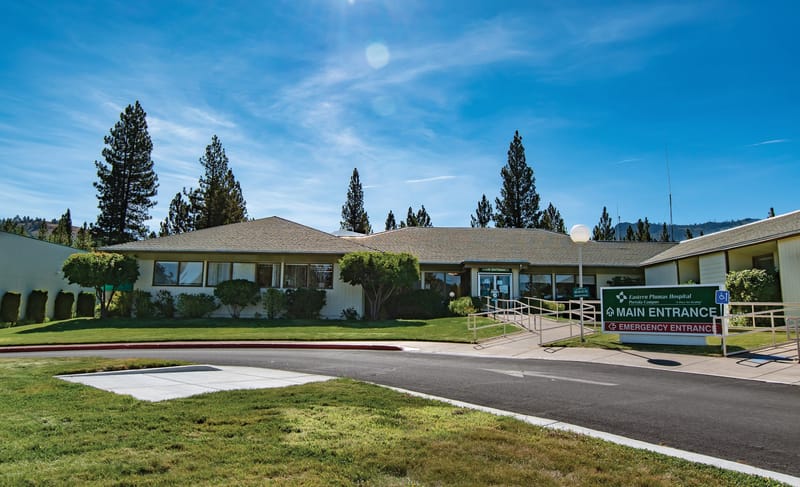
Eastern Plumas Health Care’s Portola campus. The organization is in line for a $419,000 grant to recruit and retain health professionals serving Plumas and Sierra counties.
Eastern Plumas Health Care
SACRAMENTO – The One Big Beautiful Bill is funding a $233.6 million rural health effort in California, with hospitals serving Sierra, Plumas, and Nevada counties in line for grants to recruit staff and coordinate care across the region.
The Centers for Medicare & Medicaid Services (CMS) said October 29 that California had committed its full first-year allocation from the law’s Rural Health Transformation Program. The announcement highlights the fiscal year 2026 award first announced December 29, 2025. California’s proposed local grants are now moving through agreements with individual organizations.
The program pays for changes in how rural care is delivered: recruiting and keeping health professionals, connecting small facilities with regional specialists, and upgrading the systems used to share patient information. California’s Department of Health Care Access and Information, known as HCAI, administers the state program under federal oversight.
The law also changes Medicaid, called Medi-Cal in California. Leaders at Plumas District Hospital and Partnership HealthPlan of California have warned that the temporary grants fall short of the financial pressures those changes would create.
Where the Local Money Would Go
HCAI’s October 21 recommendations include:
Eastern Plumas Health Care: $419,000 for workforce recruitment and retention, serving Plumas and Sierra counties.
Plumas District Hospital: $2,427,666 for regional care partnerships and $800,000 for workforce recruitment and retention.
Tahoe Forest Hospital District: $1,559,015 for regional care serving Placer, Nevada, El Dorado, Sierra, and Plumas; $998,208 for workforce efforts in Nevada County.
Seneca Healthcare District: $255,691 for workforce recruitment and retention in Plumas County.
Sierra Nevada Memorial: $708,220.53 to the hospital foundation for regional care and $998,240 to the hospital for workforce efforts.
Health Alliance of Northern California: $1,861,538 for workforce efforts across seven counties, including Sierra and Nevada.
The state finalizes these recommendations through signed agreements with recipients. Its grant-notification guidance requires organizations to satisfy outstanding conditions and complete a risk assessment before both parties execute an agreement. Eligible project spending begins under the agreement’s terms.
Under the state’s recruitment and retention guide, participating organizations can offer eligible health professionals bonuses of up to $150,000, tied to five years of full-time service at qualifying rural sites. That means at least 32 hours a week of direct patient or client care. Organizations set individual awards within the $150,000 ceiling. The program also allows shared staffing arrangements and regional coordination.
For patients, the intended benefit is a more stable local care team. The grant guide identifies fewer vacancies, lower turnover, and longer service in rural communities as program goals.
The regional partnership grants, called Accelerator Partners, support networks linking rural hospitals, clinics, and other providers. The state’s plan pairs regional centers with smaller facilities so they can coordinate primary and maternity care, specialist advice, referrals, and transfers. Telehealth can bring a specialist into a visit remotely; shared records can help the next provider see what care a patient has already received.
The Source and Statewide Spending Plan
Congress established the rural health program through the One Big Beautiful Bill, signed July 4, 2025. The administration now calls the law the Working Families Tax Cuts Act.
The law appropriates money from the United States Treasury to CMS: $10 billion annually for fiscal years 2026 through 2030, totaling $50 billion. That makes California’s award federal funding administered by the state.
Under the federal allocation rules, half the money is divided equally among approved states. CMS allocates the other half using factors including rural population, health facilities, and the circumstances of rural hospitals.
California’s first-year plan includes $87.51 million in care-delivery grants, $67.56 million in workforce grants, and $11.65 million in technology grants, for $166.72 million altogether. Another $56.51 million supports contracts, and $10.41 million supports HCAI’s program operations.
The state’s budget narrative describes technical help to build regional networks, a workforce data tool, grant administration, and a Rural Technical Assistance Center. The center’s work includes helping providers connect electronic records, strengthen cybersecurity, introduce remote monitoring, and evaluate technology purchases.
The statewide program also reserves $11.65 million within its funding for federally recognized Tribes and rural Tribal health care. Its separate electronic-records grants help rural facilities adopt or replace systems so they can exchange patient information.
Support and Financial Concerns
United States Representatives Kevin Kiley and James Gallagher welcomed the funding in the October 29 federal release.
Kiley said the investment, resulting from legislation he supported, would help providers overcome the Sierra’s distances and rugged terrain to serve residents and visitors. Gallagher described the funding as a step toward stronger rural hospitals and shorter journeys for care.
“Families in the North State shouldn’t have to drive hours just to see a doctor,” Gallagher said.
Northern California health leaders have also described both the practical opportunities and the financial pressures surrounding the program.
At a March 10 joint hearing of the Assembly and Senate health committees, Plumas District Hospital Chief Operating Officer Darren Beatty drew on his ambulance work to explain how conflicting patient information complicates care. He described receiving different accounts from a clinic, a hospital, an emergency department, and the patient. During the hour-and-a-half ambulance ride to a Reno hospital, he had to sort out those differences so the receiving team could care for the patient.
Beatty said the transformation program offered rural hospitals an opportunity to invest in technology that could improve that exchange of information. He also argued that its temporary funding was too small to make up for the Medicaid reductions expected under the One Big Beautiful Bill.
The same law changes Medicaid eligibility and financing. KFF, a health policy research organization, reports that the Congressional Budget Office estimated it would reduce federal Medicaid spending nationwide by $911 billion over 2025–2034 compared with the previous-law projection.
Partnership HealthPlan of California, which administers Medi-Cal benefits in Sierra, Plumas, Nevada, and other Northern California counties, raised a similar concern earlier this year. In a March 18 finance committee meeting, Chief Executive Officer Sonja Bjork described the statewide rural funding as insufficient to offset Medicaid reductions.
Eastern Plumas offered a more confident assessment of its own finances in fall 2025. As The Mountain Messenger previously reported, Chief Executive Officer Doug McCoy said planning and operational changes positioned the organization to weather the anticipated reductions while expanding services.
For the rural grants, implementation continues through individual agreements and workplans. HCAI says it will update the recipient list weekly as agreements are executed.