State Conservancy Plans $100,000 Wolf Coexistence Outreach Grant
Wolves already roam Sierra County, but the agreement remains unsigned.
3 min read
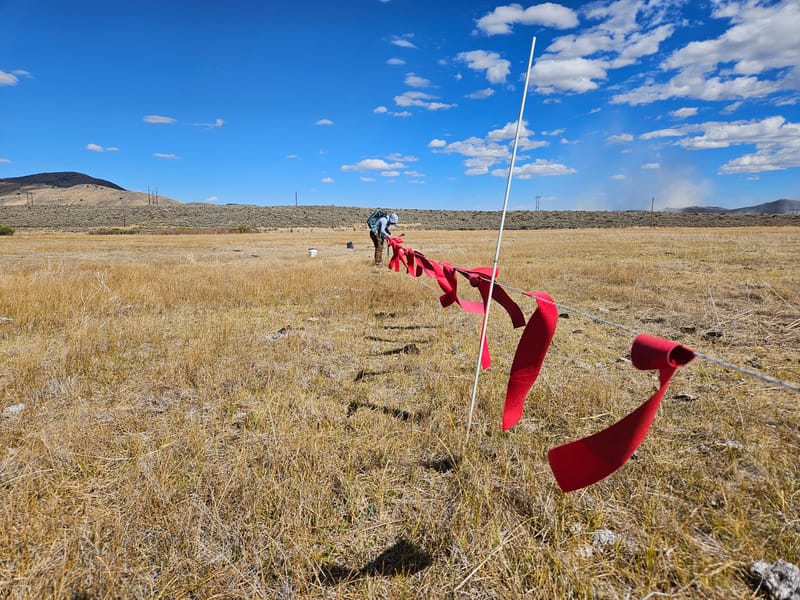
Fladry, shown being installed here, is one tool used to deter wolves from entering ranches.
California Department of Fish and Wildlife
AUBURN — The Sierra Nevada Conservancy plans to spend up to $100,000 on outreach to help mountain communities live alongside gray wolves, an award its executive officer authorized without a vote of the agency’s governing board. The agreement has not been signed, and the conservancy and its grantee are still working out what the money will pay for.
Executive Officer Angela Avery is using delegated authority to make the award to the University of California Cooperative Extension, according to a staff report prepared for the conservancy’s September 3 board meeting. The two organizations are “still developing specific tasks and deliverables,” the report says, and conservancy staff are working with the extension “to finalize the grant scope of work and deliverables before executing the grant agreement.”
The board will hear an update at its quarterly meeting in June Lake, in Mono County. The item is informational, and the report says no formal action is needed, though boardmembers are encouraged to share their thoughts.
The conservancy calls the award a Wildlife Coexistence Capacity Building Grant. It is meant to build the capacity of communities already living with wolves, and of those that may soon be, by supporting work that manages and mitigates wolf-livestock conflict “while supporting wolf recovery.” The money would equip community leaders, technical experts, and decision-makers to serve as trusted local resources, and it would pay for community-building activities that circulate information, tools, and strategies. It is not a fund for killing wolves, and it is not compensation for ranchers who lose livestock.
Where the work will happen is described only in general terms. “The grant will serve the Sierra Nevada-Cascade Region, with a focus on counties where wolves are currently present and adjacent counties that are likely to experience future wolf activity,” the staff report says. Neither the report, the September 3 agenda, nor the conservancy’s August 19 announcement names a single county.
Sierra County falls inside the target area on both counts. The conservancy’s service area spans roughly 27 million acres and all or part of 24 counties, and state law places Sierra County in the northeast Sierra subregion alongside Lassen, Modoc, and Plumas counties. Supervisor Paul Roen represents the subregion on the conservancy’s governing board.
Wolves are beginning to repopulate Sierra County after the Beyem Seyo pack was lethally removed in 2025. The Department of Fish and Wildlife recognized the Long Valley pack in April, and it ranges across eastern Sierra, eastern Plumas, and south Lassen counties. An area of wolf activity around Sierra Valley remains active, and the department has detected two gray-colored wolves between Truckee and Sierra Valley. None of the seven depredation investigations opened in the county this year has produced a confirmed or probable wolf determination.
The staff report describes the conditions the grant is meant to address. California wolves “primarily occupy working landscapes where cattle are abundant and vulnerable, elk are scarce,” it says, and deer, the wolves’ primary wild prey, have been declining for decades. Recent data suggest cattle make up a significant portion of the diet of some California wolves, according to the report, which calls the region’s rugged terrain, dispersed ranches, and limited wild prey “a uniquely complex socio-ecological setting.”
The conservancy has been working the issue outside the grant as well. Avery and the agency’s regional scientist sit on a state and federal Interagency Wolf Management Team, and in May they joined a delegation of officials in Sierra Valley to meet ranchers whose herds have been affected. The report says the agency is also examining habitat restoration for deer and elk as a long-term way to rebuild the native prey base.
Gray wolves were extirpated from California in 1924 and began recolonizing the state in 2011. Eleven packs are now confirmed statewide, and the animals are listed as endangered under both state and federal law.
The board meets at 9 AM Thursday, September 3, at the June Lake Community Center, 90 West Granite Avenue. Written comments are due by 5 PM Friday, August 28, at public-comments@sierranevada.ca.gov.