Southwest Sierra #60 — The Horizontal Wells
I should start by explaining that I am Alleghany County Water District’s General Manager.
5 min read
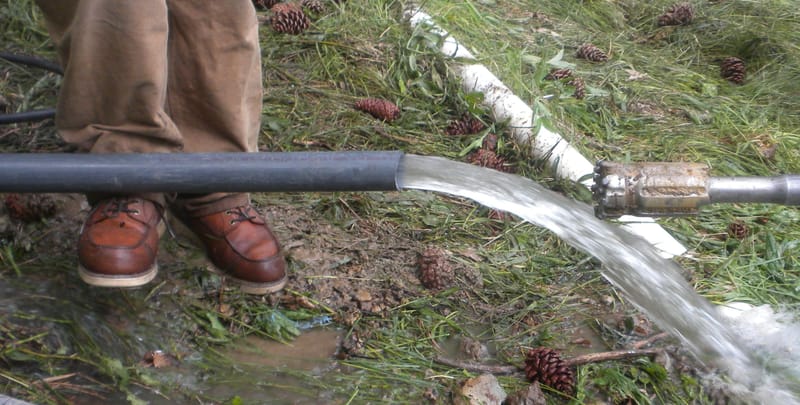
Ray Wittkopp’s feet next to the second successful and fastest flowing driven pipe. May 15, 2017.
Continued from last week… I should start by explaining that I am Alleghany County Water District’s General Manager. This mostly volunteer job landed in my lap in late 2013, sort of by default, and not because I really wanted it. Once I do commit to something however, I try to give it my best effort. Now, back to the Planning Project: Once it had been determined that vertical wells were not a viable option for Alleghany’s water supply, I contacted Neil’s Control Blasting, the drillers mentioned last week. This was in April of 2017. A man named Roger Lee was my contact. The first time that I spoke to Roger, he immediately waxed nostalgic about Alleghany. As a teenager, his uncle brought him here to deer hunt every year. He had even attended the “Buck Stew” at the Bucket Club! This was an annual event to celebrate the opening of deer hunting season held for many years through the 1970s.
Roger came to Alleghany where we looked at the spring site and discussed the job. His company does horizontal drilling for many jobs, but usually for drainage under roadways. This was an application that he had never considered, but he agreed that it should work. 2017 had started with heavy rainfall, resulting in, among other things, the failure of the Oroville Dam spillway. Neil’s Control Blasting was one of the contractors hired for the repair job. They were in-between jobs with the Oroville Dam project scheduled to start at the beginning of June. Roger said that if I could cut through the red tape, they could be on site in early May. He estimated three to four days for the entire job. This included mobilize and demobilize. He said that if we couldn’t get it scheduled immediately, he wasn’t sure when they could squeeze it in. This was a much smaller job than what his company usually handles. He even had some left-over schedule 40 perforated pipe that he said he would donate to the job.
I was doubtful if I could get through the state’s red tape by May. After Roger left, that very day, I was looking for a document in the ACWD file cabinet when the “Library Angel” handed me a document about the California Uniform Public Construction Cost Accounting Act. This is an act that allows public agencies to use their own employees and/or to bypass the formal bidding process for smaller jobs. The job quote that Roger provided the next day fit the parameters. On May 2, 2017, the ACWD Board of Directors adopted a resolution to become subject to the act. With the help of that, and a machete named determination, I cut through the red tape.
Monday May 15th was the big day. Neil’s Control Blasting’s crew was there at 7 a.m. along with an operator from a company that was trying to sell them a horizontal drilling machine. The operator came with a brand-new, top of the line horizontal drilling machine to demonstrate! This greatly cut costs. Local gold miner Dave Jeffrey helped provide oversite for ACWD with his extensive drilling experience and general knowledge. The Sierra County Road Crew helped by laying down large steel plates (trench plates) in the spring field for the drilling machine to drive on. Within minutes of driving onto the steel plates, the machine was ready to go.
It was at that moment, standing in the spring field that I realized, if we screwed up the spring, I would be to blame! Even though literally decades of thought had gone into this project, it was now on my shoulders as the person who had pushed it through. I shared my angst with Dave Jeffrey who assured me that he would take part of the blame, but based on recent experiences I knew that I would be raked over the coals if the job failed.
We “eyeballed” where to start and were very cautious with the depth. We started with a 12 foot deep hole. Nothing. We deepened it to 25 feet. Nothing. Finally, we decided to go for it. The next hole was drilled to over 50 feet but still no water. Ray Wittkopp who was battling cancer at the time, showed up. He explained that drill steel will bend or arch down the deeper that it is driven, he suggested starting the holes about 2 1/2 feet higher up on the hillside. I was starting to wonder if we would ever hit water, when at 55 feet the first hole at the new elevation hit water. The second hole, started at the same elevation several feet from the first hole, also hit water at 55 feet and this one was a “gusher” (see photo). Before our very eyes, the nearby cisterns that had been collecting the water on the surface since 1995 went dry! Our State Division of Drinking Water (DDW) Engineer showed up just as the cisterns went dry.
None of us had thought all the way through the drilling process, as to what would happen to the existing cisterns if the driven pipes were successful. It was suddenly obvious that we had to switch the system to the driven pipes (horizontal wells) NOW! With the oversight of our DDW Engineer, ACWD Water Operators Bruce Coons and Edward Snyder were able to quickly install a new collection system, paid for by the planning project. It was put together as inexpensively as possible with the thought that a grant for a construction project for a more permanent configuration would be applied for. Under normal circumstances, planning projects do not pay for infrastructure, but these were not normal circumstances. To be continued…
About the author: Rae Bell (aka Pauline) grew up in the Ruby Mine area. She currently resides in Alleghany proper and can be reached at raebell44@gmail.com or PO Box 919, Alleghany, CA 95910.