State Approves Zone Zero Rules for Fire-Prone Homes
Northern Sierra homeowners will have three to five years to comply.
7 min read
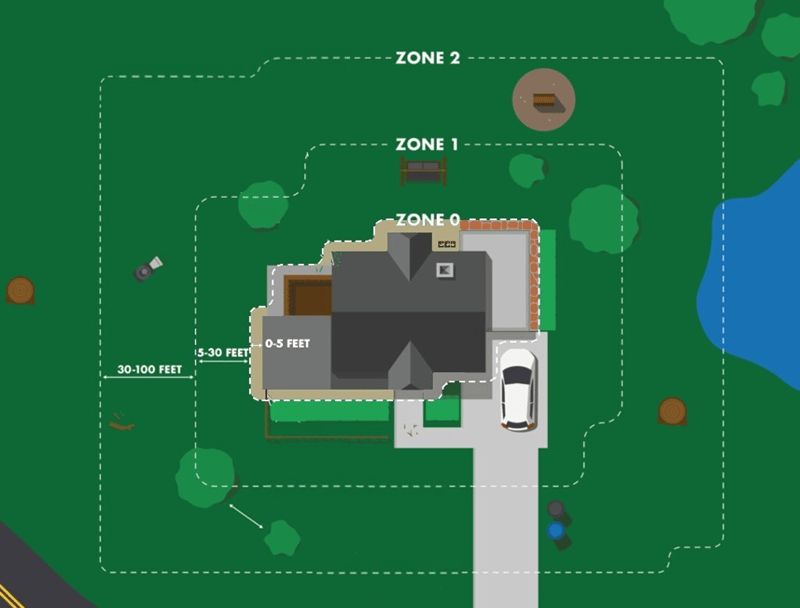
A visualization of defensible space zones surrounding a home.
Board of Forestry & Fire Protection
SACRAMENTO — After nearly six years of delay, California has settled what homeowners in the state’s most fire-prone areas may keep within five feet of their houses. The Board of Forestry and Fire Protection voted 8 to 0 on Wednesday, August 19, to adopt the state’s first Zone Zero defensible space regulations, which bar firewood, wood chips, and dead vegetation from the ground immediately around a home and clear plants out of a narrow buffer against the walls. The board writes California’s defensible space rules, which are then enforced by CAL FIRE.
The regulations apply on any parcel with a fire hazard rating in the State Responsibility Area, the largely unincorporated land where the state carries primary financial responsibility for preventing and suppressing wildfire, and on property that local governments have mapped as a Very High Fire Hazard Severity Zone. Reporting on the vote has placed the number of affected homes at close to two million statewide.
Zone Zero is the innermost of California’s three defensible space zones and the last to get enforceable standards. Zone 1, from five to 30 feet out, and Zone 2, from 30 to 100 feet, have governed tree spacing, dead vegetation, and grass height for years. The Legislature ordered the board to define the first five feet in Assembly Bill 3074 in 2020 and set a deadline of 2023, which passed without a rule as officials argued over which measures worked and what they would cost.
Then, the Palisades and Eaton fires burned through Los Angeles County in January 2025. Governor Gavin Newsom signed an executive order the following month directing the board to finish the rulemaking by the end of the year. That deadline slipped as well, and the board spent 15 months on public workshops, community walking tours, and often contentious hearings before Wednesday’s vote.
Fire officials describe the ground against a house as the place where wind-driven embers collect. “The area defined in this regulation is the most critical zone for protecting a home, and neighborhoods, during a wildfire,” Board Chair Terry O’Brien said in the board’s announcement. State Fire Marshal Daniel Berlant said research continues to demonstrate that homes and buildings are extremely vulnerable to the embers that accumulate in the closest five feet.
A study of five major California wildfires published last year points the same direction. Modeling the 2017 Tubbs and Thomas fires, the 2018 Camp Fire, the 2019 Kincade Fire, and the 2020 Glass Fire, the researchers found that hardening a house alone lifted the predicted survival rate to 25 percent. Adding cleared space in the first five feet raised it to 40 percent, and clearing out to 30 feet raised it to 48 percent. The authors described the figures as theoretical estimates, noting that their model did not account for firefighting.
What the rules require
No combustible material may sit within five feet of a structure. That covers bark mulch, wood chips, firewood, fallen leaves and branches, and dead or dying plants, on roofs and in gutters as well as on the ground.
Closer in, a vegetation-free “safety zone” is required within one foot of the walls, or out to the edge of the eaves, whichever is farther. Plants are also barred within two feet of windows, doors, and vents, and within five feet of an attached deck.
The rest of Zone Zero may still be planted, under conditions. The board allows small non-woody plants such as bulbs, poppies, petunias, and succulents in spaced groupings, low ground covers such as moss, beach strawberry, and creeping thyme, maintained grass or lawn, and potted plants in movable non-combustible containers.
Trees may stay. Branches must be kept 10 feet from chimneys, five feet above roofs, and out from under eaves, and the lower limbs that carry fire upward have to go; the bottom six feet on a large tree, or the lower third on a smaller one.
The rules also govern what can be built in the zone. Where a fence meets the house, a five-foot non-combustible section is required, which on many properties means trading a wooden gate for a metal one. New combustible fences and gates are not allowed inside Zone Zero, though existing ones may be repaired, and any shed or outbuilding in the zone must have non-combustible walls and roof.
Three years, then five
New construction must comply as soon as the California Secretary of State publishes the rule. Existing homes are phased in. Phase one, due within three years, is the clearing work: hauling off firewood, mulch, and wood chips, cleaning gutters, pulling dead and dying plants, and trimming trees. Phase two, due within five years on a schedule each local jurisdiction sets, covers the harder and costlier items, including the under-eave safety zone, combustible gates, sheds, and fencing.
The package now goes to the Office of Administrative Law for review, with a five-day public comment period open through Wednesday, September 2. The board expects the rule to take effect as early as September.
Cal Fire will enforce Zone Zero in the State Responsibility Area, where it may also delegate inspections in writing to a local agency while keeping its own authority to enforce, and city and district fire departments will enforce it in Local Responsibility Areas. The board has said implementation will lead with education and outreach rather than penalties. State law adds that Cal Fire may not change its defensible space inspection practices, forms, or enforcement to carry out the ember-resistant zone until the State Fire Marshal posts a written finding that the Legislature has appropriated enough money to do so.
Cost, insurance, and local flexibility
Cost drove most of the opposition. Sarah Flaherty, representing Los Angeles City Councilwoman Traci Park, urged the board to reject the package, telling members that compliance would cost homeowners thousands of dollars for hardscaping, fence replacement, and hillside erosion control with no funding attached for homeowners or for the fire departments doing the education and enforcement.
James Grasso, president of the Topanga Coalition for Emergency Preparedness, told LAist that the reaction in his community was shock at the scale of the work. “This is a huge burden on many people,” he said. Grasso nonetheless called the final rules a reasonable compromise, pointing to the phased timeline and the decision to allow some plants inside the five feet after the state had first proposed banning all of them.
There is also room for local variation. Assembly Bill 1455, signed in October 2025, lets a local fire agency adopt its own defensible space ordinance using alternative practices, provided they deliver “substantially similar practical effects” as the state rules, and a property owner who follows an approved local alternative cannot be cited for violating the state standard. Local governments may also set stricter standards. San Diego and Berkeley have already adopted their own versions of Zone Zero, and Los Angeles is working on one.
For homeowners struggling to keep coverage, the work may pay for part of itself. The California Department of Insurance’s Safer from Wildfires regulation already requires admitted insurers that price for wildfire risk to credit a five-foot ember-resistant zone, and Insurance Commissioner Ricardo Lara wrote last year that discounts across the full program range from 4 percent to more than 40 percent of premium depending on risk, property, and the measures completed. The two standards are not interchangeable, though: carriers verify mitigation under their own filed rules, so meeting the board’s requirement does not by itself guarantee a discount or an offer of coverage.
Checking a parcel
Two things determine what a homeowner has to do: the parcel’s responsibility area and its fire hazard rating. The Office of the State Fire Marshal publishes an online viewer that takes a street address and returns both. County planning departments can confirm the same designation.
In a State Responsibility Area, Zone Zero applies at every hazard rating, from moderate to very high. In a Local Responsibility Area, it reaches only parcels rated Very High; in Plumas County those areas lie in and around Chester, Quincy, East Quincy, and Portola.
Local standards can differ as well. Assembly Bill 1455 lets a fire agency adopt its own defensible space ordinance, and a county or district may set stricter standards, so residents should ask their own fire agency what it has adopted. Comments on the rule package go to the Board of Forestry and Fire Protection at PublicComments@bof.ca.gov and close on September 2.