Whaleback’s Offspring Are Breeding Across California’s Far North
Five northern packs produced litters, and confirmed livestock losses dropped sharply.
5 min read
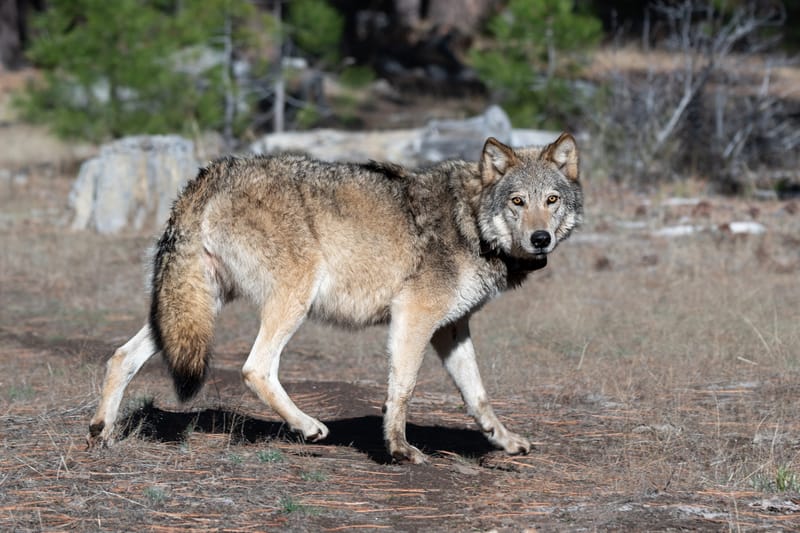
A California wolf collared and released by the Department of Fish and Wildlife in January this year.
California Department of Fish and Wildlife
NORTHERN CALIFORNIA — Two of the wolf packs California recognized this spring have produced their first litters, and both breeding females came out of the Whaleback pack in eastern Siskiyou County. The California Department of Fish and Wildlife published its April through June wolf documents on Tuesday, August 11, confirming pups in five packs. The Whitehorse pack, in western Modoc and eastern Siskiyou counties, and the Ashpan pack in eastern Shasta County are each raising at least five. Whaleback is also the pack behind most of the state’s livestock conflict.
Whitehorse was designated a pack in April, after biologists tracked two wolves through trail camera images, scat, and tracks for six months. The department captured and collared the female, CA077, in May, and genetic analysis has since confirmed at least five pups. CA077 was born into the Whaleback pack’s 2023 litter. The male traveling with her, CA164, was first recorded in California in September 2025 and is a full sibling of a male the department thinks belongs to the Interstate pack at the Oregon border.
The Ashpan litter followed a change in the pack’s membership. CA124, a female from Whaleback’s 2024 litter, moved into the pack’s range in eastern Shasta County in February and was photographed on a trail camera with what the department believes were the two adults already there. In June, the department confirmed she had produced at least five pups, the pack’s first litter on record. Those two established adults, CA048 and CA051, came out of Whaleback as well, from the 2021 litter.
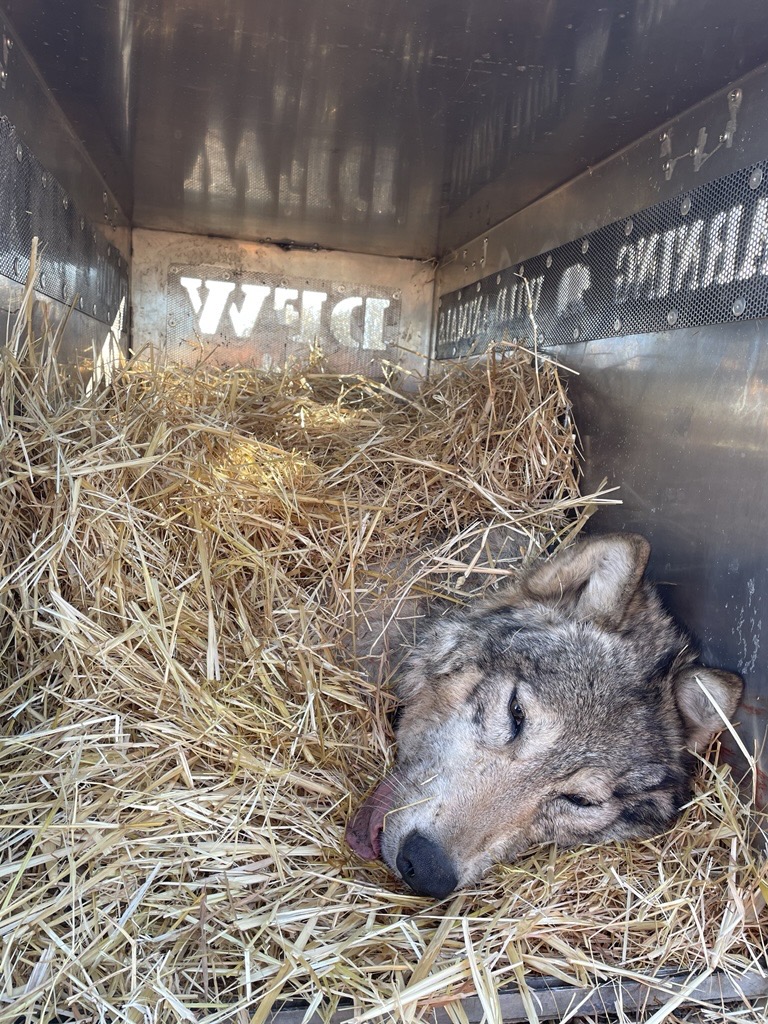
WHA01F, the breeding female of the Whaleback pack, recovering after being collared in January 2025. She was released alongside her daughter, then known as WHA29F and now numbered CA124, who this June produced the Ashpan pack’s first recorded litter.
California Department of Fish and Wildlife
Three longer established packs also produced litters. Whaleback itself had at least nine pups, its sixth consecutive year with a litter. The Harvey pack in western Lassen County had at least four, and the Lassen pack, the oldest of the state’s current packs, had at least two.
Those pups will be numbered under a system the department adopted on July 1. Until then, each wolf carried a code built from the first three letters of its birth pack, a sequential number, and a letter for its sex, so that a female born into the Lassen pack might be LAS09F. The department wrote that the system had become increasingly difficult for the public to interpret as packs multiplied and wolves dispersed across the state. Wolves now receive a number in the order they were identified, regardless of pack. LAS09F, the sole breeding female of the Lassen pack since 2021, is now CA019, and the Known Wolves document carries a table converting 50 retired codes.
Livestock conflict eased in the most recent reporting period. The department’s depredation report lists 49 investigations between April 1 and June 30, of which 10 produced confirmed wolf kills and six were classified as probable. The January through March quarter recorded 47 investigations, 21 confirmed losses, and six probable. The spring figures are not final, because 11 investigations still awaited a determination on August 10.
Nearly all of it stayed in one county. Thirty-three of the 49 spring investigations took place in Siskiyou County, most in the eastern end, inside or beside Whaleback territory. In a note appended to the depredation report, the department wrote that it and Siskiyou County “are working together to resolve ten pending depredation investigations related to the Whaleback pack as of the publication of this document.”
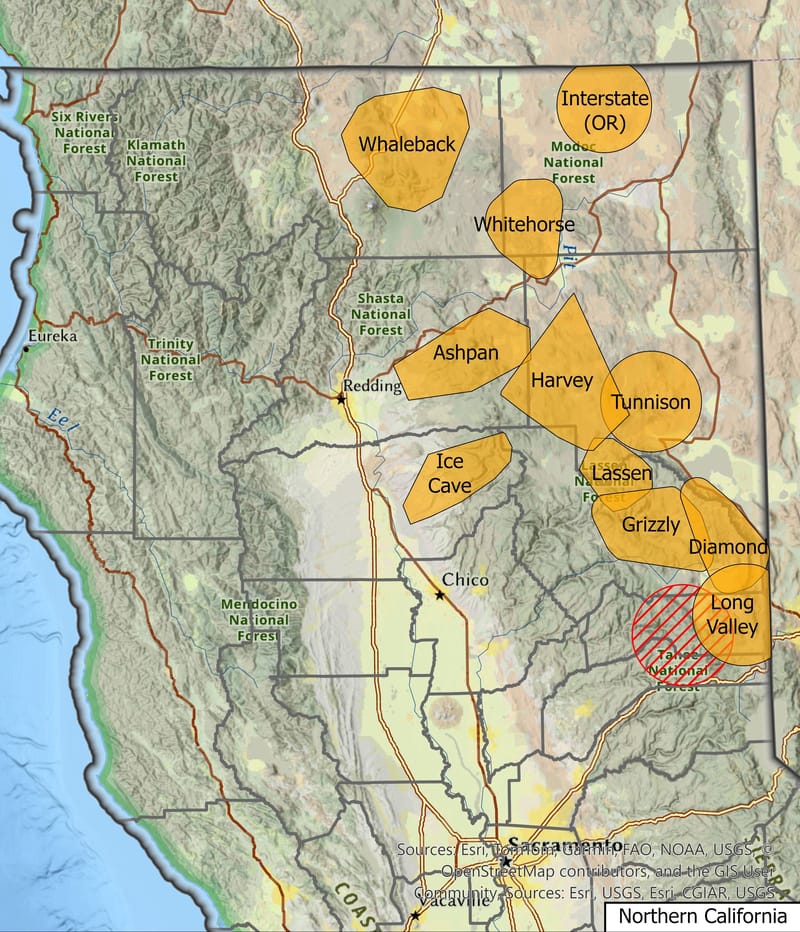
A map of known wolf pack territories.
California Department of Fish and Wildlife
Harvey pack wolves ranged well outside their own territory to feed. Investigators attributed three confirmed losses to Harvey wolves foraging beyond their territory, two of them in eastern Siskiyou County and one in western Lassen County, and classified a fourth eastern Siskiyou case as a probable loss to dispersing Harvey wolves. The Tunnison pack in central Lassen County accounted for three confirmed losses, two of them calves injured badly enough to be euthanized. Ashpan drew one confirmed and one probable loss in Shasta County, and the Grizzly pack one probable loss in Plumas County.
Two more determinations landed on July 30, after the quarter closed. Investigators confirmed the Whaleback pack in the death of a calf in eastern Siskiyou County and classified the death of a second calf, in western Modoc County, as a probable Whitehorse loss. It is the first depredation the department has attributed to Whitehorse.
Sierra County has stayed quiet. The department has opened seven depredation investigations there in 2026, and none has produced a confirmed or probable wolf determination. In October 2025, the department lethally removed three adults of the Beyem Seyo pack to address what it called unprecedented levels of livestock depredation in the Sierra Valley. Wolves have not left the area: the Long Valley pack still ranges across eastern Sierra County, an Area of Wolf Activity in Sierra Valley remains listed as active, and the department reported detecting two gray wolves between Truckee and Sierra Valley during the reporting period.
The state’s one pack outside the north is gone. The Yowlumni pack, confirmed in eastern Tulare County in July 2023 and ranging onto Tule River Tribe land, produced no litter in 2025 or 2026, and its breeding female was found dead in September 2025, having likely succumbed to complications from mange, according to the department. Ground surveys and trail cameras have detected no wolf in that territory since January other than CA091, a collared female who traveled through Inyo and Mono counties in April and May before returning. The July activity map draws no pack territory anywhere south of Nevada County.
Gray wolves are protected under both state and federal law, and killing one is a crime carrying fines and imprisonment. The department asks the public to report possible sightings through the Gray Wolf Sightings Report page on its website, and it uses those reports to identify new areas of activity.