Assembly Committee Probes Predator Conflicts in Rural California
Lawmakers, ranchers, and environmentalists debate safety, stress, and non-lethal strategies for managing predators.
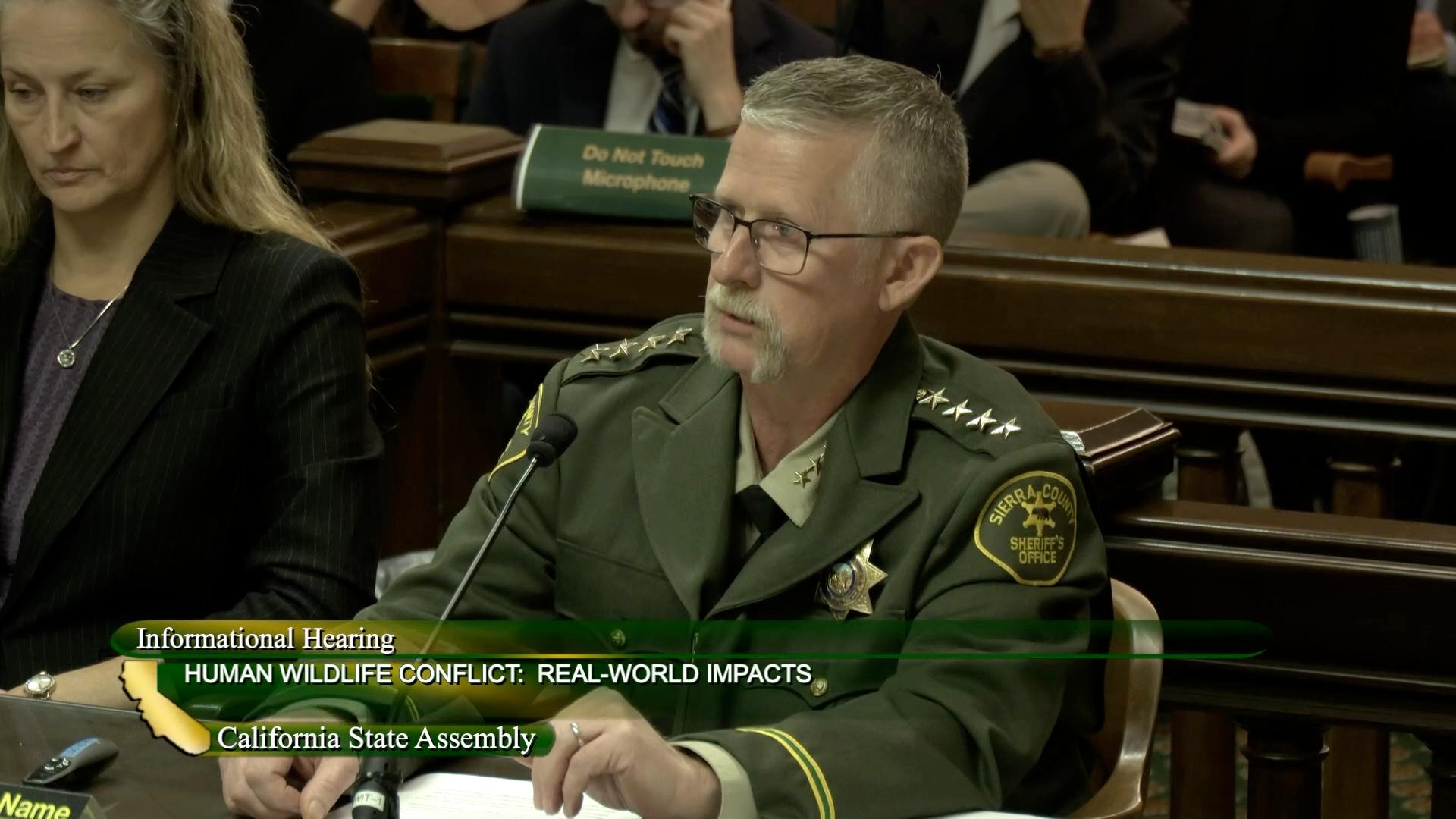
Sierra County Sheriff Mike Fisher testifies before the Water, Parks, and Wildlife Committee.
SACRAMENTO — The California Assembly Water, Parks, and Wildlife Committee held an informational hearing in Sacramento to examine rising human-wildlife conflicts involving predatory species. Discussions centered on challenges faced by rural communities in Northern California, particularly with gray wolves and black bears.
Chair Diane Papan (D-San Mateo) opened the hearing by emphasizing the need for balance between human safety and wildlife preservation amid habitat changes, development, and climate impacts. Assemblywoman Heather Hadwick (R-Alturas), whose District 1 encompasses 11 rural counties, including Sierra County, described predator conflicts as the region’s top issue, noting high densities of mountain lions, black bears, and newly arrived wolves that strain limited prey populations and local resources.
Testimony highlighted the recent high-profile conflicts in Sierra County. Present at the hearing was Sierra County Sheriff Mike Fisher, who detailed the 2025 wolf depredation crisis in the Sierra Valley, where a California Department of Fish and Wildlife strike team response exceeded $2 million in costs.
Sheriff Fisher stressed that emotional and health impacts far outweighed financial losses from livestock killed. He argued that ranchers and residents endured months of chronic stress, sleep deprivation, anxiety, and constant vigilance, degrading community safety through fatigue and heightened accident risks.
Fisher also recounted bear incidents that raised public safety concerns, including the 2023 death of Downieville resident Patrice Miller, who was mauled and partially eaten by a black bear inside her home. Fisher emphasized that the initial classification of the event as a wildlife conflict delayed the bear’s euthanization, even as it repeatedly returned and rested on Miller’s porch.
Fisher subsequently highlighted a July 2024 incident in which a large black bear broke into Loyalton High School’s agricultural barn twice, where students cared for animals. Despite requests, no depredation permit was initially issued, prompting the sheriff’s office to intervene with USDA Wildlife Services to remove the bear under public safety protocols.
Sheriff Fisher argued that repeated predator intrusions near ranches, homes, and schools extend beyond immediate attack risks to broader community well-being, and that foreseeable dangers in such settings demand proactive responses.
During questioning, Chair Papan asked about expanded training for non-lethal deterrence methods. Sheriff Fisher responded that he is collaborating with CDFW Deputy Director Kevin Thomas and the University of California Extension to develop a comprehensive hazing training program.
Fisher offered personnel from his department as instructors. The program would cover tools including rubber bullets, bean bag rounds, pyrotechnics such as loud firecrackers or whistlers fired near animals, and pepper balls to create discomfort and deter unwanted behavior in wolves, bears, or mountain lions.
Assemblywoman Hadwick raised concerns about wolf location data sharing with ranchers, trust-building with local sheriffs, appeals for unconfirmed depredations, and accelerating adaptive management under the state’s wolf plan. CDFW officials and Natural Resources Secretary Wade Crowfoot acknowledged communication gaps, ongoing efforts for county liaisons and real-time data agreements, and commitments to institutionalize partnerships while upholding endangered species protections.
Several environmental groups also testified and gave public comment, arguing that using lethal force against animals, even as a last resort, is not an effective management strategy. Beth Pratt, California Regional Executive Director for the National Wildlife Federation, described successful coexistence efforts in Yosemite National Park during the 1990s through the Keep Bears Wild program. The program shifted focus to human behavior through public education and secure food storage, resulting in bear incidents dropping to near zero in the Yosemite Valley. Pratt advocated increasing funding for the California Department of Fish and Wildlife and highlighted ecosystem-scale solutions, such as the Wallis Annenberg Wildlife Crossing, designed to maintain habitat connectivity and reduce conflicts.
The hearing concluded with public comment, during which representatives from many organizations broadly recognized the need for funding to sustain CDFW coexistence programs after prior one-time allocations expired. Participants called for resources to support proactive non-lethal measures, community education, and rapid response in rural areas. The final public comment came from California Cattlemen’s Association President and rancher Rick Roberti, who described altered wolf behavior, including reduced fear of humans, and urged lawmakers to meet directly with affected residents for firsthand understanding.