California Confirms First Case of Largemouth Bass Virus
Nevada County die-off prompts statewide precautions for anglers.
4 min read
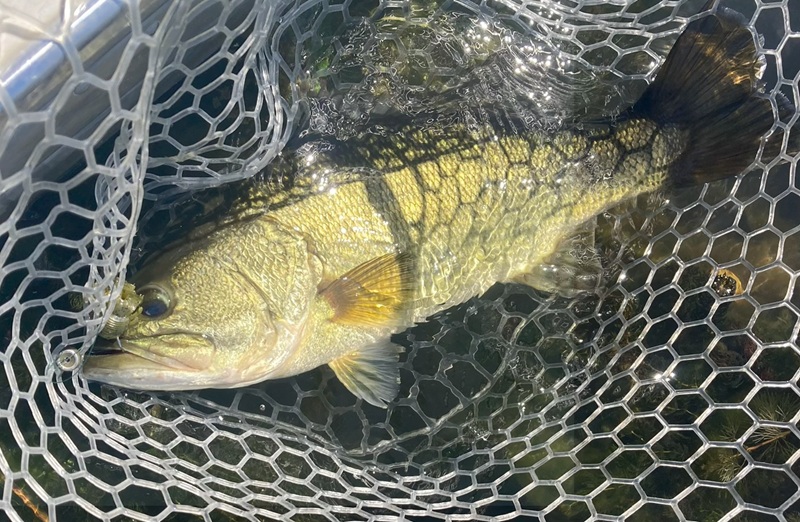
A largemouth bass rests in a landing net.
California Department of Fish and Wildlife
NEVADA COUNTY – A virus capable of killing large bass has been confirmed in California for the first time after a September fish die-off at Lake of the Pines, prompting state wildlife officials to urge anglers to clean their equipment and avoid moving fish between waters.
The California Department of Fish and Wildlife announced November 12 that its Fish Health Lab confirmed largemouth bass virus in largemouth bass and bluegill from the private, 232-acre Nevada County lake. About 220 fish died, mostly largemouth bass.
For anglers who travel between lakes, the immediate response is to prevent fish, leftover water, bait, and dirty equipment from carrying the infection elsewhere. The department is asking people to take precautions at every waterbody while it investigates the virus’s distribution in California.
How the Virus Affects Fish
Largemouth bass virus belongs to a group called ranaviruses. Fish can carry it while appearing healthy, and infection can spread through water, contact between fish, or eating infected prey, according to the department’s fact sheet. Smallmouth bass can also develop disease; spotted bass, bluegill, and crappie can carry the virus with few or no outward signs.
An affected bass may become sluggish, develop sores, or struggle to swim below the surface. One characteristic injury is an overinflated swim bladder, the internal sac that helps a fish control its buoyancy. The American Fisheries Society’s fish-health guide describes diseased fish swimming near the surface and losing their balance. Laboratory testing is needed to identify the infection because other diseases can produce similar signs.
CDFW says outbreaks typically run for days or weeks, while the loss of larger bass can affect fishing for years. Survivors can develop resistance and populations can recover. The department reports no available treatment or vaccine.
CDFW says the virus poses no risk to people or other warm-blooded animals, including through eating bass or swimming. Fish should still be cooked to at least 145 degrees Fahrenheit to prevent other foodborne illnesses.
What Anglers Can Do
CDFW’s advice applies to boats, fishing tackle, and other recreational gear that touches water or mud. Its recommendations are to:
Drain bait tanks, bilges, livewells, and other compartments before leaving.
Rinse, clean, or dry wet or muddy gear before leaving. Wash it with hot water and let it dry thoroughly before using it in another waterbody.
Leave fish in the waterbody where they were caught unless taking them for immediate consumption. That guidance covers live fish, dead fish, and fish parts.
Clean harvested fish at the waterbody or at home, putting scraps in the trash.
Put unused bait in the trash.
Handle fish intended for release gently.
To reduce stress on released fish, especially in warm water, the Minnesota Department of Natural Resources recommends tackle that lands fish quickly, prompt release, and adequate aeration when livewells are used. It also recommends scheduling tournaments during cooler conditions.
What Other Outbreaks Show
The virus’s documented history reaches back to fish collected from Lake Weir, Florida, in 1991. A 2002 study genetically matched that earlier virus with one recovered after a 1995 die-off at South Carolina’s Santee-Cooper Reservoir, establishing that the Florida finding preceded the better-known outbreak.
The Santee-Cooper event killed about 1,000 largemouth bass, according to the Northeast Black Bass Technical Committee’s 2006 report. It was the first reported fish kill attributed to the virus.
Texas later experienced losses at two prominent bass fisheries. A study by Texas Parks and Wildlife Department biologists reported an estimated 1,800 bass deaths at Sam Rayburn Reservoir in 1998 and 4,800 at Lake Fork in 1999.
Tournament records showed smaller leading fish after the outbreak. In a 2004 account on the Texas department’s website, records kept by Sam Rayburn guide Will Kirkpatrick showed that the top 80 bass weighed on each day of an annual three-day tournament averaged 6.87 pounds over the four years before the outbreak. The average fell to 4.80 pounds in 2001, then climbed to 6.07 pounds in 2003.
Longer-term surveys gave a more encouraging picture of overall fishing success. The Texas biologists’ 2006 study compared the number of largemouth bass caught per hour before and after the outbreaks, using angler surveys from 1991 through 2004. Those catch rates held up at both reservoirs, and the researchers judged prolonged adverse effects unlikely.
Pennsylvania’s experience showed that young smallmouth bass are vulnerable, too. Repeated die-offs began in the Susquehanna and other rivers in 2005. A 2018 laboratory study found that the virus could kill young smallmouth bass, with warmer water and an additional bacterial infection making the losses worse.
The Pennsylvania Fish and Boat Commission’s 2018 assessment concluded that disease and pollution likely combined to cause the earlier die-offs. By then, surveys showed a rebound in adult bass numbers. The commission voted to reopen the affected stretches of the Susquehanna and Juniata rivers to spring bass fishing beginning in 2019.
In California, CDFW asks anglers to report significant largemouth bass die-offs to a regional office. The North Central Region, which serves Sierra, Nevada, Plumas, and Yuba counties, can be reached at (916) 358-2900 or R2Info@wildlife.ca.gov.