PG&E Will Pay $22 Million for Mosquito Fire
The utility admits missed repairs and skipped tests while denying fault.
5 min read
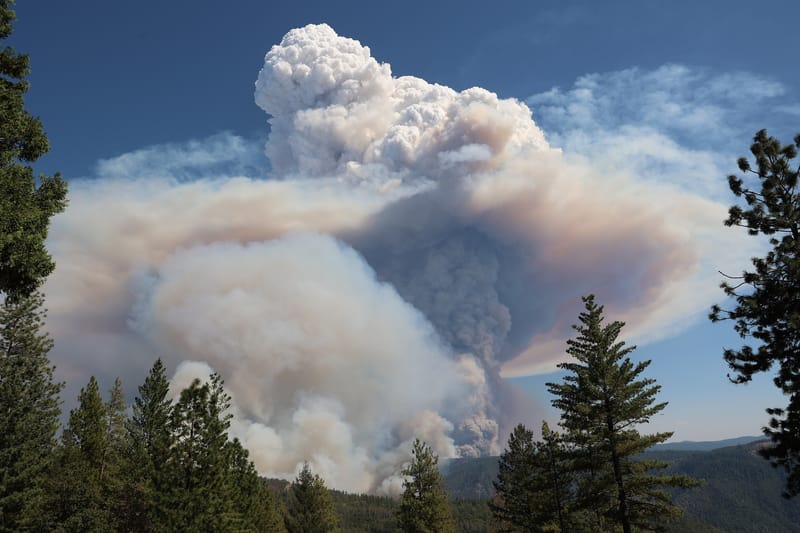
A pyrocumulonimbus cloud rises from the Mosquito Fire on September 8, 2022.
CAL FIRE
CALIFORNIA — Pacific Gas and Electric Company will pay a $22 million penalty for the 2022 Mosquito Fire, which burned 76,788 acres in Placer County and destroyed 78 structures, under a settlement the California Public Utilities Commission approved on Thursday. In the deal, the company admits its crews missed repair deadlines and went six years without required tests on two switches at the pole where state investigators say the fire most likely began. It denies the fire was its fault.
The fire’s first minutes are laid out in the investigation report of the Commission’s Safety and Enforcement Division. On the evening of September 6, 2022, crews were working to restore power to the Placer County Water Agency’s Oxbow Powerhouse, a small hydroelectric plant that had shut down that afternoon. At 6:12 PM, PG&E remotely closed Switch 47 on Pole 014/191, a transmission pole near Oxbow Junction Reservoir east of Foresthill. Three minutes later, an operator for the Northern California Power Agency, which runs the water agency’s electrical equipment, closed a circuit breaker that tripped open within a second, then closed it again with the same result. At 6:17 PM, the power agency reported to PG&E that a fire had ignited near the switch.
Division investigators concluded that electrical arcing at the lowest jumper on the pole most likely started the fire. Their report, dated July 16, 2025, stops short of a formal cause determination, because the division does not determine the cause of fires. The United States Forest Service is the lead authority on the Mosquito Fire and had not released its findings as of the division’s report. The California Department of Forestry and Fire Protection, known as CAL FIRE, still lists the cause as under investigation.
The fire forced widespread evacuations and burned for 46 days before it was declared contained on October 22, 2022, damaging 13 structures in addition to the 78 destroyed. The consent order the Commission adopted states the fire caused no injuries or fatalities. The division’s investigation report says two firefighter injuries were reported, a count it attributes to local news coverage.
PG&E’s admissions in the settlement are specific. The company acknowledged that maintenance tags were not repaired within required deadlines, that an internal miscoordination after the fire left a second pole unpreserved as evidence, and that Switches 47 and 49 at the Oxbow Junction pole went six years without required function tests. It also acknowledged that when crews regained access on September 22, 2022, the jumper on the lowest phase of Switch 47 did not appear to have proper clearance from its switch rod, though it says aerial photographs from May 2022 showed appropriate clearance and workers who visited twice in August 2022 saw no problem. Alongside each admission, PG&E noted that the tags were repaired before the fire, the unpreserved pole was not involved in the ignition, and the switches had operated properly in the weeks before the blaze.
The two allegations PG&E still disputes involve its Transmission Centralized Inspection Review Team, an internal group with the power to cancel repairs that field inspectors recommend. The division alleged the team cancelled six repair orders in the Oxbow Junction area without adequate justification and left three loose tie wires unrepaired. PG&E says the team documented its reasons and the wires were either fixed or did not need fixing. Rather than litigate, the two sides wrote the answer into the settlement: PG&E will spend up to $1 million on an outside review of how the team works, with a report due within a year of the reviewer’s hiring. The consent order specifies the review “is not related to the ignition of the Mosquito Fire,” and the division kept the right to open a new enforcement case after reading it.
The other $21 million is a fine, paid from shareholder funds into the General Fund of the State of California, the state’s main operating account. The settlement directs no money to people who lost homes; by comparison, the Dixie Fire settlement the resolution cites included a $2.5 million payment to tribes impacted by that blaze. Any part of the $1 million the review does not use goes to the General Fund as well. PG&E must pay within 30 days after the decision becomes final and no longer subject to appeal, a clock that starts later than Thursday’s vote.
The settlement is an administrative consent order, a streamlined tool the Commission created in November 2020 so staff could resolve enforcement cases without citations or the years a formal investigation can take. Commissioners must still vote to give it force, which they did Thursday. The draft circulated for a 30-day public comment period, and no comments came in.
“Having personally experienced the fear and uncertainty of evacuating during the Eaton Fire, I know that wildfire safety is not an abstract issue, it is about protecting people, homes, and communities,” Commissioner Christine Harada said in a statement announcing the vote. “This Resolution holds PG&E accountable while requiring an independent review of its inspection and maintenance practices.”
The $22 million is smaller than what PG&E has paid over other recent fires, comparisons the resolution itself draws. The Zogg Fire, which killed four people in Shasta County in 2020, cost the company $150 million. The Kincade Fire of 2019 cost $125 million, and the Dixie Fire of 2021, which burned nearly a million acres, cost $45 million. In each of those cases, the resolution recounts how the fire started at PG&E lines; the cause of the Mosquito Fire remains officially undetermined. In setting the amount, the division also weighed PG&E’s finances, including credit ratings below investment grade and a stock valuation well below its utility peers.
Thursday’s resolution closes the division’s Mosquito Fire case in full. The settlement cannot be used as evidence of fault in any other proceeding, including any future request by PG&E to recover fire costs from customers, and it sets no precedent for other cases.