Fish and Wildlife Plans to Collar More Deer, Elk, and Wolves
CDFW to enhance wildlife tracking with helicopter collaring of deer, elk, and wolves.
3 min read
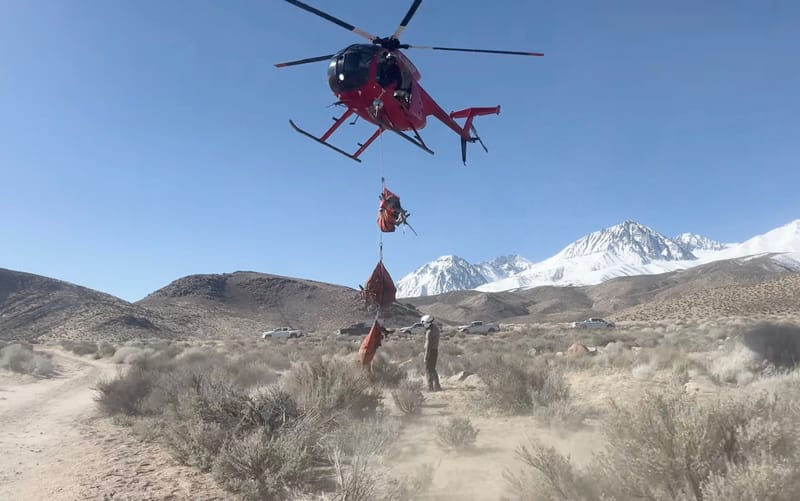
The CDFW transports captured mule deer by helicopter during a collaring effort earlier this year. Credit: CDFW.
CALIFORNIA — The California Department of Fish and Wildlife (CDFW) announced on Monday a new initiative to capture deer, elk, and gray wolves using helicopters in northern California. Crews will fit the animals with GPS collars during operations scheduled for January 2026. The effort aims to enhance scientific understanding of wildlife movements while addressing concerns about wolf-livestock interactions in rural areas.
Helicopter captures involve spotting target animals from the air, followed by the use of a net gun to safely entangle and bring them to the ground. Biologists then approach the immobilized animal, potentially sedate it, and fit a satellite-enabled GPS collar around its neck, perform brief health assessments and sample collections, and release it near the capture site. Captured wolves receive relocation to the nearest suitable public land habitat if necessary. This method, widely employed in wildlife management across North America, intends to minimize stress and injury compared to ground-based trapping.
The GPS collars transmit location data to CDFW scientists on a daily basis for up to three years. Researchers use the information to study habitat preferences, migration patterns, population dynamics, and survival rates. For gray wolves in particular, location data automatically feeds into an online mapping tool that provides approximate wolf positions to livestock producers, enabling proactive measures to reduce conflicts. The collars do not provide real-time tracking.
Gray wolves began naturally recolonizing California in the early 2010s, primarily dispersing from Oregon. As of late 2025, the state hosts ten confirmed packs, including the Diamond pack in Plumas and Lassen counties, the Grizzly pack in Plumas County, and others spanning nearby regions. CDFW monitors the population through public reports, camera traps, and GPS collars, with the species listed as endangered under both state and federal law, although efforts are underway to delist it federally.
This latest helicopter program builds directly on prior collaring operations. In January 2025, CDFW crews captured and collared 12 gray wolves across several northern counties using similar aerial methods, marking a significant expansion of tracking efforts at the time. Earlier initiatives in 2023 also employed helicopter net-gunning for wolves, elk, and deer in northeastern California.
Operations will occur on public lands managed by CDFW, the U.S. Forest Service, and the Bureau of Land Management, as well as private properties with owner permission. The targeted wolf capture areas include Siskiyou, Lassen, and Tehama counties, with potential efforts extending to uncollared groups in Plumas, Modoc, and Shasta counties. Although the Sierra Valley used to be a stronghold of wolf activity and livestock depredations, members of the Beyem Seyo pack operating in the region were euthanized in October, and the pack is no longer active.