Katie's Sightings
3 min read
A Little Lakes Basin Geology
 Glacial Polish and the Sierra ButtesGeology isn't something that grabs my interest even though it surrounds me! I guess I prefer to study living organisms! However, I often see evidence of glacial polish when I'm hiking in the Lakes Basin. So I did a little research and here's what I learned.
The following information is from the website hikemtshasta.com.
"In a broad perspective, the northern Sierra Nevada can roughly be defined as that part of the Sierra Nevada that begins at Carson Pass, includes the Lake Tahoe Basin and continues north 120 miles to Lake Almanor. Compared to the parts of the Sierra Nevada that lie further to the south, this area is typically more subdued and less wild than the vast wilderness of jagged mountains that is the signature of California’s signature mountain range. While there are some fantastic mountains around Lake Tahoe, the subdued trend becomes more evident the further north you go. Despite this, the Lakes Basin area appears to be an island of craggy, glacially carved terrain. It is surrounded by decidedly less rocky, less rugged mountains in nearly every direction.
Geologically the area is something of an island as well. Most of the exposed rock in the Lakes Basin area is composed of quartz porphyry. This is situated between an extensive area of marine sediment to the west and a large granite pluton to the east. The confused geologic structure of this area is common in the northern Sierra Nevada. Rather than consisting of a single granite pluton like most of the range to the south, the mountains in this region are a seemingly random mixture of a variety of rock types. In spite of this, the composition of the cliffs at the Lake Basin area are distinct, with few other examples of it anywhere nearby. It is the quartz porphyry that gives the cliffs their white to pink range of colors and the area’s visual distinctiveness."
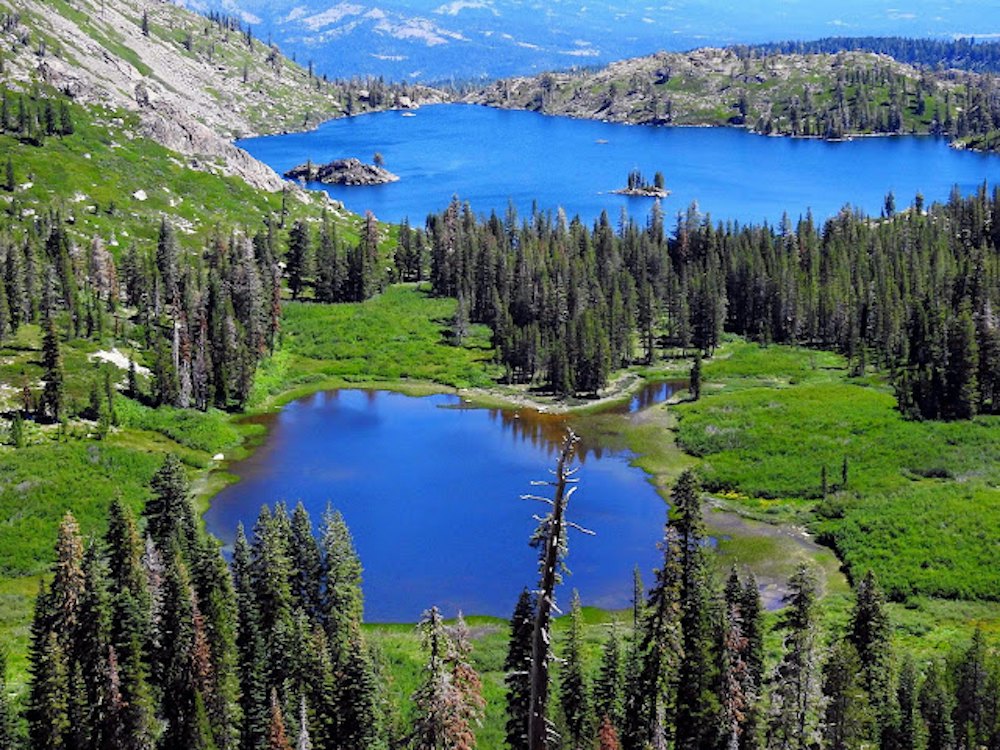
Mud Lake (foreground) - Long Lake (background)
"Strictly speaking, the Lakes Basin proper lies at the northern end of this glaciated area, focused on the basin containing Long Lake. However, the area is geologically cohesive and glaciation and lakes abound, making the name Lakes Basin appropriate to the whole area. In total, there are 6 primary lakes basins here. From north to south, these are the Jamison, Lakes Basin (proper), Gold Lake, Salmon Lake, Packer Lake and the Sardine Lake basins. Worth noting, the Lakes Basin proper, which is around Long Lake, is the centerpiece of the Lakes Basin Recreation Area."
There are approximately 50 lakes in the Lakes Basin, and I've hiked to 46 of them! They range from clear, rock-bound lakes, to murky pond-like lakes. Each one is unique and beautiful! Not all of them are named, so we sometimes create our own names for them! One lake was bone-dry when we first encountered it, so we named it "Not a Drop Lake". We've been back to that lake, and even swam in it, since then! Unfortunately, I can't show you a photo of it as my new computer doesn't have a CD reader. RATS! Here's a collection of photos of some of the Lakes Basin lakes I've visited this past summer!
 Big Bear Lake
 Long Lake
 Round Lake
 Veronica Lake
 Upper Tamarack Lake
 Un-named Lake