Katie's Sightings
3 min read
North Yuba River Happenings!
 River Otter (Lontra canadensis) Tracks
One morning this week, I drove down Hwy 49 to see what all the recent rain had changed. After several stops with views of the fast flowing North Yuba River, I decided to hike on a trail that paralleled the river. It had been a few days since the heavy rains, and the river had slowed down and cleared to a beautiful clear, glass green. As I hiked along the trail, to my delight I spotted two River Otters swimming and hunting in the shallow water along the distant shoreline!!! They were moving quickly downriver, so I ran down the trail with hopes of getting some photos as they swam past. I waited for about 15 seconds and they indeed showed up, but there were THREE of them! WOW!!! Luckily I got a few photos as they sped past! Two of them definitely stuck together, with the third one following at a short distance behind the pair.
 Northern River Otter - Lontra canadensis
The information I've found about Northern River Otters on the internet varies quite a bit from site to site. Here's a summary of what I've learned, but please don't take it as 100% accurate!
• Typically, but not always, if you see a group of Northern River Otters it is the female and her offspring, or a group of adult males. However, a group of otters could also be a family unit, including the male!
• Offspring are usually born in March or April. Breeding may have taken place as long as 9 or 11 months before then. Females can delay the implantation of embryos, so that their birth occurs in the Spring! Once the embryo is implanted, the gestation period is 60 days.
• The den where the pups were born was probably underground in an old riverside Beaver or Muskrat den, or in a hollow tree near water. The den may or may not have had several tunnels, with one tunnel having an underwater entrance. (Apparently otter dens vary considerably!)
• Usually the female raises 1-6 pups on her own, without the help of the male. After two months, the pups begin to learn how to hunt and swim. In four months they are weaned and can feed themselves. At this point, the male may return to the family group, which will stay together for another 6-8 months, or until another litter is born.
• A Northern River Otter's tail is highly muscular and comprises up to 40 percent of the otter's total body length (3-5 feet). With the tail's strong, undulating movement, a river otter propels itself through the water at 6-8 miles per hour and can easily dive to up 60 feet.
• Male Northern River Otters are usually not territorial with each other, and are often quite social. They can also be quite solitary. Both male and female youths and adults, are quite playful and are frequently seen chasing each other, sliding down riverbanks, or burrowing through snow.
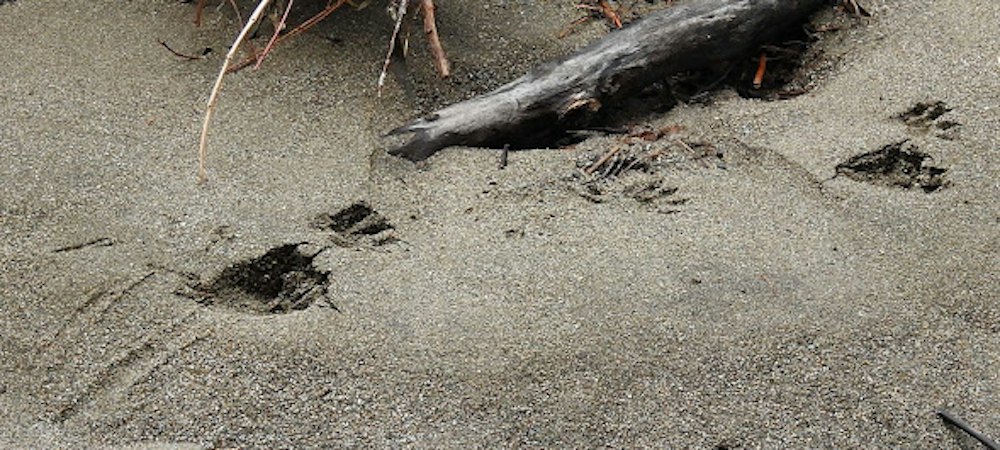
Later the same day, I went on a different walk with my husband seven miles upriver from where I saw the otters. To my surprise I found fresh River Otte0r Tracks in the newly "washed" sand, left after the recent high water. I would almost bet that it was one of the Otters I had seen. We don't have a large population of Otters. Three Otters would probably be a healthy population for a 30-50 mile stretch of the river.