Katie's Sightings
3 min read
It's HOT out there!
 Black Bear - Ursus americanus
It's been really HOT this past week, with temps in the high 90's and low 100's! It was way too hot for us, and made me wonder how wildlife copes with excessive heat. Here's what I've learned!
The bear in the photo above, looks like it's taking advantage of a sprinkler! The truth is, it wasn't really in the sprinkler's reach, and was just eating fallen cherries off the ground! It was such a "cool" photo, I couldn't resist putting it in my blog! The way that most mammals really deal with the heat is by being active at night. During a hot day, they remain inactive in the shade. If a Black Bear is active during the day, its thick coat of hair can insulate it somewhat from the heat.
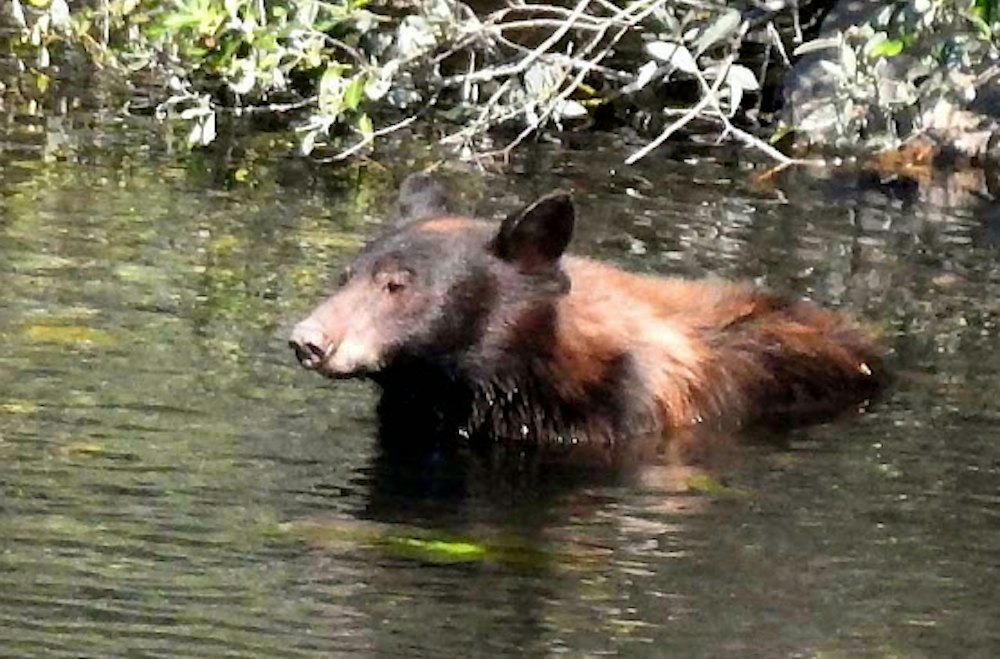
However, if it stays out in the sun too long a Black Bear can indeed overheat. To cool off, it will retreat to the shade, possibly stretch out and lie down on its sparsely furred belly to cool off, drink from a water source, or even wade in a river! I spotted this Black Bear lying in the river a few years ago! It was a super HOT day, and the bear was taking advantage of the cool river water. It stayed in place in the river for the entire five minutes I watched it from a distance!
 Columbian Black-tailed Deer - Odocoileus hemionus columbianus
Some mammals, including deer, will head for the water to cool off during a heat wave as well. Occasionally I'll see deer in the river during the summer. Sometimes they are crossing the river, sometimes they're just walking along the edge of it. I have often thought that it's a way to travel without leaving a track. I've never seen them lying down in the river like the bear pictured above, but I'm sure it cools them off!
 Northwestern Fence Lizard - unknown frog
Sceloperus occidentalis occidentalis - sp.?
 Northern Pacific Rattlesnake - Crotalus oreganus oreganus
Herptiles (amphibians and reptiles) are ectotherms, and are dependent on external sources to maintain their body heat. To regulate their body heat they will bask in the sun when it's cool, and hide in the shade when it's too hot. It turns out that extremely hot temperatures can kill a snake within 10-20 minutes. So when the air temperature reaches the high 90's and into the 100's, reptiles seek out shade and wait for the temperature to drop. Reptiles like lizards and snakes might burrow underground or move under a rock or log. Amphibians will stay in water or damp mud to keep from drying out.
So wildlife has a variety of ways to beat-the-heat!
Myself, I headed up to the Lakes Basin to cool-off in the higher elevation lakes!
Your questions and comments are appreciated. Please feel free to email me at northyubanaturalist@gmail.com. Thanks!