Katie's Sightings
4 min read
Small Mammals
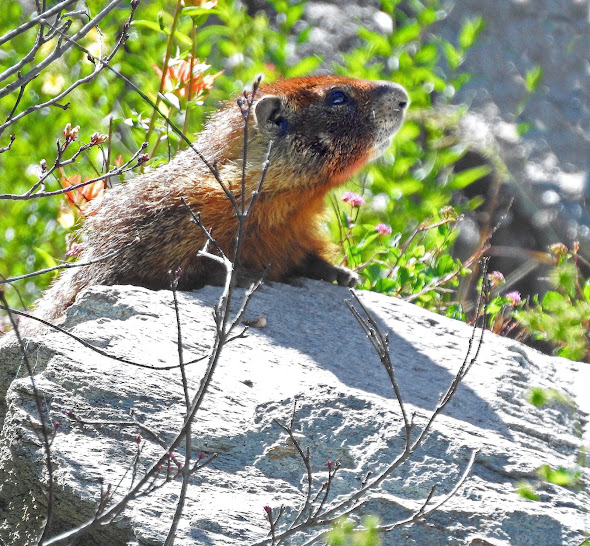
I lucked out this week and spotted a Yellow-bellied Marmot near 8,000' in elevation! It was in one of the wildflower-covered, rocky slopes in the Lakes Basin. We were able to watch it for a minute or more until it backed off the boulder it was on, and disappeared into the bushes. How cool!!! I don't see Marmots very often, and this is the first one I've seen this year!
Yellow-bellied Marmots are the most common large rodent in the Sierra, and generally live underneath rocky talus slopes from 5,400' to 14,000' near vegetated meadows. They can often be seen perched on a boulder. If threatened, they make a very loud chirp that you can hear from quite a distance. The main predators of Marmots are coyotes, followed by badgers, martens, bears, and Golden Eagles.
Most marmots reside in underground colonies of about ten to twenty individuals, consisting of males, females, and their offspring. Their underground tunnels have many side passages, in which they raise their young, hibernate, and hide from predators. There is only one breeding season per year, which starts two weeks after they wake up from hibernation. The males mate with up to four females in a season. The females give birth to 4-5 pups, after a 30 day gestation period. The pups are born in April or early May, and are blind and naked at birth. Within two months they are weaned and can forage for food, consisting of plant material, insects, and bird eggs.
The young marmots remain with their mother until the following summer, even hibernating with her. Marmots hibernate for approximately eight months starting in September and lasting till May. In the Fall, they put on a layer of fat that sustains them through hibernation. During hibernation, young marmots will lose up to 50% of their body fat! The male of the harem drives out the male offspring upon their awakening from hibernation. Female offspring are allowed to remain in the harem. The young males then dig their own burrows and start looking for female mates to start their own harem.
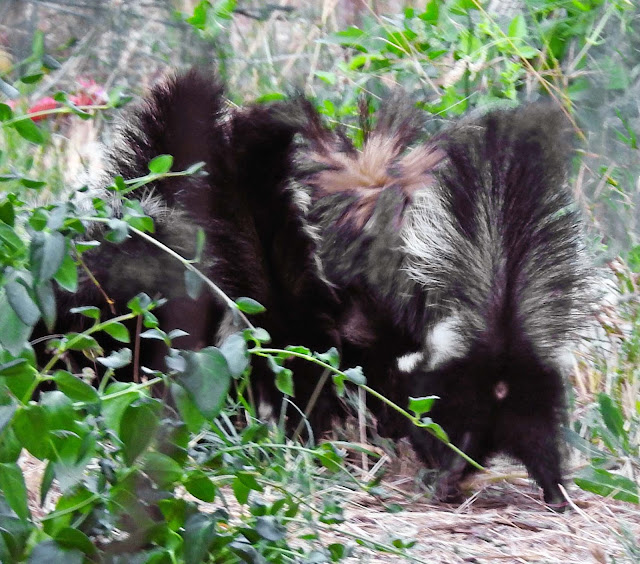
Early one evening, I saw an adult female skunk with three young skunks in our kitchen yard! The light was fading and they moved quickly, so I didn't get a great photo. I haven't seen young skunks before, and they were so cute!!! However, I didn't get close!
If a skunk raises its tail, it's time to beat a hasty retreat! The highly potent musk of skunks, keeps most predators away! When approached by a predator, they raise their tail, then they stamp their front feet vigorously and hiss and growl. If those actions don't deter the predator, they will quickly present their hind end and spray musk. They can spray up to 12 feet away, with accuracy! Most predators don't come back a second time, once they've been sprayed!
Skunks live in dens year-round. They have been known to make their dens under woodpiles, buildings, concrete slabs, and rock piles. Their dens have also been found in hallow trees, rock crevices, and abandoned ground-squirrel and fox dens! Skunks use their dens year-round. Skunks will often share a den with other skunks. They don't hibernate, but go into a state of torpor, in which their body temperature drops and they fall into a deep sleep. To stay warm during winter weather they plug the entrance to their den with dry leaves and grass.
Striped Skunks breed from February through April. Males will mate with several females. Once mating has occurred, the males are not welcomed by the females. The gestation period is 59 to 77 days. Sometime in May, the females give birth to a litter of 4-7 kits. After 6-8 weeks they are weaned, and begin to hunt with their mother! By July or August, young males begin to disperse and become independent. Their sisters will typically remain with their mother for almost a year.
Skunks have poor eyesight, but like many nocturnal animals they have highly developed senses of hearing, touch, and smell. They are omnivores, and eat mice, gophers, voles, rats, birds & eggs, beetles, beetle larvae, caterpillars, fruit, nuts, carrion, bird seed, some garden produce, and even pet food!