Katie's Sightings
4 min read
Butterflies & Moths!
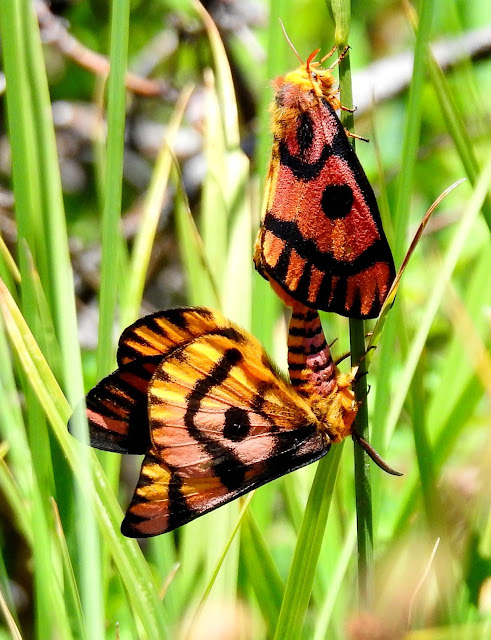
We came across this pair of of Common Sheep Moths mating in the Lakes Basin this week, around 7,500' in elevation! I've never seen these beautiful moths before, and their coloring was exquisite! They were fairly large, with a wingspan of about 3". We watched them for a good 5 minutes and they were still mating when we left! Here's what butterfliesandmoths.org has posted about them.
"Adults emerge in early morning and mate in late morning. Females lay eggs in rings on plant stems. Eggs overwinter and hatch in April and May. Young caterpillars feed together in groups and when they are older they feed alone. Fully-grown caterpillars pupate in loose cocoons in the leaf litter or in burrows in soft soil, and adults emerge from July-September. At high elevations and northern latitudes, 2 years are needed to complete development. The cocoons overwinter and in the spring the adults emerge and start the cycle again. Caterpillar Hosts: Mountain lilac (Ceanothus), mountain-mahogany (Cercocarpus montanus), bitter cherry (Prunus emarginata), bitterbrush (Purshia tridentata), snowberry (Symphoricarpos), currant (Ribes), wild rose (Rosa), willow (Salix) and others. Adult Food: Adults do not feed. Habitat: From sea level to at least 8400 feet in a variety of habitats including chaparral, pine and redwood forests, oak woodlands, and riparian areas."
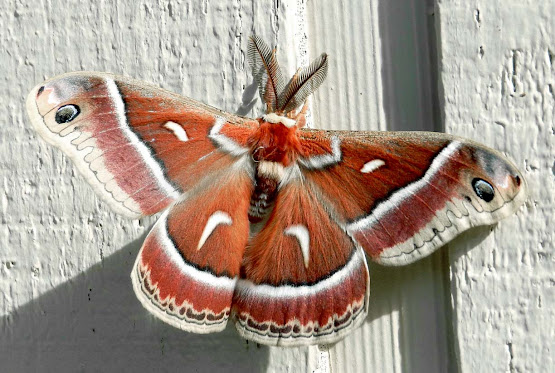
Another local moth that I've seen in the past is the large Ceanothus Silk Moth. These gorgeous adult moths are large, with a wingspan of 3.5"-5"! As adults, their primary purpose is to reproduce, and do not feed. After mating and laying eggs the adults soon die. Again, here's what butterfliesandmoths.org has posted about them.
"Life History: Females glue eggs singly or in clumps on leaves of the host plant. The eggs hatch in 9-14 days and the caterpillars eat leaves. The cocoon is spun in the outer part of the host plant and is attached to a twig by only one-half its length.Caterpillar Hosts: A wide range of plants including buckbrush (Ceanothus), manzanita (Arctostaphylos), gooseberry (Ribes), madrone (Arbutus menziesii), willows (Salix), alder (Alnus), and mountain mahogany (Cercocarpus betuloides). Adult Food: Adults do not feed. Habitat: A wide variety of habitats including coastal areas, chaparral, and conifer forests."
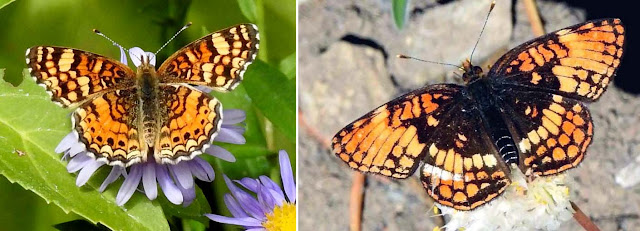
There are many butterflies fliting around the Lakes Basin. They differ from moths in many ways. Here are the basic differences:
Butterfly vs. Moth
wings usually open at rest - wings usually closed at rest
usually diurnal - usually nocturnal
usually brightly colored - usually dully colored
usually have clubbed antennae - usually have "feathered" antennae
Adult butterflies spend most of their time searching for mates, laying eggs, feeding and resting. Males either search for mates or perch and wait for females to fly by. If another male comes near a perched male, they will often engage in an upward spiraling flight, after which the "intruder" usually leaves. If a female flies by, of the same species, the perched male will force the female to the ground to mate. Another method of perching is known as "hill-topping".
Wikipedia states: "Males of many butterfly species may be found flying up to and staying on a hilltop - for days on end if necessary. Females, desirous of mating, fly up the hill. Males dash around the top, competing for the best part of the area - usually the very top; as the male with the best territory at the top of the hill would have the best chance of mating with the occasional female, who knows the "top male" must be strong and thus genetically fit. Studies have shown that even slight elevation differences on flat terrain can trigger hill-topping behavior. Flowering or tall trees may induce hill-topping behavior."
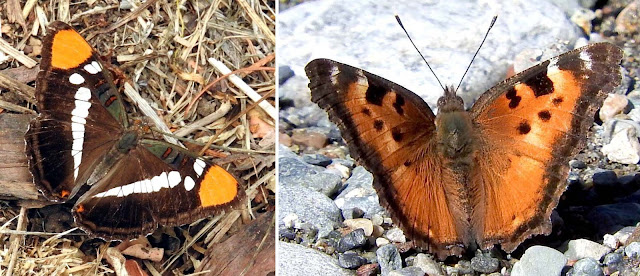
Wikipedia also states, "Butterflies have "complete" life cycles, with four different stages: egg, caterpillar (larva), chrysalis (pupa), and adult. The entire life cycle, from the deposition of the egg to the emergence of the adult, usually takes about a month for most butterflies.