Night Sky
1 min read
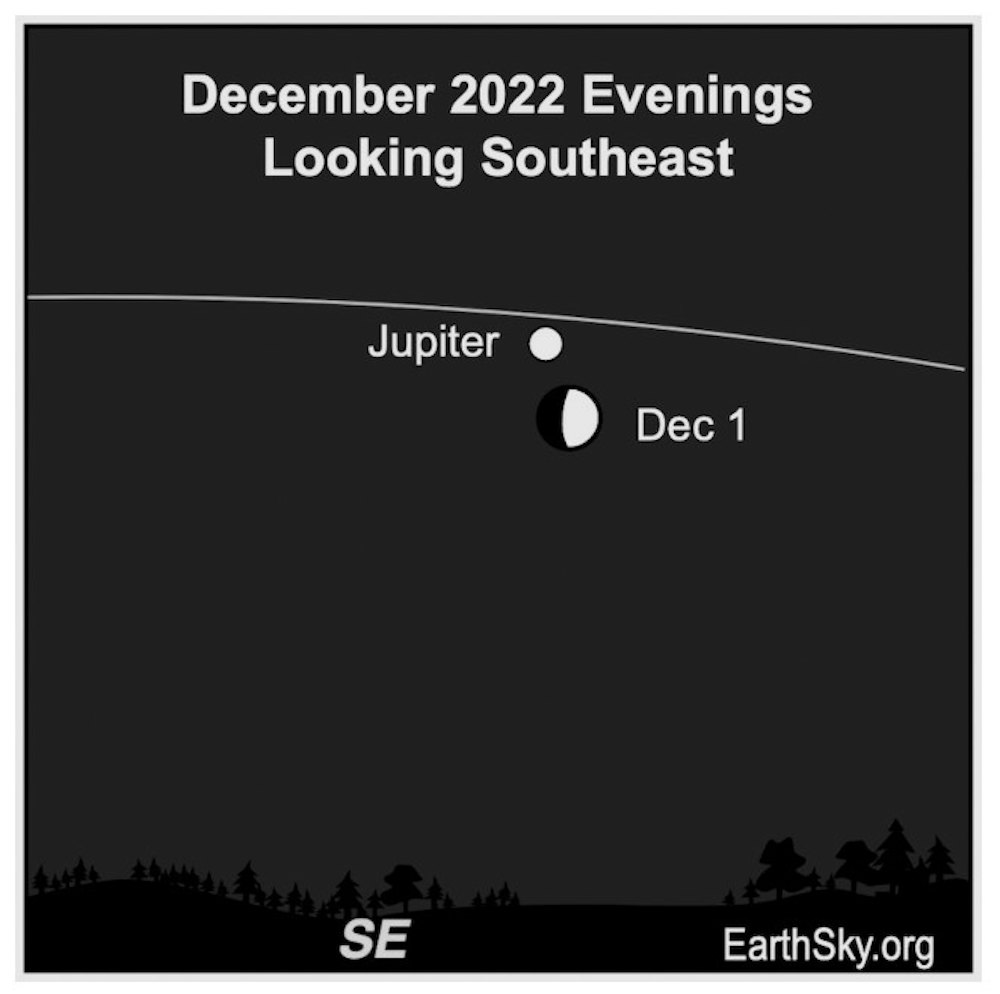
Jupiter Conjunct Moon, December 1
Jupiter, containing over twice as much matter as all of the other planets combined, is the most massive planet within our solar system. Unlike earth, it is composed mostly of liquid and gaseous hydrogen and it lacks a solid surface. Orbiting the sun roughly five times as far away as the earth, despite its size, this "gas giant" spins very quickly and makes a complete revolution in slightly less than 10 hours. Jupiter takes twelve years, however, to circle the sun.
For the ancient Greeks, Zeus, the king of their immortal gods was equated with Jupiter. The Romans, as well, considered Jupiter to be the chief of all their gods, a power maintaining his power with thunderbolts while being a protector of the mortals who provided him with tributes.
At the moment, in Jupiter's journey around the sun, the moon and Jupiter will appear close to one another after sunset in the southern sky. Shortly after midnight the the duo will set in the western horizon. Tomorrow night, however, Jupiter will lead the way over the horizon as the two orbs separate.