Sierra County Board Receives Overview of Drought Resilience Plan
The presentation detailed local water system vulnerabilities, emergency responses, and long-term mitigation strategies.
3 min read
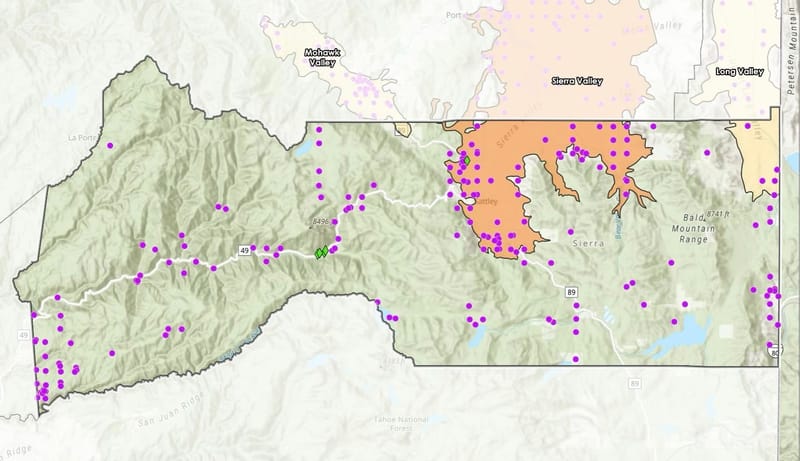
Locations of domestic wells (purple dots) and state small water systems (green diamonds) in Sierra County. Credit: Sierra County Drought Resilience Plan.
SIERRA COUNTY — Neil Stewart, of Stantec, an engineering services company, presented an overview of the Sierra County Drought Resilience Plan to the Board of Supervisors on March 17. Stewart works as a water resource engineer and served as the county lead for the plan prepared with support from the California Department of Water Resources. The presentation covered the plan’s purpose, key findings, and next steps.
The plan meets the requirements of Senate Bill 552 for improved water supply reliability in small and rural communities. It establishes a Drought and Water Shortage Task Force and identifies risks along with proposed solutions for state small water systems and domestic wells. Sierra County added coverage for small spring-fed systems prevalent in the area. The effort focuses on shortages caused by drought and by non-drought hazards such as wildfires, earthquakes, floods, extended power outages, and water quality issues.
State small water systems provide piped water to at least five but no more than 14 service connections. Domestic wells supply water to no more than four connections. The plan applies only to these systems and does not cover larger municipal supplies. Senate Bill 552 directed counties to address vulnerabilities in these specific systems, following earlier laws such as Assembly Bill 1668 and Senate Bill 606 that highlighted gaps in planning for small suppliers.
The Drought and Water Shortage Task Force includes members from county departments, including the Office of Emergency Services, Environmental Health, Planning and Building, and Public Works and Roads. Other participants come from the City of Loyalton, the Sierra Valley Groundwater Management District, the State Water Resources Control Board, a domestic well owner, and a state small water system representative. The task force met four times during plan development and will convene at least annually to review water supply conditions. The group makes recommendations to the Board of Supervisors but holds no decision-making authority.
The risk assessment found no widespread historic water shortages in Sierra County. Elevated vulnerability is evident in the communities of Calpine, Pike, and Verdi, along the North Yuba River, and in rural areas of the Sierra Valley Groundwater Basin near Sierraville and Loyalton. Isolated domestic well users outside these zones also face risks. Key drivers include high density of domestic wells, very high wildfire hazard ratings across much of the county, and water quality concerns in some locations. The full assessment used a Department of Water Resources tool and incorporated local input.
Short-term response actions aim to deliver emergency and interim drinking water supplies during shortages. Examples include distributing packaged or bottled water, trucking supplies to affected areas, and establishing water-filling stations. Some actions can be taken immediately, while others need additional resources such as pre-negotiated contracts or extra funding. The county will maintain an annual process to assess the health of the relevant systems’ water supplies.
Long-term mitigation strategies emphasize communication and outreach to help residents improve their own water supply reliability. A dedicated website provides resources, educational materials on groundwater monitoring and water quality fixes, and county contact information. The plan supports community-initiated consolidation opportunities and helps ensure the small systems are factored into broader county planning documents, such as hazard mitigation updates. Additional resources could expand direct assistance, like enhanced monitoring or treatment programs.
Implementation falls primarily to the Office of Emergency Services with support from other county departments. Annual coordination meetings and a task force review each May will track progress and conditions. The plan updates at least every five years or after significant events. The implementation roadmap assigns responsibilities, priorities, and notes resource needs for many actions. County staff may seek additional funding to fully carry out the strategies.
The full Sierra County Drought Resilience Plan is available on the county website at sierracounty.ca.gov/830/Drought-Task-Force, along with related documents and contact details. A supervisor suggested the presentation materials could also benefit the City of Loyalton Council. Stewart agreed to prepare slides for county staff to share if requested before the end of March.