Sierra County Sheriff, District Attorney Oppose Newsom’s Clemency Plan
Newsom would replace California’s 548 death sentences with life without parole.
6 min read
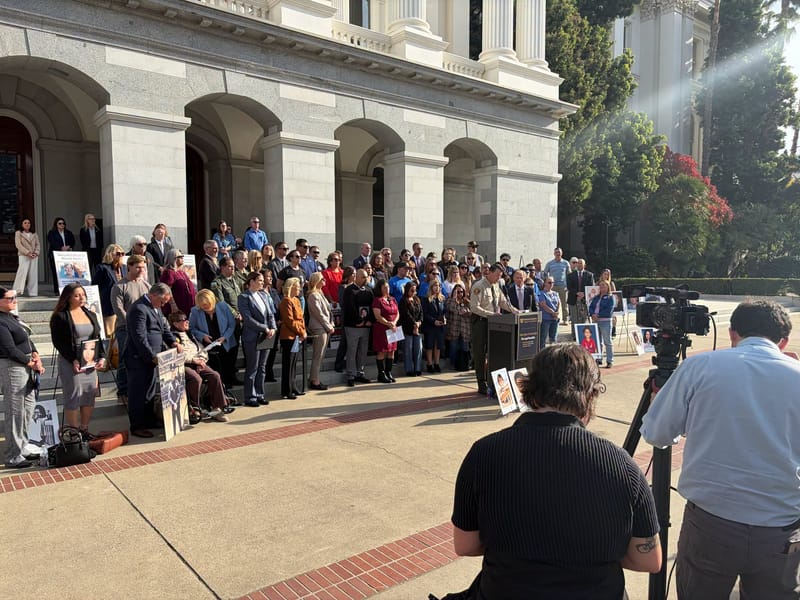
Victims’ families and law enforcement officials gather at the State Capitol in Sacramento on November 12 to oppose the proposed death sentence commutations. Sierra County Sheriff Mike Fisher and District Attorney Sandra Groven attended the rally.
Sierra County Sheriff’s Office
DOWNIEVILLE – Sierra County Sheriff Mike Fisher and District Attorney Sandra Groven oppose a plan Governor Gavin Newsom announced November 5 to replace California’s 548 death sentences with life in prison without parole. In a joint statement posted November 18 on the Sheriff’s Office Facebook page, they said juries had weighed the evidence in each case before deciding that death was the appropriate penalty.
“For one elected official to disregard those decisions and the will of California voters is deeply troubling,” Fisher wrote. He and Groven joined other sheriffs, prosecutors, and victims’ families at a November 12 rally at the State Capitol in Sacramento. Survivors and relatives spoke about how the crimes had changed their lives, the two officials said.
Fisher and Groven cited the 2016 vote on Proposition 62, which would have abolished California’s death penalty and converted existing death sentences to life in prison without parole. Sierra County voters rejected the measure by 1,223 votes to 572. Statewide, 53.2 percent voted against it.
Other Northern California sheriffs made their own appeals to Newsom. Tehama County Sheriff Dave Kain wrote to the governor opposing all 548 proposed sentence changes. Sacramento County Sheriff Jim Cooper asked Newsom to reconsider the proposed sentence change for Luis Bracamontes, who murdered Sacramento County Deputy Danny Oliver and Placer County Detective Michael Davis Jr. in 2014. Cooper recalled watching Bracamontes laugh in court as Oliver’s two young daughters looked on.
What a commutation would change
A commutation is a form of clemency that allows the governor to reduce a sentence after a conviction. Under Newsom’s plan, each person would serve life in prison with no eligibility for parole. The convictions would stand, as would any orders to repay victims for their losses. Groven questioned the state’s assurance that everyone would spend the rest of their lives in custody, saying that “those promises ring hollow.”
California last executed a prisoner in 2006. Newsom halted executions by executive order in 2019, leaving the death sentences in place. As of November 19, all 548 death sentences were still in effect, according to the Habeas Corpus Resource Center, a state agency that represents people sentenced to death who cannot afford a lawyer. Each sentence would change when Newsom issues a formal commutation certificate. California law would still allow prosecutors to seek the death penalty in future cases.
All of the cases on the governor’s list of intended recipients were prosecuted outside Sierra County. One is the case of Dennis Ervine, who was sentenced to death for the 1995 murder of Lassen County Sheriff’s Deputy Larry Griffith. Yuba County prosecuted Eric Houston for the 1992 murders of teacher Robert Brens and students Judy Davis, Beamon Hill, and Jason White at Lindhurst High School in Olivehurst. The California Supreme Court upheld Houston’s death sentence in 2012. White’s mother, Mary Stickle, is among the relatives asking the state Supreme Court to stop the commutations.
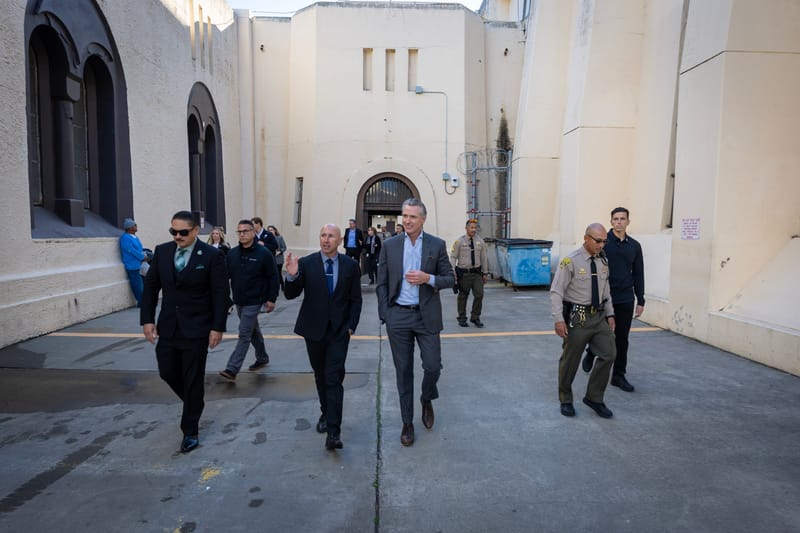
Governor Gavin Newsom visits San Quentin Rehabilitation Center on October 23 for the prison’s annual film festival.
Office of Governor Gavin Newsom
In his November 5 open letter to Californians, Newsom said he believed the state had a moral duty to forgo executions, however grave the crime. He pointed to innocent people sentenced to death and to decades of failed efforts to make the system fair. He said he had considered making exceptions based on the crime. Each family he spoke with experienced its own loss as the worst imaginable, he wrote. Choosing which prisoners to spare would, in his view, amount to ranking the lives taken.
“We can now let these offenders die in obscurity while we forever remember and honor their victims,” Newsom wrote. He acknowledged that his decision could bring back painful memories for families who disagree with him.
Should the justices recommend commuting 382 death sentences?
Newsom asked the California Supreme Court to recommend life without parole for 382 people his office identified as having more than one felony conviction. Under the state Constitution, at least four justices must recommend clemency before the governor can reduce a sentence for someone in that group. By the governor’s count, he can commute the other 166 sentences on his own. He asked the justices to make their recommendation by year’s end so he could act before leaving office.
The justices invited outside groups and individuals to submit written arguments by November 24 on the legal questions raised by the governor’s request. Newsom may answer those arguments by December 4.
Should the court block the plan to commute all 548 death sentences?
District attorneys from Yuba, Sutter, Placer, Butte, Modoc, Shasta, Tehama, and other counties joined victims’ relatives in a separate petition filed November 16 asking the justices to halt all 548 commutations. Butte County District Attorney Mike Ramsey said each family deserved to have the governor weigh the facts of its case. The families and prosecutors argue that state law requires Newsom to consider each case individually and give prosecutors advance notice so victims’ families can weigh in. They also say more than 382 people have the additional convictions that require court review.
The dispute turns in part on who must be notified before a sentence can be reduced. When someone applies for a commutation, the district attorney in the county of conviction must receive written notice at least 10 days before the governor acts. The prosecutor must make reasonable efforts to notify victims and their families, who can tell the governor whether they support or oppose the change. The petitioners say those protections apply here. In his explanation to the court, Newsom said the notice requirement applies when a prisoner asks for clemency. He said he initiated the commutations himself and would notify prosecutors and ask them to help reach victims.
In the challenge brought by families and prosecutors, Newsom and the state prison system filed a letter November 17 opposing a temporary halt to the commutations. The court gave the state until November 25 to respond to the petition and the families and prosecutors until December 4 to reply.
Why some support Newsom’s plan
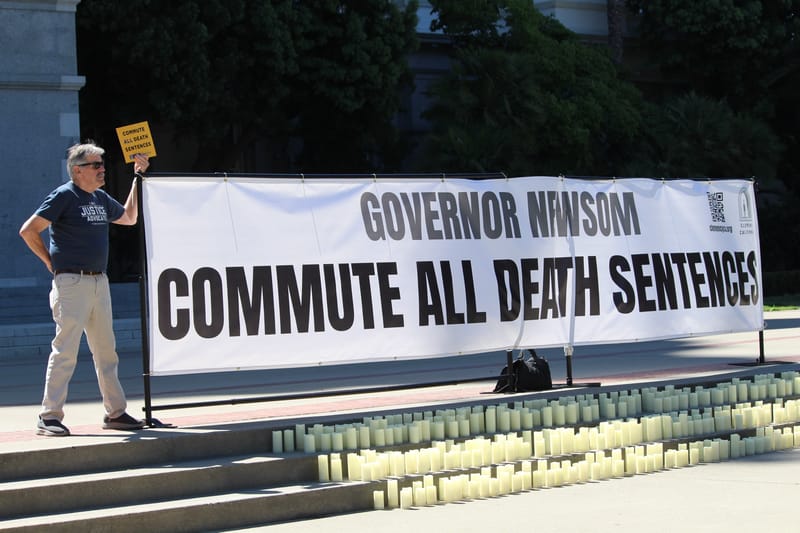
Clemency supporters lined the State Capitol steps in Sacramento with candles on June 30. Each candle represented a person under a death sentence in California.
Clemency California, Joshua Weise
Marc Klaas joined the petition to stop the commutations. His 12-year-old daughter Polly was kidnapped from her Petaluma home in 1993 and murdered. Richard Allen Davis, who was convicted of her murder, is among the 548 people whose sentences Newsom wants to change. Polly’s sister Jess Nichol supports the commutations. In a statement released by Clemency California, a campaign that urged Newsom to commute every death sentence, Nichol said she once wanted the man who killed her sister to be executed. “But over time I’ve realized that whether he’s executed has absolutely nothing to do with my recovery or with real public safety,” she said.
In the same statement, Contra Costa County District Attorney Diana Becton backed the commutations. She argued that money spent pursuing executions could pay for mental health treatment, drug intervention, and gun violence prevention. Jeanne Woodford, who oversaw four executions as warden of San Quentin State Prison, said the possibility of executing an innocent person still haunts her.