Sierra County Suspends Sixteen to One Mine’s Permit
Supervisors can lift the suspension once planners have a complete application.
5 min read
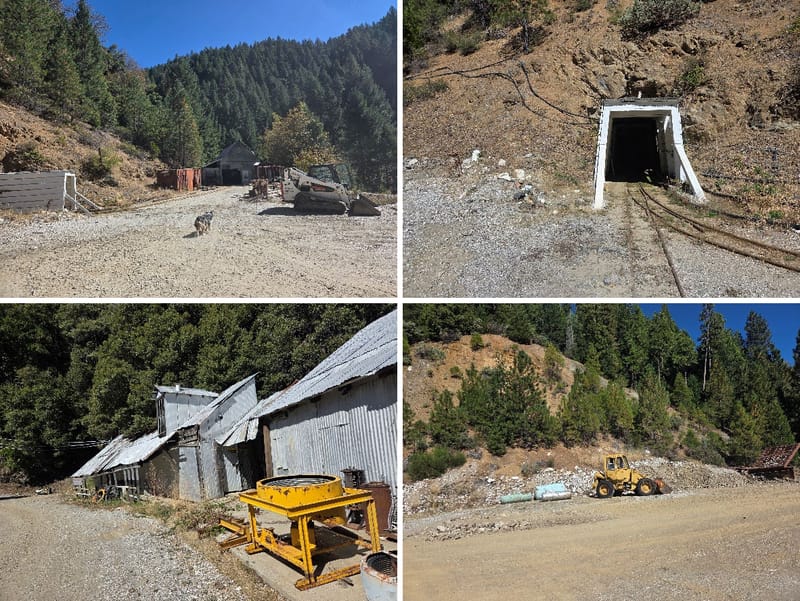
The Sixteen to One Mine in Alleghany during its September 30 inspection. Clockwise from upper left are the mine yard, tracks leading into a mine entrance, a loader beside piles of rock, and corrugated metal buildings.
DOWNIEVILLE – Sierra County supervisors voted 4–0 (Supervisor Paul Roen absent) on Tuesday, November 3, to halt mining operations at the Original Sixteen to One Mine in Alleghany. After years of permit violations at the mine, the board had twice given Quartzview Corporation more time to apply for an updated permit and explain how it would work the mine and restore the land afterward. This time, with the operator’s application still incomplete, supervisors suspended its special use permit.
Once Planning Director Brandon Pangman finds the application complete, he will bring it back to supervisors, who can then vote to let mining resume under the existing permit while the county reviews the proposed changes.
The county issued the permit in 1989, nearly a century after gold mining began at the site in 1896. By 2025 the mine had been violating permit conditions for years, and its reclamation plan no longer described all the ground the operator would have to restore. The Planning Commission recommended revocation that September. In December, supervisors gave Quartzview until July 1 to submit a complete application to update the permit and the plan.
When Quartzview missed that deadline, Supervisor Lee Adams moved to give the company another 90 days, until October 7. He warned Roger Haas, Quartzview’s chief executive, that he could lose the permit if he missed this one too. The July order limited operations to their existing level, which Pangman described as mostly cleanup. Haas wanted to hire more miners and reopen more underground workings, and he told supervisors he had a partner willing to help take the operation “from a hobby mine to a real mine.”
Vice Chair Sharon Dryden seconded the July extension. She didn’t want to derail that hiring, she told Haas, but “time is running out and our patience, I think, is wearing thin.” Asked by The Mountain Messenger about revocation on October 22 with the application still incomplete, Haas cited the five jobs at the mine and the prospect of five more: “I think that they’ll give us some more time.”
At Tuesday’s hearing, Adams told his colleagues, “I don’t want to revoke the permit, but we just can’t be going on with more extensions.” Dryden said she had been leaning toward revocation until staff offered suspension as an alternative. Staff’s draft would have kept the mine shut until the county approved a new permit and reclamation plan. At Adams’s suggestion, supervisors agreed to take up the suspension as soon as the application was complete, which Pangman says could speed up the resumption of operations by up to a year.
What the Mine Plan Left Out
Quartzview had submitted about 250 pages on September 29, eight days before the deadline. One reason that filing fell short was that the company’s plans for its ore were still changing. The application called for trucking rock to the Eagle Mountain Mine in Riverside County, where Quartzview had already sent ore for processing. “We can recover gold, silver, rhodium, osmium, and iridium out of the ore,” Haas told supervisors. “And so it changes how we want to operate the mine dramatically.”
County planners had ordered the shipments stopped after a September 30 inspection, saying they exceeded the permit and violated the board’s July order. Quartzview appealed, arguing that the rock had been stockpiled for at least 15 years and the permit allowed “subsequent haulage or processing.” With the Planning Commission due to hear the appeal on November 12, Haas asked supervisors for time to work its decision into the plan.
Quartzview also wanted the option of processing ore in Alleghany. In an October 23 letter, county planner Ashley Loogman told Haas what that would take: the plan needed to describe the work at the mine and how the company would restore the processing area afterward. For rock headed south, planners wanted to know how much would leave each day, in what trucks, and by what route.
One difficulty, Haas told The Mountain Messenger in October, had been getting clear instructions for his consultant on how to mark revisions so planners could find them. He said he and Pangman had since agreed on a format. Pangman told supervisors that staff had returned a detailed checklist with each of at least five submissions; Loogman’s letter called for a marked-up plan and a response to each item.
Pangman had hoped to get the county’s environmental consultant out to the mine “before the snow flies.” Without a clear description of what Quartzview intended to do there, he told supervisors, the county risked losing a whole season before field studies could begin.
Keeping the Mine Running
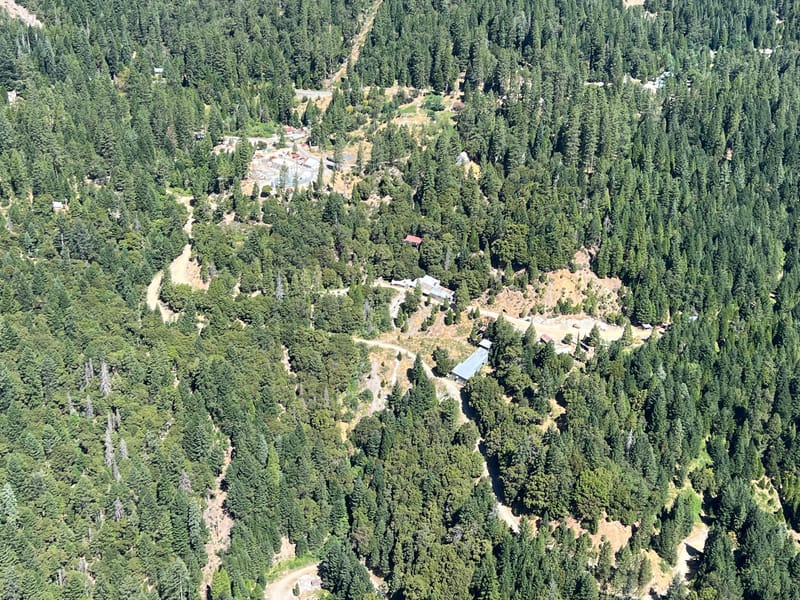
An aerial view of the Sixteen to One Mine in Alleghany.
Sierra County Sheriff Mike Fisher
The ore shipments had brought in cash, Haas told supervisors, at a time when it was hard to raise money for the mine. He attributed that difficulty to a federal lawsuit over control of the company that owns the property, Original Sixteen to One Mine, Inc. “It’s just this cloud on everything we do,” he said.
Michael Miller and other plaintiffs allege Quartzview claimed shares it had not paid for and used that claim to call the 2022 meeting that ousted Miller and another director. Quartzview and Haas deny wrongdoing; Quartzview reported a majority stake in 2022.
Quartzview also faces the cost of treating water the mine discharges into Kanaka Creek. Haas said the company planned to install its treatment system underground, where the equipment could be protected from freezing. He said small-scale tests had shown the system could work; the state says pilot tests reduced some pollutants but fell short of the final limits. At its December 10–11 meeting, the Central Valley Regional Water Quality Control Board is scheduled to consider giving the operator until 2029 to meet limits for arsenic, antimony, iron, and nickel.
After the vote, Haas wanted to know what his crew was supposed to do about the water coming into the underground workings. “Are you telling me to turn the pumps off and let it flood?” he asked.
Pangman said the crew could do maintenance and that he thought pumping could continue if needed under a state permit. He would spell out the limits in writing: no digging, prospecting, exploration, ore processing, or hauling ore off the property.
Haas told The Mountain Messenger afterward that he thought he could keep his five miners on. “I think we’re two weeks from getting the complete application in,” he said.