Southwest Sierra Then & Now #5
5 min read
Sunday April 16, 2023 ~ ALLEGHANY – In the two weeks since I last wrote, most of our snow has melted. Dirty piles remain in shady spots. Another five to six inches is in the forecast for tomorrow night. April snow is common here, but it melts quickly. The first snows of last winter arrived in early November before the deciduous trees had shed their leaves. For better or worse we are seeing our yards for the first time this calendar year. Sometimes, the task of raking leaves must wait until spring. The robins and many other birds have returned but the bears have not come out of hibernation yet.
About eight years ago, I invested in a “bear tough” trash can to use as a compost bin. “A fed bear is a dead bear”. Prior to this, I was letting my wet garbage (no meat) rot in sealed fivegallon buckets before adding it to the compost heap. This was a way to avoid feeding the bears, but it was a slimy and stinky endeavor. I got the idea to convert a “bear proof” trash into a compost bin. I was shocked when I saw the price tag for metal bear proof trash cans, as seen in parks. I found a plastic one that was under $300 with shipping and decided to give it a try. My “bear tough” trash can arrived by freight and I when I saw it, I was doubtful if the heavy black plastic would hold up against a bear attack. We (my husband under my direction) drilled several ¼ inch holes in the bottom for earthworm ingress/egress (mining terms) and drainage. We also drilled holes in a few areas near the top for ventilation.
I tied the bin to a large fir tree below the house and added some starter material with red worms from an older pile plus leaves and food scraps. Within a few weeks the bin vanished. Our yard is on a steep hillside, with a ravine along one edge. I searched the ravine and found the bin lying in the bottom on its side, but intact! I was impressed. The bin remained there for several months because I was too busy to deal with it. In the meantime, I bought some heavy-duty ratchet straps rated for 3,333 pounds at the hardwarestore. Eventually we (as in both of us together) managed to haul the bin back up to the fir tree where it was securely strapped to the tree. This little set-up worked great until last year. Due to circumstances I won’t go into, the bin ended up in a different spot in the sun last summer. Possibly this, combined with its age resulted in a degradation of the plastic? A small bear managed to chew through it the same week we got our first snowstorm (and had a large meal).
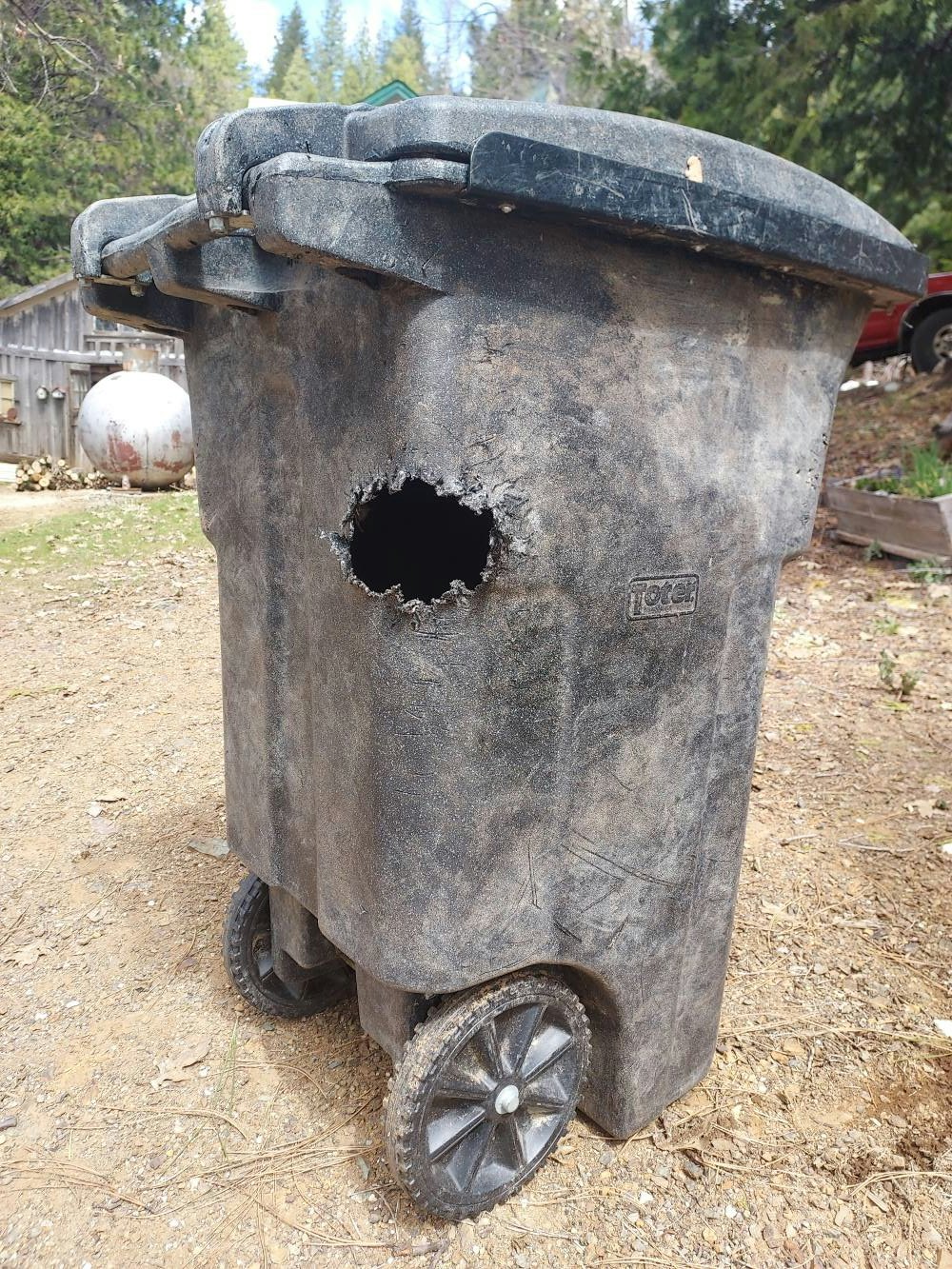
An online search revealed that Ace Hardware carries the bins now. I went to B&C in Grass Valley expecting to have them order one and they happened to have one in stock. The person who loaded it onto our truck told me that somebody had returned it. He said that a lot of people have a problem with the latch (people proof?). Funny, because when he went to show me how to open the latch, it wasn’t latched. I noticed that he moved a lever in the lock mechanism under the lid to get it to latch. This is not explained in the instructions! The latch on my first bin only lasted a few years. I had a problem with it not latching and would repeatedly slam the lid down to get it to latch. The latch finally got stuck in lock position and was replaced with two bolts and wingnuts. Now I know the trick to get it to latch. The new bin has been strapped to a small oak tree in a new compost area that I started two years ago. We’ll see how it fares.
Composting notes: The bin is primarily for food scraps with leaves and dirt added to help it along. The red worms do most of the work and thrive. Ideally, I would have two bins, so that one could be left to “finish” while a new bin is started. As it is now, I give the bin at a least a one-month break from new scraps before emptying it.
Leaves and yard waste are composted in piles. I keep a pile of leaves and whenever I have green waste, I layer it with the dead leaves in a new pile that “cooks down”. It is important to wet each layer of leaves when you pile them for composting and to wet each layer when layering dead and green material. If you don’t, the center of pile will stay dry and this can create a fire hazard. The moisture is also needed for decomposition. The trick is to have it be moist but not soggy.
BIG NEWS for Forest City and South Sierra: The State Dept. of Parks recently announced that “The U.S. Forest Service – Tahoe National Forest was awarded $422,400 of federal grant money in support of expanding recreational opportunities to California’s communities. The funding is for construction of approximately 10 miles out of the 17-mile Mexican Mine Trail, connecting the community of Forest City to the towns of Downieville and Goodyears Bar.” The money is specifically for non-motorized trails. Will this create business opportunities in our area? Will this impact the fire depts. with increased rescue calls? Only time will tell.
I am looking forward to a hike or bike through my old stomping grounds near the Mexican Mine. When my family lived in that area (1975-1991), and the road was closed by snow, one of our options for reaching civilization was to hike to the Triple Pocket Mine (about 3 miles, mostly downhill) and then along the trail to Downieville for about a mile. While this was the shortest option, it was not snowmobile friendly and the way back was all uphill. Because of that and the fact that we got our mail and went to school in Alleghany, it made more sense to leave a vehicle near the closest plowed road in that direction. When I was a teenager, my parents would occasionally let me, and my younger brothers do a day skihike to Downieville. The last time I hiked this route was with my husband, almost 40 years ago!
If you have news or suggestions to share please email Rae Bell Arbogast: raebell44@gmail.com