Bullock Rejects State Findings on Measure V Mailers
Nevada County had already paid a $31,500 penalty five days earlier.
7 min read
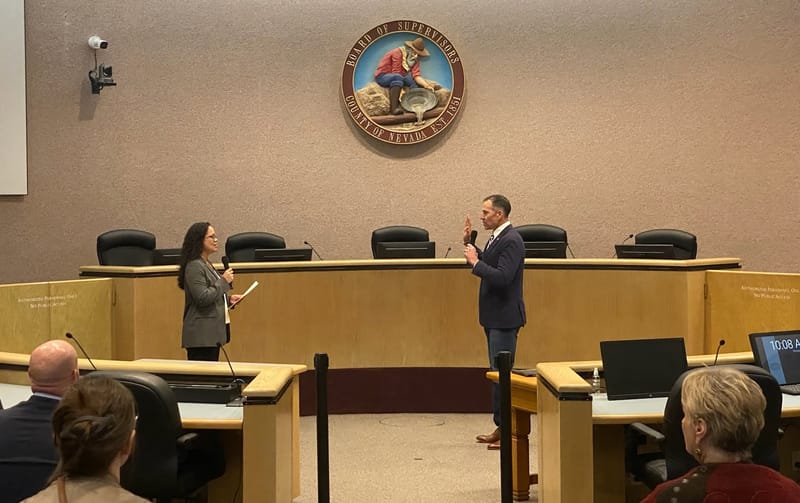
Hardy Bullock being sworn in for his second term as Nevada County’s District Five Supervisor.
Supervisor Hardy Bullock
NEVADA CITY — California’s political ethics regulator finalized a $31,500 penalty against Nevada County on August 20, concluding that the county spent public money campaigning for the failed Measure V sales tax. Five days later, one of the supervisors who voted to put the measure on the ballot told the public he does not accept the finding.
Supervisor Hardy Bullock, who represents District Five, used part of his time during announcements at Tuesday’s Board of Supervisors meeting to read a prepared statement disputing the conclusions of the Fair Political Practices Commission. He told his colleagues he had watched video of the commission’s hearing and had checked with County Counsel before speaking. “In my view, the conclusions reached do not align with constitutional standards governing public agency communications,” he said. “I respectfully disagree with the findings.”
Bullock’s argument was that the enforcement action penalizes something state law asks counties to do. “Counties and local jurisdictions are explicitly required and supported by statute to provide voter information concerning measures, public safety issues, and governmental activities,” he said, adding that “the distinction between providing information and engaging in persuasion is often faint and nuanced.” He said he found that especially true of a subject as complex as wildfire. He also told the board that outreach from other local agencies — advertisements, informational articles, and flyers — “would likely be considered noncompliant if subjected to the same scrutiny.”
Bullock described Measure V as “an effort, in my opinion, to help our community address the catastrophic effects of wildfire” that “was solely intended to convey the magnitude of the issue and the proposed solution.” He said the measure was the product of extensive work by the board, senior staff, and community members, and that he respects the voters’ decision to reject it. “That outcome does not alter the statutory obligation of this county to inform voters, nor does it negate the good faith effort undertaken to meet those obligations,” he said, closing by saying he “respectfully and entirely” disagrees with the commission’s findings. No other supervisor responded. Announcements are a reporting item on which the board takes no action.
What the commission found
The commission approved the settlement on Thursday, August 20, on its consent calendar. It found seven violations of the Political Reform Act, assessed $4,500 on each and set the total at $31,500 — just under the $35,000 maximum. The agreement names Board Chair Lisa Swarthout as the signatory for the county, which submitted payment for the state to hold until the commission acted.
Measure V, formally the Wildfire Prevention, Emergency Services and Disaster Readiness Measure, would have raised the countywide sales tax by half a percent for ten years to pay for clearing vegetation along evacuation routes, improving warning systems, and expanding community outreach. It needed a simple majority and failed with 48.41 percent support, or 24,144 yes votes.
The case rests on two postcards the county mailed shortly before the November 8, 2022 election. Around October 7, 2022, the county sent 33,351 copies of the first at a cost of $17,708; around October 26, it sent 33,101 copies of the second at a cost of $16,906. The board paid for both with special appropriations from the county Office of Emergency Services, a funding choice the commission weighed as evidence the mailers were campaign material rather than ordinary county communication. In all, the county spent $34,614 in public funds on 66,402 pieces of mail.
Under the standard the commission drew from the California Supreme Court decisions in Stanson v. Mott and Vargas v. City of Salinas, a public agency crosses the line when the style, tenor, and timing of a communication make it reasonably characterized as campaign material rather than a fair presentation of facts.
In the first postcard, the commission pointed to the assertion that “Measure V is responsive to community priorities” and the warning that “Nevada County must be well prepared for ongoing natural disasters,” language it found implied a yes vote was the required action. Investigators also faulted the imagery, including photographs of a vulnerable senior and traffic on an evacuation route. The half-percent sales tax increase itself, they found, was buried “in the smallest font within the largest bulk of writing.”
The second postcard drew the same conclusion. It opened with the statistic that “92% of Nevada County residents live in high or very high fire hazard severity zones,” then offered Measure V as the answer. Benefits ran in bullet points while the $12 million a year the tax would raise sat inside a longer paragraph, and the reverse side did not mention the tax at all. The commission described both mailers as “unfair and fundamentally promotional,” and found that the disclaimer each carried, stating that the county did not advocate a yes or no vote, “did not cure the otherwise impermissible advocacy.”
Because the spending counted as independent expenditures, it also triggered campaign reporting duties the county did not meet. The county missed 24-hour deadlines for both mailers and never filed the semiannual statement disclosing the $34,614, which was due January 31, 2023. Voters were left with limited knowledge of the county’s campaign activity, including its cost, before and after the election. Corrective reports were filed as part of the settlement.
The size of the penalty was largely set in advance. In February 2021, the commission directed its enforcement division to seek at least 90 percent of the maximum whenever a government agency campaigns at public expense. In mitigation, the agreement notes that the county had no prior record of similar violations and cooperated with investigators; it also notes that neither the county nor its attorney asked the commission for advice about public mailers before the postcards went out.
Bullock helped create the measure he defended Tuesday. On August 9, 2022, after a hearing that ran more than five hours, supervisors voted 4 to 1 to send the tax to voters, with Bullock, Heidi Hall, Ed Scofield, and Susan Hoek in favor and Dan Miller opposed. Bullock said in a statement afterward that the measure “could have been prepared better” and that the county team shared responsibility, but that the potential cost of inaction was too high. Three of the five supervisors seated when the postcards went out still hold office: Bullock, Hall, and Hoek. Swarthout took office in January 2023 and Robb Tucker in January 2025.
The county’s public position has been narrower than Bullock’s. In a media release on August 10, Public Information Officer Taylor Wolfe wrote that “in a narrow finding, FPPC staff determined that the postcards were not strictly informational and should have been treated as campaign-related mass mailings for purposes of disclosure and reporting,” and said the county “takes its obligations under the Political Reform Act seriously.” The agreement the county signed reaches past disclosure and reporting. Its first two counts find that the mailings themselves were prohibited campaign-related mass mailings sent at public expense.
Residents press for an accounting
Two residents raised the enforcement action during general public comment, earlier in the same meeting. Michael Taylor of District One asked the board to direct staff to prepare and publicly present a full accounting of what Measure V has cost taxpayers, from its conception through the commission proceedings. He said the $34,614 spent on postcards is only one identifiable piece, and listed staff and management time, County Counsel and outside counsel, consultants, polling, printing, and postage among the items he wants itemized. He said he has filed public records requests and found it impossible to get all the answers.
A second resident told the board that the officials responsible should repay the money themselves rather than leave taxpayers to absorb the penalty, and said misuse of public funds can be prosecuted criminally. Neither speaker received a response from the board.
Similar questions came up at the commission’s own hearing. Commissioner Elsa Ortiz said she was glad the commission was pursuing cases against local agencies that cross the line, and that such cases teach agencies how to comply, but that one thing had continued to bother her: “the basic illegality of using taxpayers’ money.” The commission cannot reach that spending because its jurisdiction covers campaign reporting, she said, and she asked whether agencies could be made to reimburse what they spent. Commissioner Alf Brandt, whose remarks covered the Nevada County case and a second mass-mailing matter on the same calendar, said penalties are “just becoming a cost of business.”
Commissioner E. Dotson Wilson said the calculation works because no individual bears the cost. Officials who approve unlawful communications are not personally liable “under current statute,” he said, and if they were, “I think they’d think twice.” Chair Adam Silver pointed to Assembly Bill 2413, by Assemblymember Rhodesia Ransom, which would make an agency and an elected official jointly and severally liable for penalties over certain large-format advertisements paid for with public money. Silver called it “a good first step to having political actors think a little bit harder before they sign off on a potentially illegal communication.”