Supervisors Back Ambulance Driver Exemptions for Downieville
Volunteers could qualify to drive without emergency medical technician certification.
3 min read
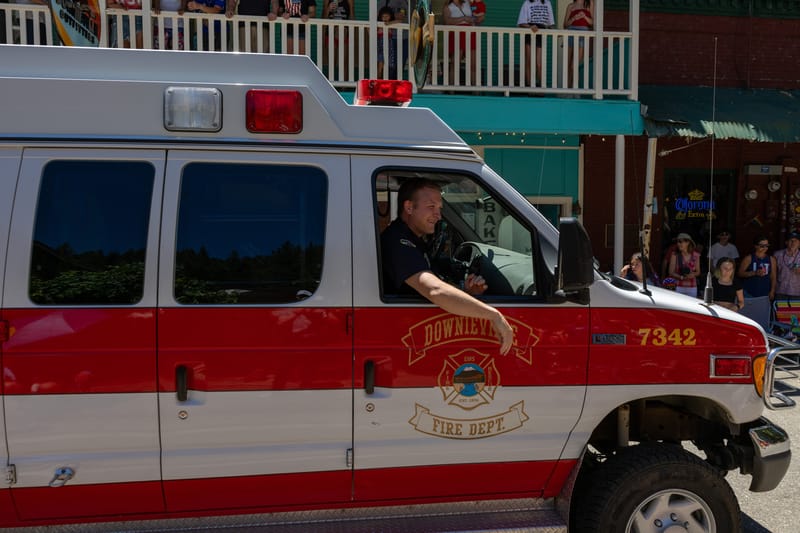
A Downieville Fire Department Ambulance during the 2023 Fourth of July parade.
DOWNIEVILLE – Sierra County supervisors expressed support November 3 for allowing Downieville’s ambulance service to use volunteer drivers who are not certified emergency medical technicians. The proposal would help fill the driver’s seat while qualified medical personnel care for patients being transported from western Sierra County.
The board’s consensus gives the Downieville Fire Protection District support to pursue exemptions for individual volunteers through the California Department of Motor Vehicles. At the board meeting, Supervisor Lee Adams said the department would bring forward drivers by name for the county’s backing. Each driver would need a state ambulance driver certificate issued through the exemption process.
The district provides ambulance service around the clock and averages about 200 calls a year, according to an October 26 issue paper from district Chairman Frank Lang. Its usual ambulance crew consists of one paramedic and one driver who is an emergency medical technician.
Lang listed an active staff of two paid paramedics, two volunteer advanced emergency medical technicians, and one emergency medical technician driver. Other volunteers hold ambulance driving credentials but are not routinely available, he wrote.
The district had found a driver for every call, Lang reported, although “we do not always have a scheduled driver.” The department had begun discussions with Nor-Cal Emergency Medical Services, the local agency overseeing emergency medical services, about using the volunteer exemption.
An approved volunteer could drive while a qualified attendant provides patient care. State regulations generally require the attendant to hold a current California emergency medical technician certificate, while also recognizing licensed paramedics and certain other medical professionals.
California law generally requires ambulance drivers to meet the medical training standards for ambulance attendants within one year of receiving their initial ambulance driver certificate. Vehicle Code section 12527(d)(2) provides an exception for volunteer drivers serving volunteer ambulance services in unincorporated areas of counties with fewer than 125,000 residents, based on the most recent federal census.
To use that exception, the district would need to identify the proposed drivers and document why the exemptions are necessary for public health. The Board of Supervisors and at least one of three health authorities must submit that information to the Department of Motor Vehicles: the county health officer, the county medical care committee, or the local emergency medical services agency coordinator.
The submission must identify both the driver and the volunteer ambulance service and accompany the driver’s application for an ambulance driver certificate. The state then restricts the certificate to driving for that volunteer service. The exemption lasts until the certificate expires, and the department may terminate it if the qualifying conditions cease to exist.
Applicants must also meet the remaining ambulance driving requirements. The Department of Motor Vehicles requires applicants to be at least 18, hold a driver’s license valid in California, pass its ambulance driver examination, submit medical examination documents, and provide fingerprints for an initial certificate. State law also requires competence in operating the ambulance and using its safety and emergency care equipment.
For Downieville, the next step described by Adams is to bring forward the individual volunteers for county support. Lang’s request seeks backing for volunteers who already hold driver’s licenses and are willing to obtain the additional ambulance driving credential.