Supervisors Take No Action After Contentious Flock Camera Hearing
Nearly every speaker urged removal; supervisors said conflicting facts need reconciling.
11 min read
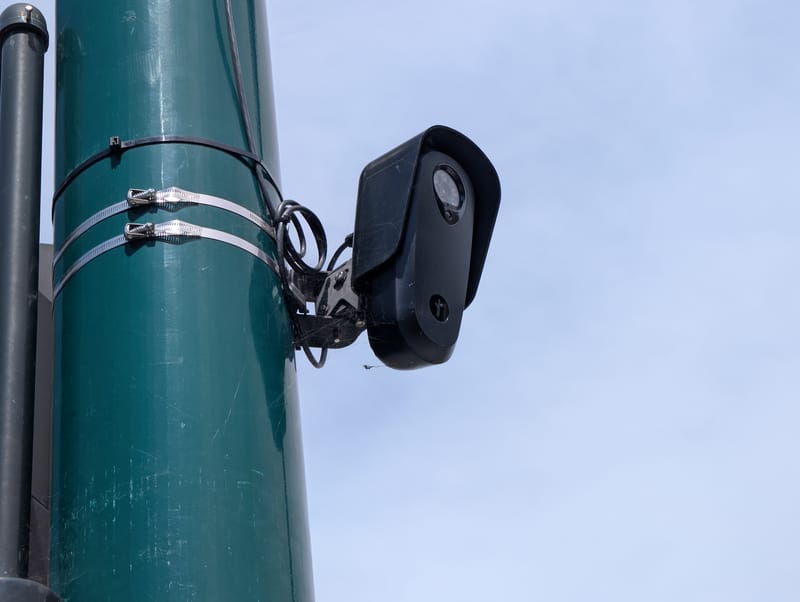
Nevada County hosts 25 Flock cameras, similar to the one pictured.
NEVADA COUNTY — Residents told the Nevada County Board of Supervisors on Tuesday morning that the county should get rid of its automated license plate readers. They spoke after an hour-long presentation in which the Sheriff’s Office and a Flock Safety executive defended the cameras as a narrow investigative tool that has helped locate a missing juvenile and arrest a homicide suspect. Chair Lisa Swarthout said at the outset that no decision would be made.
The hearing exposed a disagreement not only about whether the cameras belong in Nevada County but about what they actually do. Commenters argued that Flock owns and monetizes the data, that its devices have been hacked, and that far more searches have been run against county cameras than the Sheriff’s Office reports. Flock denied the first two claims and referred the third to the Sheriff’s Office, which said it could not evaluate the figures. “There’s been some questions here that I think between the community and the answers that have been completely opposite,” said Supervisor Rob Tucker, who joined the board after the contract was signed. “I think there is a point where there’s either misinformation or we need some fact-checking.”
Undersheriff Sam Brown opened for the Sheriff’s Office and turned the presentation over to Lieutenant Dennis Haack, an administrative lieutenant. Haack said the county’s 25 cameras cover roughly 750 miles of public roadway, primarily at points where vehicles enter and leave the county. They read license plates and record vehicle characteristics such as make, model, color, bike racks, and toolboxes. The cameras do not record audio and do not use facial recognition, he said, and the Sheriff’s Office does not use Flock’s video camera, gunshot detection, or drone products.
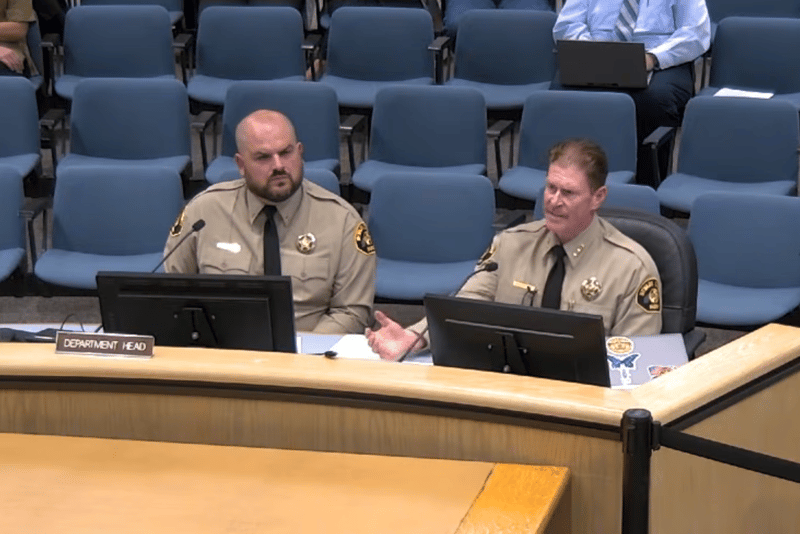
Lieutenant Dennis Haack (left) and Undersheriff Sam Brown (right) address the board and the public.
Nevada County
In 2023, Supervisors approved a one-year pilot program for $78,750, with Supervisor Heidi Hall casting the lone no vote. In 2024, the board approved a maintenance services agreement of $75,000 a year running through 2029. Total spending is forecast at $411,552, which includes $42,100 budgeted for replacing poles and cameras. Haack said vandalism against the cameras has increased locally and is tying up investigators on felony cases.
Deputies complete Flock training, and the operations lieutenant audits the system periodically, Haack said. Much of the presentation dealt with what one of those audits turned up. In October 2023, California Attorney General Rob Bonta issued a bulletin interpreting state law to bar California agencies from sharing license plate data with federal and out-of-state agencies. Nevada County shut off that sharing in 2023, but a January 2025 audit found one camera searched by an out-of-state agency. The auditor traced the access to an option still enabled in the software permitting what Flock calls a national lookup, which lets an outside agency search a plate and receive limited information. Nevada County turned it off in February 2025, and Flock disabled it for all California agencies that June.
Deputies have used the system in missing person cases, burglaries, narcotics and domestic violence investigations, auto thefts, homicides, robberies, and sex offenses, Haack said. “The list of what we don’t use it on would be much shorter,” he said. He described three cases from this year: a missing person investigation with human trafficking implications in which a juvenile was located in Florida, a juvenile rape case in which a suspect vehicle later registered on a reader in Nebraska, and the arrest of a Stockton homicide suspect at a Penn Valley gas station after a Flock camera identified his truck. “As of this presentation, I’m not aware of any court rulings that rule ALPR as a violation of anyone’s constitutional rights,” said Haack.
Public comment
The first speaker during the scheduled public comment period felt Flock’s assurances did not match published security research. “I feel a little bit lied to and betrayed by our law enforcement officers here,” he said. A Grass Valley homeowner who followed him told supervisors he had not been told the cameras were coming to his community or that he would be paying for them.
A District 1 resident said he was undecided on the merits but troubled by how the county got here. The pilot program could be switched off without penalty, he said, while the five-year agreement arrived on the consent calendar. “And the new contract has no way of canceling […] without having financial consequences,” he said. He asked the board to hold a workshop where residents could be heard before any decision is made.
A resident who said he works as an information technology director disputed the claim that the county owns the data, pointing to the contract terms and to the fact that the servers belong to Flock. “So that means we have to trust these people,” he said. He also faulted the presentation for offering case anecdotes without any count of cases solved, and without any accounting of wrongful stops or misuse by officers.
Another District 1 man, a video engineer in the community for more than 25 years, called the camera network an impressive, but unacceptable, piece of engineering. He raised official misuse, Fourth Amendment concerns, false positives that could escalate a traffic stop, and mission creep. “But I also have no doubt this mass surveillance network is incompatible with modern liberal democracy,” he said. “You might trust the current users of this technology to do the right thing, but do you trust the next administration or the one after that?”
A District 3 resident said a group of residents obtained Flock records through a California Public Records Act request and that the totals do not match the county’s public portal. Over one 30-day period, she said, the portal showed 103 searches while the records request showed 271,577, and she asked for an independent investigation to reconcile the two. She also read from a recent news article reporting that at least 54 cities nationwide have voted to cancel, decline to renew, or reject Flock readers since the start of the year. “Basically, it’s a runaway technology that can’t effectively be regulated, and the costs far outweigh the benefits,” she said.
A woman who has lived or worked in the county for about 15 years told supervisors the people with the most at stake were not in the room. “You’re not going to hear women come up and talk to you about these matters because there’s a lot that can be tracked that can be used against us, whether it be domestic abuse, whether it be our reproductive rights,” she said.
Several speakers pressed the board to act rather than listen. One told supervisors they could create a civilian sheriff oversight body under Assembly Bill 1185, the 2020 state law authorizing counties to establish such boards, and could place it on the next agenda. Two residents phoned in, both opposed, and a caller from District 4 said the only acceptable outcome is complete removal of the cameras. Several speakers said they do not believe deleted data is ever truly deleted, and two raised concerns about cameras near Pioneer Park and Memorial Park in Grass Valley.
The board’s questions
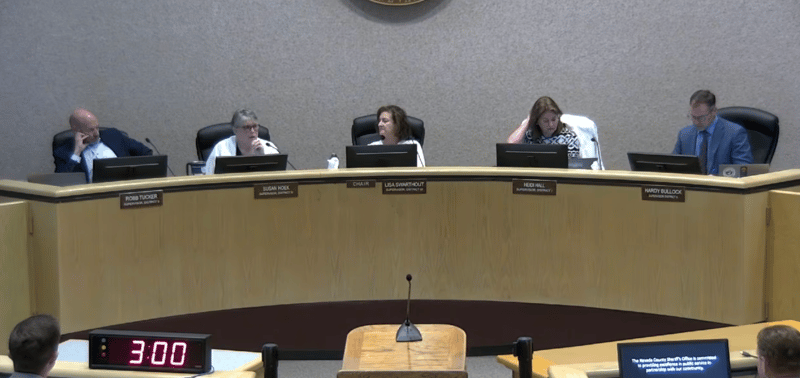
Nevada County supervisors question Flock and the Sheriff’s Department.
Nevada County
Supervisor Sue Hoek, who said she wanted to hear answers before offering any views of her own, asked Flock to respond to the public directly. Trevor Chandler, the company’s senior director of public affairs, took the questions in order. “Flock does not sell data. We are not a social media company. We are not an advertising company. We are a public safety company,” he said. The contract clause allowing less than 1 percent of data nationwide to be used for machine learning covers images stripped of location, ownership, timestamp, and agency, he said. “County owns the data, Flock does not own the data, Flock does not sell data, period.”
Deletion is not like moving a file to a trash folder, Chandler said. “It is a hard data sanitization process, which is done automatically after your data retention date is up,” he said, putting Nevada County’s retention period at 30 days and calling sanitized data irretrievable by either the company or the agency. On security, he said, “it is simply not the case that Flock has been hacked.” A widely circulated video claiming tens of thousands of cameras had been compromised prompted a Miami-Dade task force to try the technique on one of its own cameras without success, he said.
Chandler referred the question about search counts back to the Sheriff’s Office. Brown said the two figures had been offered without a time frame or any account of how they were compiled, leaving him nothing to check them against. He said he wrote the numbers down and called the gap concerning, but that residents have raised similar mismatches before without saying which records request the figures came from, what data was pulled, or how it was sorted. “I’d need to know that to be able to give you a good answer,” he said.
Bullock, who voted for the pilot program, asked whether the pledge not to sell data covers stripped metadata and whether anything binds the company not to sell in the future. Chandler said the contract states Flock does not own customer data, and that selling it would place the company under the regulatory structure governing data brokers. In the case of a federal judge ordering the data produced, County Counsel Trevor Koski said the Sheriff’s Office policy of refusing federal requests applies outside a legal process; if a subpoena were filed in federal court, county counsel would move to quash it, and the county would abide by the ruling.
Bullock said he voted for the cameras because the parameters the Sheriff’s Office described to the board match how the office has used them. “So I still stand behind the rationale of the use of the cameras,” he said. On the constitutional objections raised in public comment, he said people are already recorded and tracked whenever they leave home — “I think that ship has sailed a long time ago” — and that for him the crime-fighting value outweighs the privacy concerns the community is wrestling with. He added that he had never voted to let anyone outside Nevada County query the county’s data.
His support is not unconditional, Bullock said. “I’m fully willing to raise my hand and cancel this contract and remove all the cameras as one board member,” he said, if he concludes the balance has tipped. He wants the competing search figures resolved first, and told the board he has heard the numbers repeatedly without supporting information from either the community groups or county staff. “I do think for the board to make the right decision we need to understand that,” he said. He then returned to the national lookup option the county left on for more than a year, asking Flock to make compliance the default rather than a box an agency has to find and check. “I don’t check the right boxes most days,” he said.
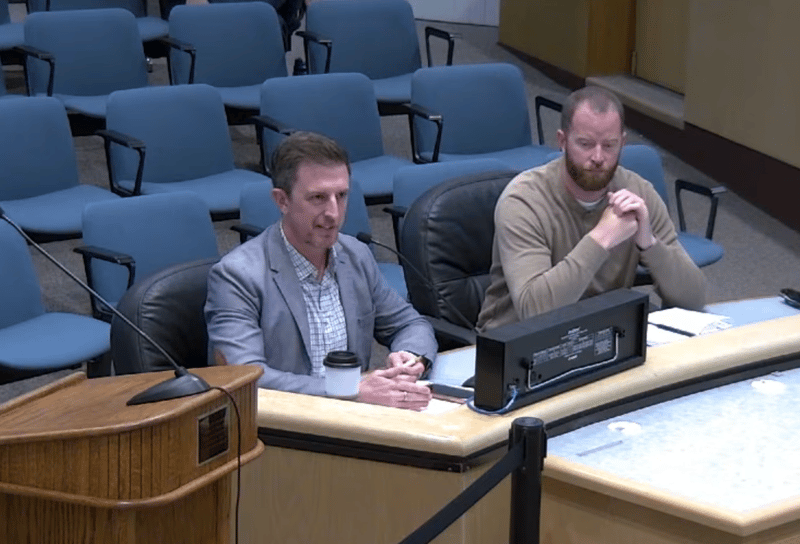
Trevor Chandler (left) answers questions from board members.
Nevada County
Chandler said Flock now blocks out-of-state sharing by California agencies by default and has removed federal sharing relationships, acknowledging that the company could have put up clearer guardrails for local agencies sooner. “We fully acknowledge that had we done that earlier, it could have saved a lot of heartburn,” he said. Brown said the missed setting was the Sheriff’s Office’s responsibility too. “We did miss it for a period of time, but we did catch it through auditing,” he said.
Brown also pushed back on the suggestion that clean audits mean the office is not looking hard enough. “We do hold people accountable when they do things wrong,” he said. In response to concerns about park cameras, he told Tucker that the county operates no video cameras under the contract and that equipment in city parks would be a question for city jurisdictions. The readers point at the roadway, he said: “They’re not pointed at houses.”
Tucker said the exchange had cut against what he expected. He came in assuming the community’s account was the accurate one, he said, and instead heard that there is no video, that Flock does not own or sell the data, and that it has not been hacked. He said he found the technology helpful and the answers useful, and that he had hoped to keep the discussion on Nevada County rather than on national and international politics. He also objected to how some commenters addressed the board, saying he did not appreciate the tone and being lectured to. He has not settled on a position: “And to be honest, I haven’t made a decision on this. I’m open to it.”
Hall, who cast the only vote against the pilot program, said her objection at the time was about data leaving California. “I actually was really concerned about the sharing of data across state lines specifically for women seeking reproductive health care,” she said. State law and the department’s protections had changed by the time the second contract came forward, she said, and she has since seen the tool used in kidnapping, stolen vehicle, and sexual predator cases. “I want to make sure that the Sheriff’s Department has a tool that can help them in this specific way,” she said. She described her own view as conflicted: “I do remain concerned with how that data is being used.”
Hall asked whether Flock could retrieve year-old data if compelled. Chandler said hard-deleted data is gone, and Brown said the exception is material a deputy downloads into evidence, which then moves through the court process. She also asked whether other vendors exist should the county decide it is not comfortable with what it heard; Haack named Axon among the alternatives, and Brown said the office reviewed other providers before choosing Flock. Hall said the company’s assurances are now on the record, but that confidence in Flock remains a problem. “There’s still the issue of trust,” she said, adding that she shares some of the distrust herself.
Swarthout said she requested the presentation a couple of months ago after hearing from constituents on both sides, including residents who want the system kept for its public safety benefits. She asked the Sheriff’s Office to voluntarily contact the residents holding the conflicting numbers and try to reconcile them. “I trust our sheriff’s department. I trust the people who work here,” she said, adding that she cannot make the community trust the board and that distrust of local government has grown harder to overcome in recent months. “I don’t think this is the end of the discussion,” she said.
The board voted 5–0 to accept the presentation and took no action on the contract.