California Revises Zone Zero Rules for Homeowners
Plant spacing changes; compliance dates depend on final state filing.
6 min read
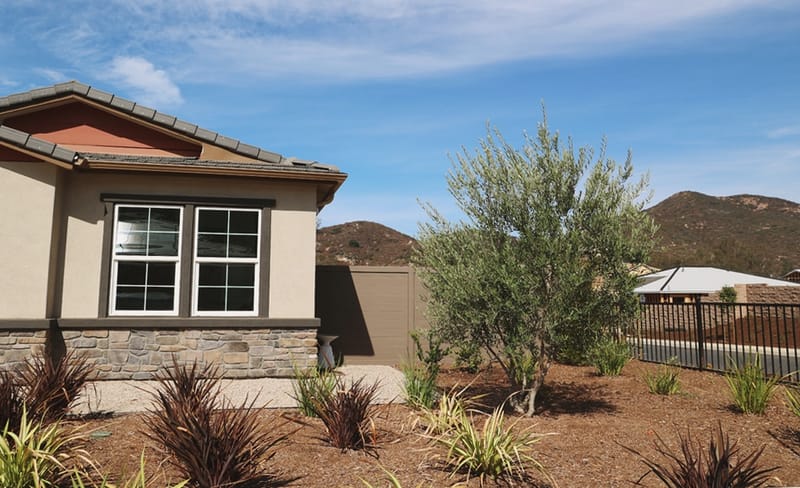
A gravel strip separates a house from nearby landscaping. California’s Zone Zero rules focus on the first five feet around buildings and attached structures.
CAL FIRE / Ready for Wildfire
SACRAMENTO – California’s Board of Forestry and Fire Protection has revised its Zone Zero wildfire rules, changing how plants must be spaced in the first five feet around homes and clarifying the timetable for clearing vegetation, moving firewood, and replacing combustible fence connections.
The board adopted the revised package November 5 and plans to submit it to the Office of Administrative Law on or after November 13. The regulations would take effect when filed with the Secretary of State after approval. That filing date would start a phased compliance schedule for existing homes; new construction would have to meet the full standard.
The action follows the August adoption reported by The Mountain Messenger. Board staff subsequently withdrew that package during state review to revise its wording and bring it into alignment with state law, according to a November board memo.
Zone Zero is intended to reduce the chance that wind-blown embers ignite material next to a building and carry fire to it. The approach still allows some low-growing plants and properly maintained existing trees, alongside areas that must be kept clear.
The rules would cover homes and other qualifying structures at all hazard ratings in State Responsibility Areas, where the state carries primary financial responsibility for wildfire protection. In Local Responsibility Areas, where local government is responsible for wildfire protection, the rules cover locally designated very high fire hazard zones.
What changed
Small plant groupings and pots would have to be at least two feet apart. The earlier text required a gap of one and a half times the plant’s height. For plants growing in the ground, the distance is measured between their widest points.
The new wording also expressly prohibits planting new trees in Zone Zero. In their explanatory summary, board staff say that prohibition would begin on the effective date and aligns with the state’s existing Wildland-Urban Interface Code. Existing trees outside the required clear buffers may remain if they meet the clearance and maintenance requirements. The rule defines a tree as a woody perennial that, at maturity, reaches at least 15 feet tall and has a trunk or stem at least four inches in diameter measured four and a half feet above the ground.
For existing homes, the revised timetable moves the Zone Zero firewood-storage ban from the effective-date requirements to the requirements beginning three years later. It also specifies that the director of the California Department of Forestry and Fire Protection, known as CAL FIRE, sets the later compliance timetable in State Responsibility Areas, while local agencies set it by ordinance in Local Responsibility Areas.
What the first five feet would look like
Under the revised rule text, Zone Zero extends horizontally from a building’s exterior walls and from attached decks, stairs, and pergolas. The distance stops at five feet, the property line, or another covered structure, whichever comes first. A self-supporting deck, stairway, or pergola within one foot of the building counts as attached.
Within that area, the general restriction on combustible material applies whenever vegetation is in a flammable condition. It covers items that continue burning after ignition, including bark mulch, wood chips, plastic and wooden items, and vegetative debris. Firewood would have to be stored outside Zone Zero. Roofs and gutters must be kept free of leaves, needles, and other combustible material, and the space beneath decks, balconies, pergolas, and stairs must be cleared of vegetation and combustible items.
The closest parts of the zone have stricter limits. A buffer free of vegetation and combustible material must extend at least one foot from the wall, or to the edge of the eaves if farther, up to five feet. Similar clear areas extend five feet from attached decks, stairs, and pergolas, and two feet from windows, doors, and vents. A house with three-foot eaves, for example, would have a three-foot clear strip beneath them.
Beyond those buffers, non-woody plants — plants without persistent, hardened woody stems or trunks — are allowed under specific limits. Lawns and ground covers may be no more than three inches tall. Plants between three and 18 inches tall must be in groupings no larger than one square foot, with at least two feet between groupings.
Potted non-woody plants may be up to 18 inches tall, measured from the base of the visible plant. Their pots must be movable, made of noncombustible material, no larger than five gallons, and spaced at least two feet apart. All permitted plants must be kept free of dead or dying material.
Trees allowed to remain outside the clear buffers require regular attention. Dead or dying branches must be removed, and live branches kept at least 10 feet from chimney and stovepipe outlets and five feet above roofs. Branches must stay out from under eaves, at least five feet from attached decks, stairs, and pergolas, and two feet from windows, doors, and vents. Where there is no eave, branches need one foot of clearance from the building. Lower limbs and other vegetation that can carry fire upward must be removed through the first six feet of the tree, or the lower third of its height, whichever is less.
Fences or gates attached to a building, or coming within one foot of it, must have a five-foot noncombustible span measured from the attachment or closest point. New fences and gates within five feet must be entirely noncombustible; the text exempts repairs to existing fences and gates from those fence provisions. Outbuildings in Zone Zero — defined here as buildings smaller than 120 square feet and not used for human habitation, such as wood or bicycle sheds — must be made entirely of noncombustible materials.
Inspectors must allow temporary exceptions to the mulch restrictions to prevent erosion during construction or an emergency, as determined by the inspector.
Checking a property and its deadlines
For Sierra, Plumas, and Nevada county residents, the Office of the State Fire Marshal’s map page provides an address viewer and state and local maps. Residents should confirm the applicable designation with their local jurisdiction. Plumas County’s map resources, for example, identify Local Responsibility Areas in Chester, Quincy, East Quincy, and Sierra Valley; the adopted hazard map supplies the additional classification needed to determine coverage.
The revised text divides the timetable this way:
New construction: Full compliance begins on the regulations’ effective date. The definitions use the date the initial building-permit application was submitted to distinguish new structures from those already built, under construction, or with an application submitted before the effective date.
Existing homes, at the effective date: Roof and gutter clearing, removal of dead or dying tree branches, 10-foot clearance from chimney and stovepipe outlets, and the restrictions on new combustible fences and gates apply. Roof and tree maintenance also reflect existing state requirements.
Existing homes, three years later: The Zone Zero restrictions on combustible material and firewood storage, clearing beneath decks and similar features, and the additional tree-clearance requirements begin.
Existing homes, at the three- or five-year stage: The clear buffers beside buildings, allowed-plant standards, existing fence connections, and outbuilding requirements begin under the applicable implementation schedule. CAL FIRE’s director sets that schedule in State Responsibility Areas. In Local Responsibility Areas, it is set by local ordinance supported by a written finding from the responsible fire agency.
The board says it adopted the required guidance document August 19. Public Resources Code Section 4291 separately makes changes to CAL FIRE’s Zone Zero inspection practices, forms, and enforcement contingent on a posted State Fire Marshal finding that the Legislature has provided sufficient resources.
Local fire agencies may adopt alternative practices for covered properties in Local Responsibility Areas through an ordinance and written finding. The revised language says those alternatives must provide substantially similar protection against ember ignition and substantially similar safety for responding emergency personnel.
The next public-comment window begins when the Office of Administrative Law posts the submitted package. Comments are due within five calendar days and must go to staff@oal.ca.gov, with a copy to publiccomments@bof.ca.gov. The board’s notice gives November 18 as the closing date if the package is submitted and posted November 13.