Grass Valley Police End Flock Camera Contract
Chief cites unsettled law and community concern in reversing course.
7 min read
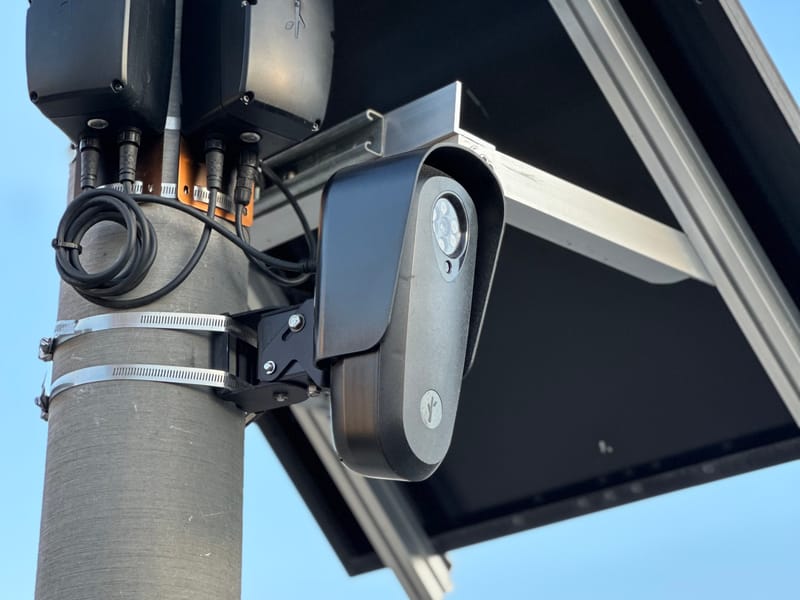
A Flock camera, similar to those installed in Grass Valley.
GRASS VALLEY — Residents filled the Grass Valley City Council chambers on Tuesday evening, prepared to argue that the city should get rid of its automated license plate readers. They learned in the first minutes of the meeting that the argument was over. Police Chief Alex Gammelgard opened with a letter to the community announcing that his department will indefinitely suspend its use of fixed-point readers and exercise its ability to cancel its contract with Flock Safety. Mayor Hilary Hodge twice asked the audience to hold its applause so the meeting could continue.
The decision closes a program the City Council approved in late 2021 on a 5–0 vote. Gammelgard wrote that he supported the readers then because he believed the technology could protect the city from expanding organized retail theft and help solve violent crime, and that it has since helped solve what he called countless cases. He credited the system with more than 100 stolen vehicle recoveries and arrests, hit-and-run suspect identifications, robbery arrests, and locating missing and at-risk people.
What changed, the chief wrote, was the technology. A system that once only read license plates has come to include far more powerful computer-intelligence tools, and networks that expanded across jurisdictions extended the reach of both the collection and the databases behind it. Department policy addresses many of the resulting concerns, he wrote, “yet we do not control outside providers and/or their system designs and product development.”
Much of the letter dwelled on constitutional questions the courts have not settled. The United States Supreme Court has not taken up license plate readers directly, Gammelgard wrote, leaving lower courts with what a recent privacy decision called “a trail of breadcrumbs-sprinkling hints-for how lower courts should proceed on these novel Fourth Amendment issues.” Those cases do not concern license plate readers, he wrote, “however, ALPR issues can certainly be defined as ‘Fourth Amendment issues.’” Among the questions he listed were the warrantless collection of information, the methods of collection, the security and storage duration of data, the use of data for product development, and the sharing of data for governmental and non-governmental purposes.
The letter also disclosed what the department found in its own audit records. Reviews turned up 160 queries against the Grass Valley network from out-of-state or federal and tribal agencies, a figure the chief called a very small subset of overall activity, and none of the stated reasons indicated an unlawful purpose. The audit found the department in compliance with state law. Sharing within California ran at a far greater scale. At its peak, around March of this year, hundreds of thousands of queries a month by California agencies were run against Grass Valley data and other data on the network, the vast majority from agencies in Southern California. Queries by local law enforcement, by comparison, ran closer to 1,000 a month.
Gammelgard did not present the audit as evidence of wrongdoing. What tipped the balance, he wrote, was the distance between the technology and the law. “The most compelling item of evidence, in addition to widespread community concern, is the unsettled legislative actions yet to catch up with this technology,” he wrote. “While law-making is still active, judicial review is likely much further behind.”
The letter framed the reversal as a response to changed circumstances rather than a repudiation of the original vote. “More than one thing can be true at the same time, while time and information can change the calculus,” Gammelgard wrote. The initial deployment “had been well reasoned, understood at the time, and believed to be for the benefit of the community,” he wrote. “This was all true. However, things have changed since that time – rapidly.”
The department spent 60 days evaluating those changes before reaching its conclusion. “Based upon our comprehensive review, a further analysis of the technological changes and unsettled future, conversations with community members, and assessment of evolving use of ALPR technology across all branches of government, the Grass Valley Police Department has decided to indefinitely suspend our use of fixed-point ALPR readers within our City limits, exercising our ability to cancel our contract with Flock Safety,” the letter reads. The department will continue to monitor developments in license plate readers and other technologies for possible future use. Reviewing the audit records at the necessary level of detail had taken time, Gammelgard told the council. “We want to thank the community for their patience,” he said.
All four council members present praised the decision. Councilmember Joe Bonomolo said he recognized it had been difficult because of the effect on policing, then told the chief, “You guys weighed it out correctly and did a great job.” Councilmember Jan Arbuckle said the question had been difficult on many levels. “I just want the community to know we listened,” she said, adding that the council had been listening “up and down the state and throughout the country.” Councilmember Tom Ivy said the process carried a cost that residents and the department both chose to bear, and that the department’s willingness to return to the table gave him pride.
Mayor Hodge, who said she had worked closely with department staff and asked many questions of them, urged residents to seek out officers outside of council chambers. “They are our frontline trauma workers in many cases,” she said, pointing to officers who coach Little League and serve on nonprofit boards.
More than 20 residents spoke during public comment, most of them setting aside remarks written for a decision that had not yet been made. “What I prepared, I’m not going to read because of the announcement,” said a Grass Valley resident and homeowner who has attended meetings for months as part of the local effort against the cameras. “From the bottom of my heart, thank you all for listening and for making the right decision.” Another resident thanked the council “for canceling the snake oil subscription.”
Speaker after speaker then asked the city to go further and require public review before any similar technology is purchased. “I think the next step for the city is to pass a law protecting us from future adoption of surveillance systems like Flock,” said one Grass Valley resident, who credited organizers at DeFlock Nevada County with pressing the issue through public records requests. A resident who said she has worked in politics a long time told the council that “having proactive decision-making by listening to the people that you represent is rare.” A resident who described himself as a software engineer of 40 years said the cameras were only the beginning and asked how the city could keep the next such technology from arriving the same way.
Praise was not universal. The first speaker of the evening challenged the chief’s account of the program’s results, saying the cases it solved could be counted rather than called countless. “I think you can count them and let us know,” he said. Another Grass Valley resident said readers placed near shooting ranges raise Second Amendment concerns because they record who visits and how often. A resident who lives in Penn Valley said she did not believe local officers had nefarious intent in installing the cameras, “but I can’t say the same” about the company behind them.
One resident pressed the department on how far the suspension reaches, saying he understood any camera connected to Flock’s software platform can perform license plate recognition. He asked whether the decision covers such cameras along with the fixed-point readers, noting the city has many cameras on roads and in parking lots. He did not receive an answer before the mayor closed the item.
A resident who works with DeFlock Nevada County told the council he believed a license plate reader had been used against him the previous day, one day after he spoke against Flock. Officers found that the registration on one of his trucks had expired, which he attributed to his own error in mixing up two vehicles, and he said they could not have known without the technology. He also asked who ran the hundreds of thousands of searches against local data, and why.
A 17-year-old senior at Bear River High School said he had come to speak about the cameras and arrived a day late. He told the council mass surveillance has a long history as a tool of repression, and thanked the police and sheriff’s departments for listening. Another resident said it would be naive to think the fight is over, because other companies will market similar products. He credited the campaign to residents rather than to elected officials. “It was the community continually saying, no, this is wrong,” he said.
The decision reaches only to the Grass Valley city limits. Nevada County operates 25 Flock cameras of its own, and the Board of Supervisors heard an hour-long presentation from the Sheriff’s Office and a Flock executive on Tuesday morning before voting 5–0 to accept it and take no action on the county’s contract. Nevada City also continues to use the cameras. Several speakers urged residents to keep attending county meetings.
The city clerk told the council that 24 written public comments had been received and would be distributed to council members and included in the agenda packet. Gammelgard left a stack of the letters at the back of the chambers for anyone who wanted a copy, and told the council the department had a plan to physically remove the devices.