Plumas Supervisors Hear Update on USDA Wildlife Services Team
County officials review six-month progress of wildlife conflict response and prevention efforts.
By Dana Loomis
3 min read
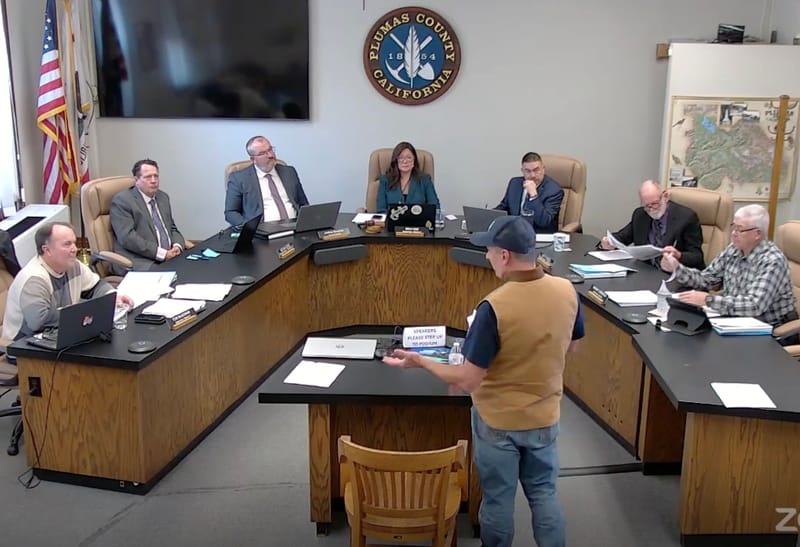
Derek Milsaps updates the Plumas County Board on his USDA team’s mission.
QUINCY — The public and the Plumas County Board of Supervisors had an opportunity at the Board’s meeting on Tuesday to hear a progress report from a team of USDA Wildlife Specialists who have been working in Plumas and Sierra Counties for the last six months.
The USDA program was first announced last August by Plumas County Agriculture Commissioner Willo Vieira, who explained that the team of two USDA Wildlife Specialists would help the community prevent and respond to depredations and other problems caused by predators and other wild animals.
The presentation on Tuesday by California District 2 Supervisor Derek Milsaps described his team’s mission as providing “leadership and expertise resolving human wildlife conflicts” to “protect agriculture, natural resources, property and human health and safety.” Their main functions, he said, consist of outreach, education, investigation, and documentation of wildlife incidents, as well as application of non-lethal deterrents, such as visual and audible harassment, drones, and range riding. He emphasized that it’s important for property owners to document and preserve the scene when wildlife incidents occur so that an investigation can be conducted.
Commissioner Vieira stressed the importance of documentation in an interview after the meeting. She encouraged “everyone to get game cameras out” and to document wildlife sightings through the CDFW (California Department of Fish and Wildlife) Wildlife Incident Reporting portal (apps.wildlife.ca.gov/wir/incident/create). “If you see something, say something,” she said, because CDFW needs statistics to act on.
The Wildlife Specialists can be engaged on a wide range of incidents, from mountain lion sightings to bears breaking into vacant houses to livestock kills. When an incident occurs, the team collects evidence and conducts an investigation to identify the kind of animal involved and recommend next steps. Their investigations can be used as a basis for obtaining a depredation permit from CDFW, but permits can only be issued to the property owner, Commissioner Vieira said. Once a permit has been obtained, property owners can take action themselves or request assistance from Wildlife Services. However, Commissioner Vieira explained that CDFW will typically issue one or two permits for non-lethal deterrence before granting a permit for lethal removal.
Supervisor Dwight Ceresola commented during the meeting on Tuesday that the USDA team had been more helpful with local concerns than CDFW; the two agencies have different missions, he said. Commissioner Vieira explained that locals often feel frustrated because calls to CDFW are routed to Sacramento and often go unanswered, but she said the Department has been more responsive to reports to its Wildlife Incident portal. Property owners who need assistance can contact the wildlife specialist team through the Agriculture Commissioner’s office (530-283-6365) or their local Sheriff.
In public comments, Josh Hart, representing the Feather River Action community group, criticized USDA Wildlife Services as “an out-of-control agency” whose programs are responsible for unnecessary suffering to animals and wasteful expenses of public funds.